
Postmark changes could cause midterm election chaos
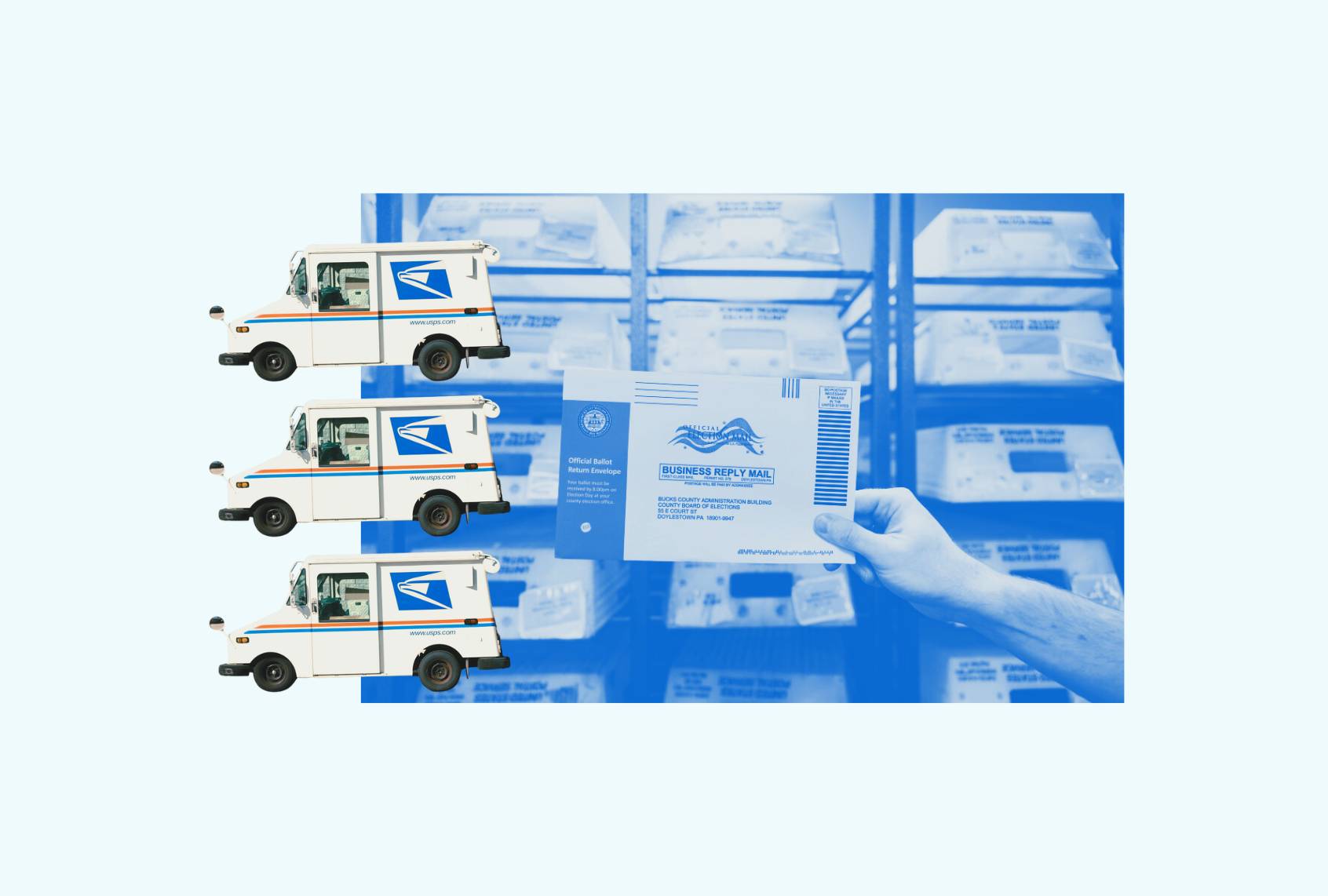
A relatively minor change at the U.S. Postal Service could have big impacts on future elections. In total, there are 14 states that allow mail-in ballots that arrive after Election Day to be counted, so long as those ballots are postmarked by Election Day. Some of these states also conduct elections entirely or predominantly by mail, specifically California, Nevada, Washington and Oregon.
A recent change to how the U.S. Postal Service postmarks letters is colliding with election administration across the country — but not every state, even those that conduct elections fully by mail, will be impacted. Still, critics say the move is set to sow chaos ahead of the 2026 midterm elections.
In a notice accompanying the new rule, the USPS said that it was aimed at making it clearer what a postmark is. Specifically, USPS said that pieces of mail are not necessarily postmarked on the day that USPS takes possession of the piece of mail, but rather when that mail piece is processed in a processing facility.
For people in rural parts of the country, specifically those who live more than 50 miles from a USPS regional hub, this likely means that their mail will be postmarked the next day. The USPS maintains that the rule does not mark an actual change in policy but is a clarification of current policy. Delays in postmarking have become increasingly common as the USPS has moved forward with an ongoing modernization campaign.
Whether the rule marks a change in policy or a notification of an ongoing shift, the notice did spark interest from members of the public, and those who deal with time-sensitive mail, because many expect the postmark to mark the time USPS takes possession of a piece of mail.
The issue, as it pertains to elections, is particularly acute in states where elections are conducted by mail and that allow ballots to be received as long as they are postmarked by election day.
Elizabeth Parmelee, a scholar of democracy and civic education at Metropolitan State University of Denver, explained how Colorado orchestrates its elections, which are conducted by mail, but without postmarks.
“The burden on the states that have been relying on postmarks, I think, is going to be voter education.”
“Every registered voter in the state receives a ballot in the mail. There are also ballot information books that come out separately, but they receive the actual ballot in the mail, and then they can vote that ballot whenever they want,” Parmelee said. “Our ballots tend to hit in early October, and then they can drop it in a drop box, they can take it to what are called ‘voter service centers,’ or they can put a stamp on it and send it through the mail.”
In short, states like Colorado have a robust system in place aimed at ensuring voters receive the information they need to make sure that their votes are in on time and counted. While some of the states that are affected by the postmark rule in their elections may also allow people to vote by mail, the new rule primarily creates a voter education problem for election administrators.
“The post office will do what the post office is doing. The burden on the states that have been relying on postmarks, I think, is going to be voter education, making sure that all voters know you cannot rely on dropping your ballot into a U.S. postal office box or at the post office itself, and being sure that will be postmarked that same day,” Parmelee said. “If you need it postmarked that same day, you need to go into the post office and stand there and watch the personnel marking it.”
Jonathan Katz, a fellow in governance studies at the Brookings Institution, told Salon that the postmark rule creates one more problem facing election administrators, who have already faced immense pressure in recent years, as well as threats and harassment. The issue exploded in 2020, following Trump’s false claims that the election was illegitimate, and has escalated since.
Start your day with essential news from Salon.
Sign up for our free morning newsletter, Crash Course.
“When you do these things — and it seems to have been done without a lot of public education — it has an impact,” Katz said. “When you’re doing things like this you would hope that the administration, any administration, Republican or Democrat, would seek to strengthen the electoral system’s integrity and security and seek to regain the trust of voters. And this is a move in the wrong direction so close to an election.”
Katz noted that mail-in ballots have, in particular, been a fixation of President Donald Trump, who has also threatened to issue an executive order aimed at mail-in ballots in recent months. In one post after last year’s election, the president declared that the vote in California was a “GIANT SCAM” and that mail-in ballots there were under “very serious legal and criminal review.”
So far, even in states like California, where the rule stands to have the most significant impact on election administration, officials have yet to quantify how many ballots may be affected.
“Our office does not know how many Californians might be impacted because we have no way of knowing how those who are voting will return their ballot,” the California Office of the Secretary of State said in a statement.
Oregon officials have also noted that the rule stands to further strain election administration and that the state has been having problems with USPS in this arena for years.
“That relationship is not exactly instilling trust at the moment,” Seger told the Spokesman Review, a local Spokane news outlet.
The postmark changes are also coming during a broader period of uncertainty when it comes to mail-in voting and states’ ability to administer their own elections. This year, the Supreme Court is set to hear a major case on whether states are allowed to count ballots postmarked before but received after Election Day. The case has already had ripple effects, with Gov. Mike DeWine, R-Ohio, citing the case in his decision to sign a bill eliminating Ohio’s four-day grace period for receiving ballots after Election Day.
“I believe that this four-day grace period is reasonable, and I think for many reasons it makes a lot of sense,” DeWine said. “Therefore, I normally would veto a repeal of this four-day grace period. And frankly, that’s what I wish I could do.”
DeWine signed it anyway, saying that he expects the Supreme Court would uphold a ruling from the Fifth Circuit, and outlaw such policies, and that the ruling would sew chaos in Ohio elections if the legislature did not act preemptively.
Katz added that mail-in balloting, despite the attacks by the president, doesn’t provide an advantage to either party and enjoys broad support from the American public. A Pew Research survey from last year found that 58% of Americans support allowing voters to vote by mail for any reason, though this support was lowest among Republicans at 32%.
The new rule will also likely have a disproportionate impact on voters in rural areas, which are more likely to be affected by next day pickup policy at the post office, and which tend to lean Republican. There will be other impacts as well, such as on overseas and military voters.
“It is always recommended that voters submit their mail ballots as early as possible.”
As with the implications of the postmark rule in domestic elections, it’s not immediately clear what impact any potential complications for overseas voters could have. Katz noted, however, that because so many elections are decided by thin margins, even small distortions could impact results.
In a comment to Salon, Sophia Lin Lakin, director of the ACLU’s voting rights project, stressed best practices for voters that are looking to ensure that their ballot is counted when voting by mail.
“It is always recommended that voters submit their mail ballots as early as possible. While the USPS has suggested that voters may request a manual postmark at a retail post office or purchase a Certificate of Mailing to conclusively prove the date they tendered their ballots, the best step voters can take is to mail their ballot well in advance of Election Day,” Lin Lakin said. “Most important here is that the USPS has been clear that there is no change in its long-standing policy to treat all Ballot Mail as First-Class Mail and to make an effort to provide a postmark for every mail ballot received. Given the important role that mail voting has in our elections, it is extremely important that USPS adheres to this long-standing policy.”
In a comment to Salon, USPS senior public relations representative Martha Johnson said, “Postmarks are generally applied at our originating processing facilities and continue to be applied at those facilities in the same manner and to the same extent as before.”
Johnson also advised voters to reference the USPS election mail informational page if they decide to vote by mail.
Read more
about politics