
‘One injection protects up to six months’: what is new HIV drug lenacapavir?
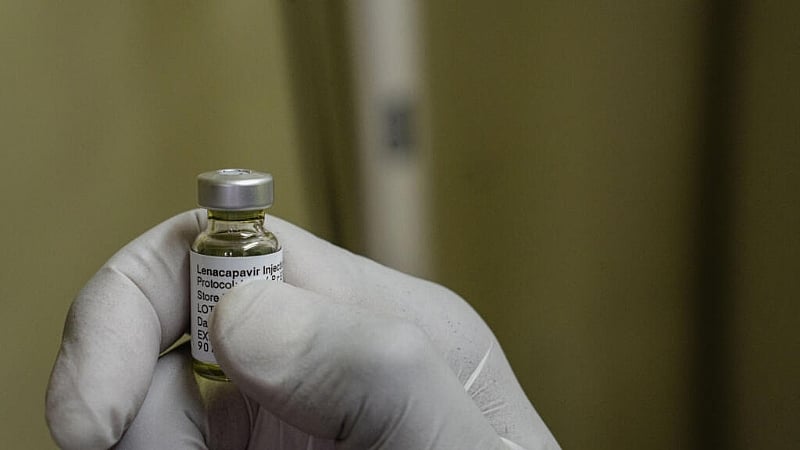
New long-acting antiretroviral treatment lenacapavir requires just two injections a year, reducing the need for daily pills. But questions remain over access, cost and whether enough doses will be available to meet demand in the country with the world’s largest HIV-positive population.
Ndong Essomba Bitchoka oversees the HIV/AIDS and tuberculosis care unit at the District Deido hospital in Douala, Cameroon.
RFI: South Africans living with HIV can now benefit from lenacapavir. Can you explain how this new treatment works?
Ndong Essomba Bitchoka: Lenacapavir is an antiretroviral drug. It prevents the assembly of the HIV virus’s RNA molecules, which stops new HIV viruses from forming. That is essentially how it works.
[It] can be used to treat HIV infection and help control the virus in certain patients. Instead of taking tablets every day, patients receive injections that limit the virus’s replication in the body for around six months.
The patient must first have their condition controlled with oral medicine, meaning tablets. Lenacapavir then supports the action of the antiretroviral drugs already being used to control the virus. The same level of control can then be maintained over a longer period when combined with other medicines.
Fiji fears crisis as WHO warns it has world’s fastest growing HIV epidemic
RFI: Do you have any idea how much the treatment costs?
NEB: I do not know the exact cost, so I cannot give a precise answer.
In many countries, such as Cameroon where I am from, lenacapavir is not yet available. In many cases, however, governments and financial partners work to subsidise these medicines. So, patients do not have to pay.
But in South Africa, I don’t yet know whether that will be the case, but I believe the government is working to see how it can subsidise access to these antiretroviral drugs, or at least in part.
RFI: For now, only 40,000 doses have been made available in South Africa. President Cyril Ramaphosa has announced that 1 million doses will be supplied within 18 months. However, the organisation Health Gap believes twice that number is necessary to meet the country’s needs. If there is a shortage, could patients who start the treatment find themselves in a difficult situation if it later becomes unavailable? What would the consequences be?
NEB: It is a good idea to begin with a certain number of doses and prioritise patients who need lenacapavir the most.
Then, depending on how patients respond to the treatment, it may be possible to increase the number of available doses and expand access to more people.
The risk is that if many doses are distributed and the state is later unable to obtain more, treatment could be interrupted. That could lead to resistance to this antiretroviral drug, which is otherwise very beneficial for patient care.
Kenya to offer patients free six-month HIV ‘breakthrough’ prevention jab
RFI: Can you explain why there has been more research into HIV treatments than into a vaccine for the virus? Is it really that difficult to develop one?
NEB: HIV is a particularly tricky virus because it mutates a great deal. You can think of it like a burglar who breaks into different houses but changes the way he operates each time.
Perhaps in one house the burglar is 1.8 metres tall, but in the next house he is 1.5 metres tall. That allows him to get through openings that would not have been possible before. He changes his route, he changes his approach. HIV behaves in a similar way because it has many mutations.
Scientists have not yet been able to develop a vaccine that can block all these different mutated strains of HIV. That is what makes creating a vaccine so difficult.
However, there are trials that offer some hope. In particular, the Brilliant 011 trial currently under way in South Africa is giving researchers reason to be optimistic. We hope to see positive results within the next few years.
This interview has been adapted from the original version in French and edited for clarity.