
There is no one left to sell Trump’s war
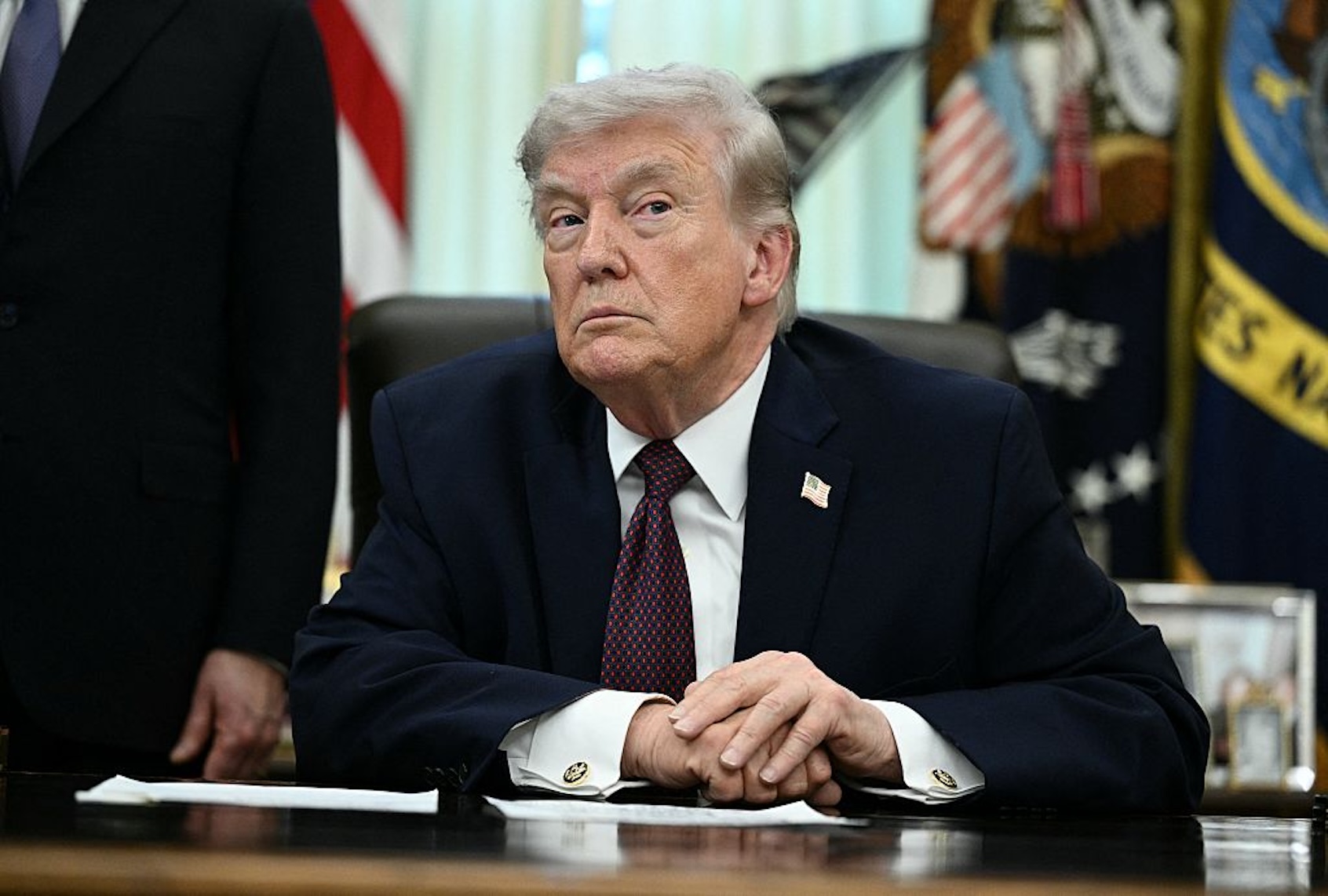
Tonight, on April Fools’ Day — the first night of Passover, with the bond markets closing early tomorrow ahead of Good Friday — Donald Trump will finally address the American people about the war he started with Israel in Iran. It has taken him more than a month to do so.
The administration seems to believe that if it can just find the right messenger or the right primetime moment, the narrative for war will click into place. But the timing of Trump’s address, after weeks of deflection and delay, dropped into a narrow window between market closures, feels revealing. Trump’s war in Iran is built on so many contradictions that MAGA’s disciplined propaganda machine of administration officials, media outlets like Fox News, podcasters and influencers is starting to crack under the strain.
For weeks the president has tried to outsource the job of selling the war to the American people, first to the Pentagon, as former Fox News anchor turned Secretary of Defense Pete Hegseth was supposed to be the perfect vessel for this message.
For weeks the president has tried to outsource the job of selling the war to the American people, first to the Pentagon, as former Fox News anchor turned Secretary of Defense Pete Hegseth was supposed to be the perfect vessel for this message. Bombastic, unwaveringly loyal and constitutionally incapable of doubt, Hegseth has stood at the Pentagon podium for four weeks and attacked reporters, called dead service members a PR operation designed to make “the president look bad” and belligerently insisted each offensive action in Iran was a military success.
Treasury Secretary Scott Bessent was awkwardly dispatched to soothe the financial markets while doubling as a kind of economic war correspondent. The nation’s top economic official argued that the war is under control because markets are “functioning,” that disruptions in the Strait of Hormuz are “manageable” and, ironically, that energy price spikes are “transitory.” On one level, it makes sense. This war is being fought as much through global trade as with airstrikes. The administration knows that if the financial system panics — if oil prices spiral further or if shipping grinds to a halt — the political consequences will be immediate and severe. Thus their priority has not been trying to explain the conflict to the American people. They are trying to manage the market reaction to it.
A five-week losing streak in the S&P 500 signals that, despite occasional rally days, overall economic sentiment has been trending negative, which fits with the ongoing uncertainty around the Iran war. Even if the market hasn’t crashed, this multi-week decline shows persistent selling pressure, not just a one-time shock, as investors gradually de-risk rather than panicking all at once.
But Bessent has not just been jawboning the Dow; he has been making military pronouncements on cable news. On Fox Business, he told host Larry Kudlow that a particular night would be “our biggest bombing campaign” and would “do the most damage to the Iranian missile launchers, the factories that build the missiles.” His Sunday show appearances have grown progressively more painful to watch. When Kristen Welker recently pressed Bessent on NBC’s “Meet the Press” about whether Trump was winding down or escalating the conflict — given that the president had threatened to “obliterate” Iranian power plants, a potential war crime, one day and mused about “winding down” the war the next — Bessent replied: “They’re not mutually exclusive. Sometimes you have to escalate to de-escalate.”
For his part, Marco Rubio has taken the administration’s messaging problem and turned it into something closer to a strategic identity crisis. The secretary of state has used his television appearances to question the very alliances that underpin American power because France won’t let our planes fly over its territory, Italy won’t let us use its bases and Spain has shuttered its airspace. On Sean Hannity’s Fox News show Tuesday, Rubio questioned whether NATO has any value to the U.S., as if unraveling the most successful peacetime alliance in history might somehow clarify the mission in Iran. (The secretary’s comments reflect those of his boss. In an interview with the British newspaper the Telegraph, Trump called NATO a “paper tiger” and said he was strongly considering withdrawing from the organization. He followed those comments Wednesday morning in an interview with Reuters, indicating that he would likely attack NATO in tonight’s address.) These are remarkable arguments to make in the middle of a war that depends on those very alliances to function.
Instead of making the case for the war, Rubio’s comments underscore its fragility. If Operation Epic Fury’s success hinges on access to bases and air space that allies are increasingly unwilling to grant, then the mission itself begins to look less like a necessity and more like a gamble. Talking tough against our oldest allies may resonate with a narrow slice of the president’s base, but to a broader audience it raises uncomfortable questions. If even America’s closest partners are balking at this war, what do they see that the administration refuses to acknowledge?
Rubio’s message collides directly with the economic messaging coming from Bessent. On one channel, the war is a high-stakes effort to stabilize a critical artery of the global economy. On another, it is a limited engagement whose consequences can be contained and whose risks are overstated.
Rubio also told Hannity that the Strait of Hormuz is not really America’s problem because “we depend very little on the strait.” Iran has built a three-tier access system during the war: allies pass freely with negotiations, compliant neutrals pay up to $2 million per vessel in yuan routed through Chinese intermediaries and adversaries are denied passage entirely. In downplaying the importance of the Strait of Hormuz to the U.S., Rubio’s message collides directly with the economic messaging coming from Bessent. On one channel, the war is a high-stakes effort to stabilize a critical artery of the global economy. On another, it is a limited engagement whose consequences can be contained and whose risks are overstated.
Apparently unsatisfied with how his Cabinet members are selling his war on TV, Trump took to Truth Social over the weekend to encourage his supporters to listen to Fox News’ biggest war hawk for talking points. “Watch Mark Levin interview of Brilliant Marc Thiessen tonight at 8:00 P.M., on FoxNews,” Trump posted to Truth Social. “Will discuss the importance of hitting Iran, HARD!!!” In return, Levin praised Trump’s “enormous intelligence” and portrayed the war’s critics as merely Trump haters. “Why would we need troops on the ground?” Levin said. “We’ve got to get the uranium — if it cannot be destroyed, if it cannot be altered, we’ve got to get it.”
But even within Trump’s own coalition, the mood is shifting from quiet dissent to outright hostility. As far-right commentator Ann Coulter posted to X, “Watching Fox News assure viewers the Iran war is going SUPER well and Trump is a total stud is like watching the same network assure viewers that Dominion Voting Systems rigged the 2020 election and Trump was the winner.”
Some on Fox News are trying to sound the alarms to MAGA and warn Trump. “I’ve spoken to many people at Fox who have told me that administration figures will come to them saying, ‘Please put me on because I have something the president has to hear,’” former Fox News star Megyn Kelly recently claimed.
Laura Ingraham is one who has fired a warning flare for the White House. The Fox News host recently said that further escalation could trigger “cascading problems for the region” and “political problems for the president.”
Want more sharp takes on politics? Sign up for our free newsletter, Standing Room Only, written by Amanda Marcotte, now also a weekly show on YouTube or wherever you get your podcasts.
Ingraham continued her skepticism this week: “Now knowing what little time we have and how quickly this can spiral out of control, we still have a lot of questions. For instance, was the president fully briefed about the risks of all of this from the beginning? And was he then able to take it all in and understand the complexity of this, how complex it could actually get, and further possibilities of casualties or other damage, the difficulty of dealing with his people? Or was he told this would be relatively quick in and out?”
Fox News host — and military veteran — Joey Jones addressed the president and his former co-worker Hegseth directly over the weekend. “Don’t nation build. Don’t win hearts and minds. Don’t spread democracy,” he pleaded. “Spill the blood without our hands tied and without a PR campaign and get the hell out of there.”
Meanwhile, Tucker Carlson pointed out on his podcast that everything Americans buy depends on energy prices, and energy prices depend on the Strait of Hormuz, which is now a toll road run by Tehran. Even Lindsey Graham, who cheered on this war with the enthusiasm of a man who has never been near a battlefield, is now telling Trump to wind it down. Alex Jones declared Trump is in “freefall” and said it was time to “cut bait.” Joe Rogan plainly called the war “insane” and noted that “people feel betrayed.” Former White House adviser Steve Bannon demanded that Israeli President Benjamin Netanyahu’s son, currently residing in Miami, be deported back to Israel and put in uniform for any potential ground invasion.
When the coalition that elected you has collapsed into a food fight about whose children should die first, the situation has become bigger than simply a messaging problem. What began as a fracturing of a historically loyal base last summer with the Epstein files has devolved into an open revolt with this war.
After he and Netanyahu launched the operation on Feb. 28, Trump never saw the rally-around-the-flag boost in approval ratings that typically accompanies military action at the start of a conflict. His net approval is now at its lowest point of his second term. Republican voters may support airstrikes in the abstract, but they recoil at the idea of ground troops. Non-MAGA Republicans have swung against the Iran War by 48 points in the last two weeks, according to the latest YouGov/Economist poll. Independents have abandoned the president in staggering numbers. Just 27% of Americans believe the U.S. made enough effort at diplomacy before using military force.
“Whether it’s how it’s being communicated in the media or how it’s being communicated here in the Congress,” said Sen. Lisa Murkowski, R-Alaska, who is reportedly considering forcing a congressional vote authorizing the war. She told Semafor, “I think [the administration’s information-sharing on Iran] is lacking.”
The quandary facing Trump as he prepares for tonight’s primetime address is enormous: How do you sell a war that is already exposing the limits of your power?
What makes this moment different is that the skepticism is not confined to the opposition. It is spreading within the president’s own base, among voters who embraced his promise of restraint and his rejection of so-called forever wars. For these voters, his war of choice in Iran is a perceived betrayal.
Trump’s address may temporarily unify the narrative and impose a sense of order on the chaos that rallies supporters and reassures allies. But unless it resolves the deeper contradictions — unless it explains not just what is happening, but why it had to happen and how it will end — it will not change the fundamental dynamic. No television pitch can fix that.
Read more
about the Iran war