
Nigeria targets end to diagnostic imports as Abbott begins local HIV, Hepatitis test kit production
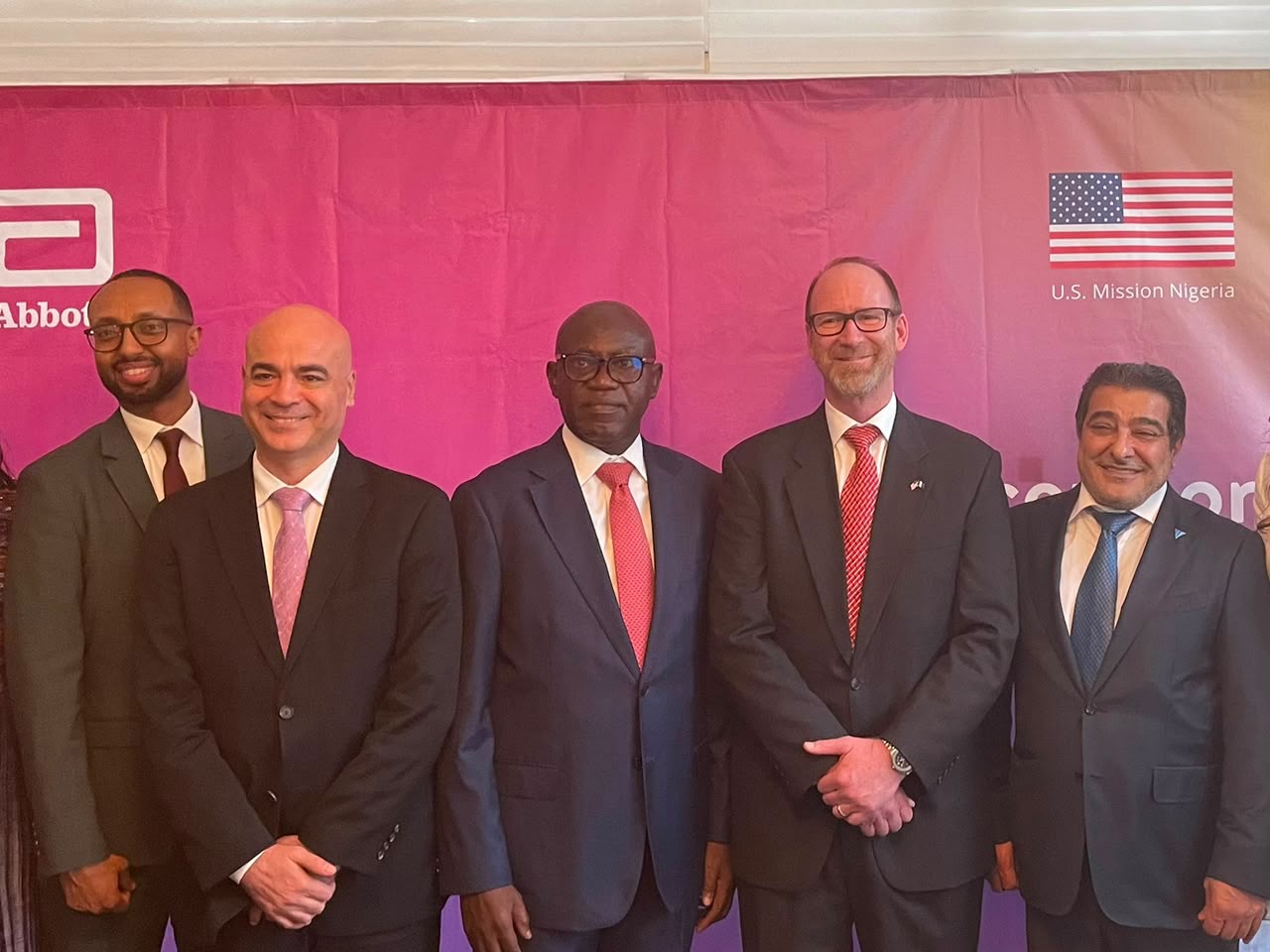
L-R; National Coordinator, Presidential Initiative for Unlocking the Healthcare Value Chain, Dr. Abdu Mukhtar; Divisional Vice-President, Abbott Rapid Diagnostics, Mr. Rabah Elsayed; Secretary to the State Government of Ogun State, Tokunbo Talabi; U.S. Consul General, Rick Swart; Group Chairman & Chief Executive Officer, Mikano International Limited, Mr. Mofid Karameh during the reception commemorating the strategic collaboration between the Presidential Initiative for Unlocking the Healthcare Value Chain (PVAC), Abbott and Afrimedical to advance local healthcare manufacturing, strengthen diagnostic capacity and improve access to quality healthcare solutions in Nigeria, held in Lagos
… PVAC, Afrimedical partnership positions Nigeria as WA’s manufacturing hub
By Chioma Obinna
With 99 percent diagnostic imports, Nigeria has taken a decisive step toward reducing its heavy dependence on imported medical diagnostics with the commencement of local production plans for advanced HIV, hepatitis and syphilis rapid test kits under a strategic partnership involving global healthcare company Abbott, the Presidential Initiative for Unlocking the Healthcare Value Chain (PVAC), and Afrimedical, a subsidiary of Mikano International Limited.
The initiative, unveiled at the Abbott Localization Reception and Partnership Milestone Ceremony in Lagos, is expected to strengthen Nigeria’s healthcare security, boost local manufacturing capacity and position the country as a regional hub for diagnostic production in West Africa.
At the centre of the partnership is the Federal Government’s push to reverse Nigeria’s longstanding reliance on imported healthcare products, a challenge officials say has left the country vulnerable to global supply disruptions.
Speaking at the event, the National Coordinator of PVAC, Dr. Abdul Mukhtar, confirmed Nigeria’s health system remains heavily import-dependent, a situation the administration is determined to change through targeted industrialisation of the healthcare sector.
“We import almost 70 per cent of the medicines we use, nearly 100 per cent of vaccines and about 99 per cent of medical devices in this country. President Bola Tinubu said this must change,” Mukhtar said.
He noted that the COVID-19 pandemic exposed critical weaknesses in global supply chains, forcing countries like Nigeria to confront the risks of overdependence on foreign medical products.
“What COVID-19 did was show us clearly that we cannot rely entirely on external supply chains for essential healthcare commodities. We must build domestic capacity,” he added.
Mukhtar described the partnership with Abbott as a landmark development, noting that the company would localise production of fourth-generation rapid diagnostic test kits for HIV, syphilis, hepatitis B and hepatitis C in Nigeria.
“This is the first time this level of Abbott diagnostic technology is being localised outside the United States. It is a major milestone for Nigeria and for Africa,” he said.
He explained that the project would create high-skilled jobs, attract foreign direct investment, deepen technology transfer and strengthen Nigeria’s position in the regional healthcare manufacturing ecosystem.
Beyond production, Mukhtar said the initiative sends a strong signal to global investors that Nigeria is ready for large-scale healthcare manufacturing.
“When companies like Abbott invest here, it shows that Nigeria is open for business in the healthcare sector. It also shows that the policy environment is improving,” he stated.
He disclosed that the Federal Government has introduced fiscal incentives, including zero import duty and zero VAT on raw materials and equipment for local manufacturing, as part of efforts to reduce production costs.
“We are also mobilising over $2 billion in development finance to support healthcare manufacturing. This is about building an ecosystem, not just individual projects,” he said.
Also speaking, the Divisional Vice-President, Commercial Operations, Abbott Rapid Diagnostics, Mr. Rabah Elsayed, said the collaboration reflects Abbott’s commitment to strengthening healthcare systems through local partnerships.
“Strong healthcare systems are built through strong local partnerships,” Elsayed said.
He noted that Abbott will localise its most advanced rapid diagnostic technologies in Nigeria, including WHO-prequalified solutions for antenatal screening and infectious disease detection.
“Early and accurate diagnosis is critical. It enables timely treatment decisions and improves health outcomes across multiple disease areas,” he explained.
Elsayed added that Nigeria’s large population, skilled workforce and ongoing health reforms make it a strategic partner for expanding diagnostic access across West Africa.
“Nigeria has the scale and capacity to become a regional hub for diagnostic manufacturing,” he said.
Chairman and Chief Executive Officer of Mikano International Limited, Mr. Mofid Karameh, said Afrimedical’s investment in healthcare manufacturing was driven by lessons learned during the COVID-19 pandemic.
“We realised during COVID that dependence on imports for basic medical supplies was a serious risk. That experience pushed us to invest in local production,” he said.
Karameh disclosed that Afrimedical currently produces about 1.8 billion syringes annually, making it one of the largest producers in Africa, with capacity to supply West Africa.
“This is not just about business. It is about healthcare security, technology transfer and national resilience.”
He added that Abbott’s decision to partner with Afrimedical followed strict global standards assessments of its manufacturing facilities.
“When Abbott visited our facility, they saw we meet international standards and immediately agreed to partner with us,” he said.
On her part, the Ogun State Commissioner for Health, Dr. Tomi Coker, described the development as historic, noting that it would improve access to affordable diagnostics, create jobs and strengthen healthcare delivery in the state and beyond.
“This is about saving lives, especially for pregnant women and children who depend on timely diagnosis.”
Earlier, the U.S. Consul General, in Lagos, Mr. Rick Swart, said the partnership reflects growing confidence in Nigeria’s healthcare market and strengthens bilateral commercial ties between both countries.
“Abbott’s investment demonstrates the immense potential for healthcare innovation and partnership between the United States and Nigeria.”
The ceremony brought together senior government officials, private sector leaders, healthcare stakeholders and development partners.