
Trump’s “hero image” includes lions, camels and motorcycles
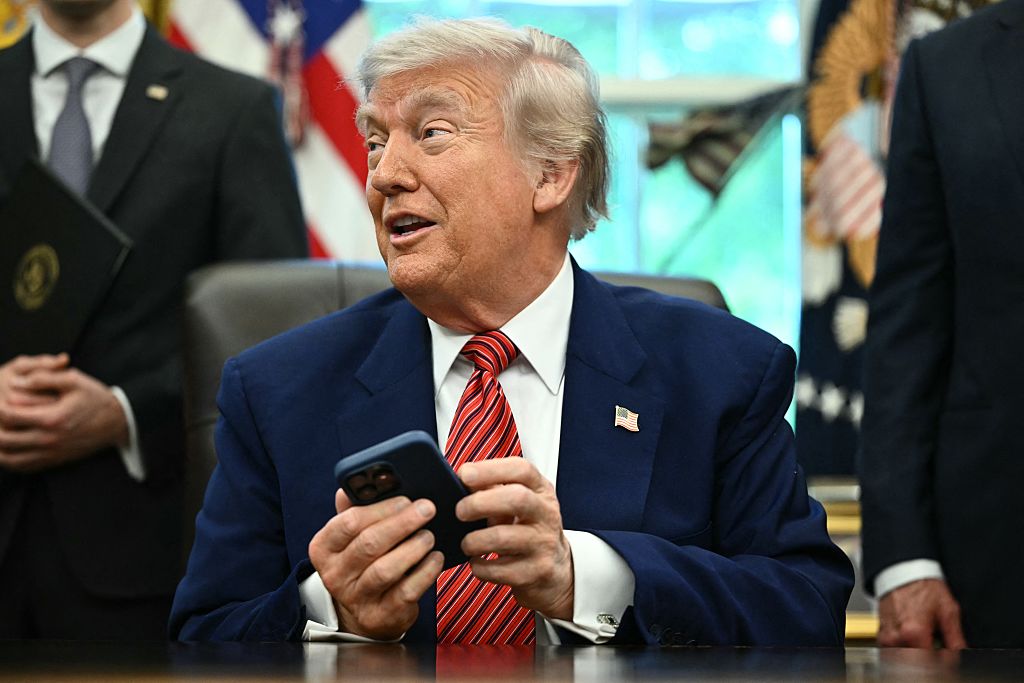
President Donald Trump shared an AI-generated music video on Truth Social this week that depicts him riding a lion through the jungle, planting a flag on the moon, appearing on Mount Rushmore and hosting a White House UFC event that has not yet taken place.
The video, created by New York congressional candidate Anthony Constantino — a businessman, founder of Sticker Mule and recipient of Trump’s endorsement — is set to a repetitive anthem declaring that people around the world love Trump. The accompanying AI-generated visuals move rapidly from scene to scene, portraying Trump as a globe-trotting hero celebrated across cultures and continents.
Among the video’s more surreal moments are depictions of Trump riding a camel through the desert, traveling through India on a motorcycle, appearing as an anime-style warrior and sharing tacos with world leaders. Other scenes place him in iconic locations around the world or transform him into a larger-than-life figure woven into famous landmarks and historical imagery.
On one level, the video is simply the latest example of increasingly sophisticated AI-generated political content. On another, it fits into a much longer pattern that has emerged throughout Trump’s social media career.
Over the years, Trump has shared or amplified images portraying himself in roles that extend far beyond traditional political imagery. Some have depicted him as a king, a superhero, a doctor, a warrior or a religious figure. Others have inserted him into imagined historical moments or fantastical scenarios. This latest video continues that trend, portraying Trump not primarily as a politician engaged in governing, but as a symbolic figure moving through history, culture and even imagined future events.
The video contains little policy messaging. Instead, it relies almost entirely on imagery that presents Trump as powerful, admired and omnipresent. The result resembles less a traditional campaign advertisement than a form of political mythmaking, using AI-generated visuals to create an idealized narrative around a public figure.
That dynamic becomes more notable given the video’s creator. Constantino is a Trump-endorsed congressional candidate for upstate New York, whose political fortunes are tied, at least in part, to his relationship with the president. Trump’s decision to share the video highlights how visibility within his online ecosystem can flow to allies who create content that reinforces his preferred image.
It’s also worth noting that this post comes on the 82nd anniversary of D-Day, with no other official post from the administration to commemorate the day at time of publication.
The post also arrives as AI tools are making it easier than ever to generate elaborate political imagery. What once would have required a professional production team can now be created and distributed in hours, allowing supporters and campaigns to produce highly stylized portrayals of political figures at scale.
And because social media posts rarely disappear entirely, they become part of a lasting digital record. Long after speeches, interviews and campaign events fade from public memory, images often remain. Trump’s Truth Social account has increasingly become a collection of posts that document not only political messaging, but also the ways he and his supporters choose to depict him.
Start your day with essential news from Salon.
Sign up for our free morning newsletter, Crash Course.
Whether viewers see the video as harmless internet absurdity, political propaganda or something in between, it raises an unusual question for the AI era: When political figures and their allies can generate endless images of themselves as heroes, warriors and historical icons, are they trying to shape public opinion in the present — or shape how they will be remembered in the future?
Read more
about Trump’s Truth Social posts