
Supreme Court’s voting rights decision could erase Black representation across the ballot
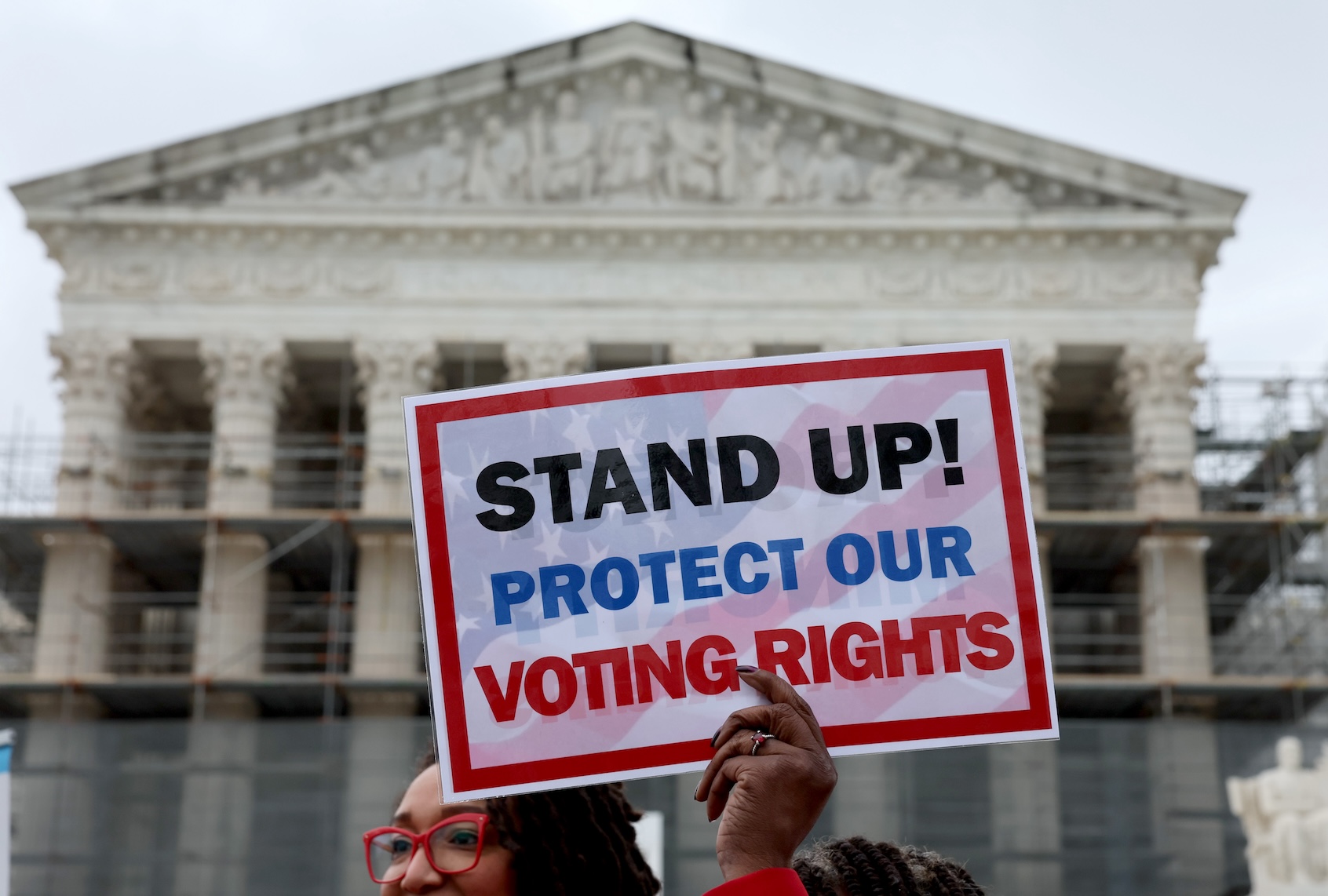
The recent Supreme Court decision on the Voting Rights Act has kicked off another wave of partisan gerrymandering across the South — yet the ruling’s implications for the representation of minority voters and the democratic responsiveness of state and local governments have largely flown under the radar. In the long run, however, these effects may prove just as consequential, as the Supreme Court has paved the way for state governments to entrench their power and lock minority communities out of representation in their government.
The effects of Louisiana v. Callais are still rippling across the country, as Republican-run states across the South suspend elections in order to redraw maps and eliminate minority majority districts in their states, giving themselves a buffer for the midterms.
In its ruling, the Supreme Court changed its standard for proving racial discrimination under Section 2 of the Voting Rights Act, now requiring people claiming that a map is racially discriminatory to prove there was discriminatory intent behind the map. Previously, rulings were made based on the nature of the maps themselves, rather than the intent of their drawers.
This new, higher standard has created a situation in which racial gerrymandering appears much easier to pull off, especially in places like the South, the people who control the redistricting process can claim that their maps are a political gerrymander (i.e. by party, which the Supreme Court has protected), rather than a racial gerrymander.
This has already kicked off a wave of gerrymandering for congressional district maps just before the midterms, but importantly, Section 2 of the Voting Rights Act also governs the rules for drawing state legislative districts, as well as districts used in local elections. This means that the representation of minority voters, especially Black Americans, is potentially on the chopping block.
Already, Alabama has moved to redraw not its congressional maps but its state Senate maps as well, in order to eliminate two majority Black districts in the Montgomery area. Similarly, Mississippi Gov. Tom Reeves has indicated that the state will be redrawing state supreme court districts before the 2027 election. While state legislative redraws have not been approached with the same urgency as congressional maps, other states could follow suit.
“I think what you’re going to see after Callais is an attempt to draw even more districts that are like that.”
Amir Badat, the manager of Black Voters on the Rise and voting special counsel at the Legal Defense Fund, told Salon that he expects the ruling to “decimate” Black political power in the South — and not only in state legislatures, but just as importantly, in local governments.
Badat used the example of DeSoto County in Mississippi. Badat worked on a challenge to DeSoto County districts that were used for the county’s board of supervisors, school board, election commission, county constables and their judges.
“This is a county that has a third of its population is Black. And of those 25 elected officials, zero of them are Black, and they’ve only had two Black elected officials in the entire history of the county. Section 2 was kind of like made to address those types of circumstances,” Badat said. “I think that we still have good arguments for why there’s still a Section 2 violation, even after Calllais, but I think that this case in particular, and the testimony that we heard at trial from residents, tells you why Section 2 is so important. Because what we heard at trial from Black people who lived in DeSoto County is how important it was for them to have representation on these bodies.”
The other way state legislatures could leverage the rulings to their advantage is to draw maps to increase their advantage in state legislative elections, Badat explained. In Mississippi, for example, many state legislative seats are not even contested because they are uncompetitive. The Callais ruling simply stands to further loosen the rules around drawing state legislative districts in a way that could easily create even fewer competitive seats.
“I think what you’re going to see after Callais is an attempt to draw even more districts that are like that,” Badat explained. “And if you can do that, it is possible to draw even safer Republican districts without the constraints of Section 2, which means that you’re going to have even less competition across the state legislature.”
Fewer competitive races means candidates will have less of a reason to campaign and, in turn, mean that voters have fewer opportunities to interact with those representing them and to express their views. Creating fewer competitive seats is not, however, the only outcome map drawers could pursue.
One person with experience drawing district maps, and who wished to remain anonymous, told Salon that they believe this ruling lowers the barriers for state lawmakers to draw themselves into entrenched supermajorities in state government and make them much harder to break.
Protecting Black representation in the South had the effect of ensuring that Democrats were favored in a number of state legislative seats, given the persistent racial polarization in the United States. Republicans already maintain a supermajority in both chambers in much of the South, including Tennessee, South Carolina, Alabama, Arkansas, Oklahoma and Louisiana. Furthermore, they maintain a supermajority in one chamber in North Carolina and Mississippi.
At the same time, state lawmakers are still feeling out the boundaries of the Callais ruling and, in the view of the person with experience drawing the map, no one wants to have their map be the first thrown out under the new standard, or to have it tossed for violating a state law or constitution.
“If the majority party has already been successfully able to gerrymander themselves into a super majority, there’s no more juice that could be squeezed out of undoing the other black Democratic districts, which are probably the only Democrats in the state legislature,” the person said. “But it additionally puts you at legal risk, not under the Voting Rights Act, but under the 14th Amendment.”
Start your day with essential news from Salon.
Sign up for our free morning newsletter, Crash Course.
The Democratic Legislative Campaign Committee, which is attempting to break GOP supermajorities in a number of states in 2026, including in the South, indicated that the Callais ruling has only increased the urgency of breaking these supermajorities in their view.
“The Supreme Court gutting the VRA has transformed the landscape of politics and catapulted the importance of state legislative races to the national stage,” DLCC President Heather Williams said in a statement to Salon. “Winning Democratic majorities in statehouses across the country is the strongest path to counter Republicans’ scheme to rig their way to power and silence communities of color.”
Beyond the partisan jockeying, however, the most immediate impact of the ruling is that minority communities, and particularly Black communities across the South, are facing a new reality where they are having their federal representation wiped out, and much of their state and local representation could soon follow.
Shayla Mitchell, a digital organizer with Alabama Values, a group that promotes community political engagement, highlighted the unprecedented lengths that politicians have gone to ensure that they can redraw the maps, lengths that include redrawing maps that are already being used in elections that are underway.
“This is totally unprecedented,” Mitchell told Salon. “Even during COVID, we had the opportunity to have a skewed voting policy, because it was a national public health emergency. But other than that, there have not been many changes or breaches to election policy. Even in a natural disaster, like when a hurricane or tornado affects the area, what they do is just migrate the polls.”
Read more
about politics