
Marauding center backs, do-it-all midfielders: Top tactical trends at every position in 2026
Elite European soccer in 2026 feels decidedly different from what we’ve become used to. Over the past couple of seasons, the Premier League has been increasingly characterized by direct attacking, set pieces and long throw-ins. Many encounters between big clubs across Europe have become frenetic, end-to-end affairs, such as the Bayern Munich–Paris Saint-Germain semifinals in last season’s UEFA Champions League.
A lot of the changes seem related to how teams play without the ball. The soccer we became accustomed to throughout the 2010s involved top sides trying to push their opponents back while keeping the ball. Once the ball reached the attacking third, they tried to outnumber defenders in key spaces and make use of their attacking talent.
One way for defensive sides to counter this approach is to use zonal marking, which involves defending space rather than individual players. They would set up in compact blocks and deny space in critical areas, whether they defended deep like Max Allegri’s Juventus in the 2010s or pressed high like teams coached by Ralf Rangnick’s disciples. While this tactic helps protect the areas closer to goal and prevent mismatches, it sometimes plays into the hands of those high-possession sides.
As a result, player marking (or man-to-man marking), in which defenders are assigned to follow attackers around up and down the pitch, started to make a comeback at the turn of the 2020s. Teams like Mikel Arteta’s Arsenal and Andoni Iraola’s Bournemouth combined this concept with their zonal marking, switching out of a zonal structure in certain situations to swarm teams attempting to move the ball forward (hybrid pressing). This makes moving the ball slowly up the pitch harder, causing teams to embrace more direct approaches with the ball.
Meanwhile, the game appears to be becoming more physical and more intense. Since the COVID-19 pandemic, every passing season of the Premier League has seen faster sprinting and more “high-intensity actions.” And with off-ball physical data like running distance or top speed becoming more accessible, scouting departments now possess more transparent measures of athleticism, leading to players’ athletic qualities being valued more.
Rather than just affecting the head coach’s team talk, these big-picture changes have a major effect on the skill sets that clubs look for when assembling their starting XIs. Let’s take a look at five positions — goalkeepers, center backs, fullbacks, central midfielders, and strikers — to see what has changed and why.
Goalkeepers: Distribution and cross-claiming
New Aston Villa goalkeeper Zion Suzuki has generated much buzz this season. One of his standout features has been his passing ability, playing quick passes to his center backs during the early buildup and exquisite floated long passes to Villa’s forwards to escape pressure.
Zion Suzuki’s passing ????
???? @AstonVilla pic.twitter.com/Nwlxp4stF9
— Premier League (@premierleague) September 6, 2026
As impressive as his reflex saves are, Suzuki doesn’t appear to be a great shot stopper. His “goals prevented” stats, based on post-shot expected goals, reveal that his shot-stopping numbers have hovered around that of the average major league goalkeeper over the past couple of seasons. In fact, in 2025-26, he prevented minus-0.4 goals per 90 minutes, implying that he did slightly worse than the average keeper last season.
However, his passing displays and his excellent cross-claiming make him a highly prized player, and his skill set epitomizes the state of today’s goalkeeping.
When Pep Guardiola’s Manchester City signed Gianluigi Donnarumma — known for his shot-stopping abilities, but arguably an average distributor — as their first-choice goalkeeper in summer 2025, it looked like elite soccer was once again prioritizing shot-stopping between the sticks. But the tactical conditions of soccer in the 2020s make ball-playing goalkeepers even more crucial than before; when teams are tasked with playing the ball past intense man-to-man presses, goalkeepers have more to do in the buildup phase.
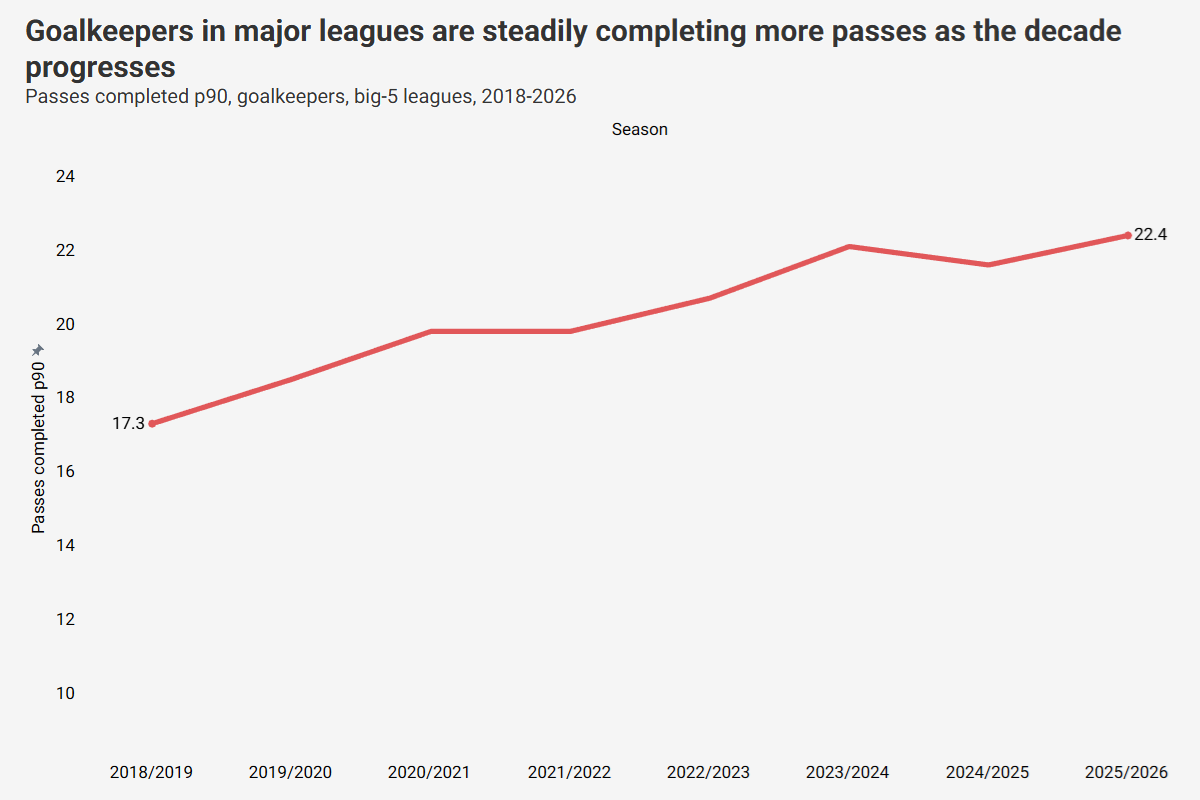
Even the most aggressive man-to-man presses don’t generally mark the goalkeeper, making keepers free options in the buildup. From this point, keepers are instrumental to playing quick passes around the box to try to bait the press for “artificial transitions” as well as with playing longer passes into space to relieve pressure and kick-start a direct attack.
As a result, the heyday of keepers primarily known for what they can do with their feet looks unlikely to recede anytime soon, with more intense pressing and more direct attacking arguably magnifying their value.
Meanwhile, although the number of open-play crosses that teams in the Big Five leagues play has decreased slightly since 2018, the ever-rising threat of set-play goals makes cross-claiming an especially valuable skill. The first-choice keepers at big clubs dominate the top of the leaderboard for cross-claiming statistics; Donnarumma ranked No. 1 for the highest percentage of crosses claimed in the Premier League last season, Barcelona‘s Joan García and Real Madrid‘s Thibaut Courtois ranked second and third, respectively, in last season’s LaLiga campaign, and PSG’s Lucas Chevalier ranked third in Ligue 1.
On the other hand, the keepers who populated the bottom of cross-claiming tables belong to either lower-table clubs or underperforming established sides like Tottenham Hotspur and Newcastle United. As valuable as goalkeepers’ distribution is in 2026, it appears that the ability to claim crosses has become crucial to success between the sticks.
Center backs: Playmaking and pushing forward
In the 2015-16 Premier League season, the top five players who completed the most passes per 90 were Santi Cazorla, Cesc Fabregas, Bastian Schweinsteiger, Aaron Ramsey and Michael Carrick, with more central and attacking midfielders completing the top 10. In 2025-26, the top five were Rodri, Lewis Dunk, Curtis Jones, Trevoh Chalobah and William Saliba, with seven center backs making up the top 10.
A decade ago, central midfielders were at the heart of elite sides’ passing moves, but today, especially in the Premier League, center backs are the primary passers in most sides.
In the Big Five leagues, center backs completed 19% more passes in the 2025-26 season than in 2018-19. Much of this has to do with intense man-to-man pressing systems, meaning that players positioned deeper have more prominent buildup duties. The 2020s have also seen nominal center backs become more involved in attacking play, taking up higher and wider positions. Attacking center backs are effective tools to dismantle mid-blocks, helping complicate marking duties with their movement.
This is easiest to do with wide center backs in a back three. Gian Piero Gasperini’s Atalanta and Simone Inzaghi’s Internazionale did this especially often. This season, Xabi Alonso’s Chelsea and Gasperini’s AS Roma are key examples, with the latter probably representing the most adventurous iteration of attacking center backs we’ve seen this century.
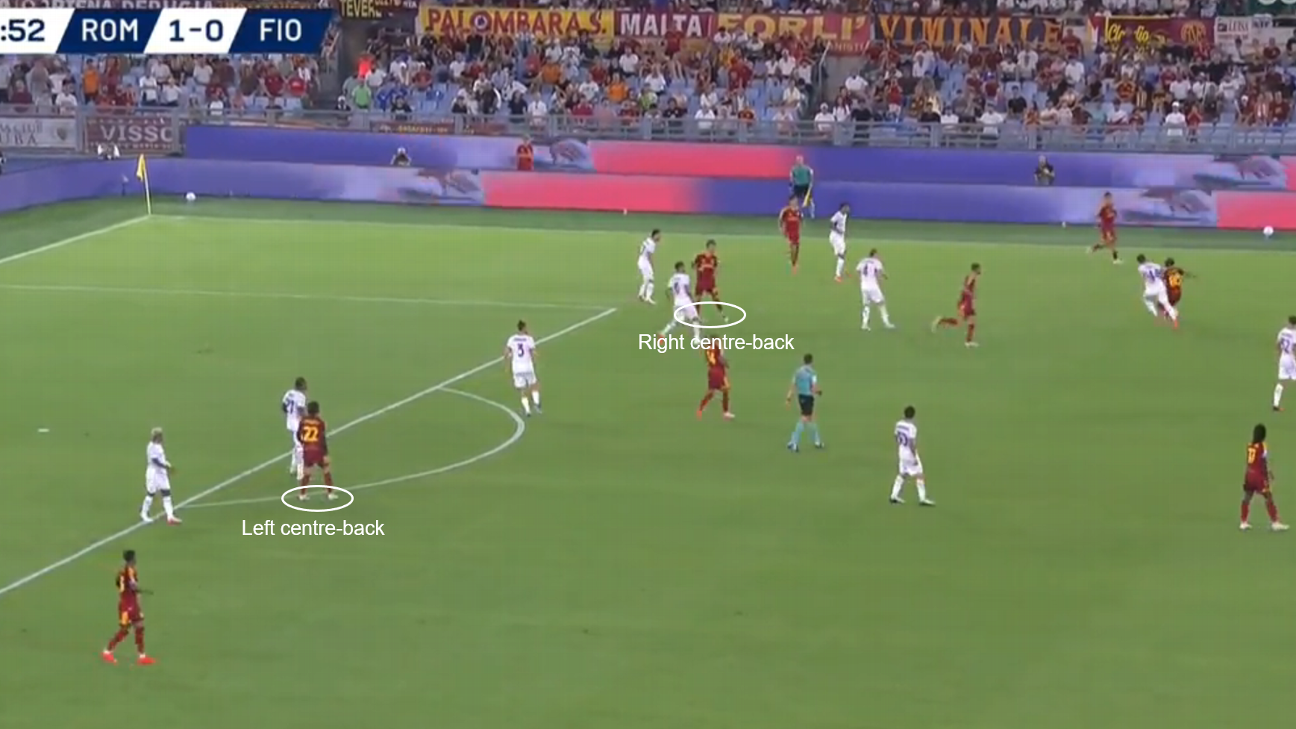
We can see some of this in back-four systems, too. Guardiola used John Stones as a center back who roved forward in possession at City, while Thiago Motta used Riccardo Calafiori and Jhon Lucumí as center backs with free roles.
As this decade progresses, the phrase “center back” might be encased in quotation marks more often.
Fullbacks: Rise of the underlap
Fullbacks often epitomize the tactical eras they find themselves in. The turn of the 2010s saw the rise of overlapping attacking fullbacks who move high up the pitch and outside wingers who cut inside with the ball. The mid-to-late 2010s saw the rise of high-intensity pressing, with high-possession sides using inverted fullbacks to provide security against counterattacks resulting from losing the ball. Meanwhile, the relative conservatism that followed the COVID-19 pandemic meant that nominal center backs were often deployed at fullback.
Today, we’re seeing the rise of attacking fullbacks who underlap, making runs into the channels between opposition fullbacks and center backs, much like inverted wingers. As Caleb Gearty notes for SCOUTED, “the ability to receive the ball” is progressively becoming more highly valued for fullbacks. After getting in behind back lines, underlapping fullbacks can put in dangerous cutbacks and crosses from closer to goal, or take shots themselves.
In the case of back-three formations, this isn’t a new phenomenon. For instance, Thomas Tuchel’s Chelsea saw wingbacks Reece James and Ben Chilwell move inside and score goals, while Inzaghi used Federico Dimarco and Denzel Dumfries as goal-scoring threats at Inter.
But now, fullbacks in back-four systems are increasingly venturing forward and inside — not just putting crosses in, but getting on the end of goal-scoring opportunities, too. Arsenal’s Calafiori and Manchester City’s Nico O’Reilly often make darting runs into the box and offer secondary goal threats. Spain‘s World Cup win saw Marc Cucurella and Pedro Porro underlap, pulling defenses apart.
Meanwhile, back-three systems feature wingbacks who pose greater goal-scoring threats than ever. Alonso’s Chelsea are an instructive example — they signed Pep Chavarría and Marco Palestra, but Alonso currently appears to favor the left-footed winger Pedro Neto at right wingback, who makes sharp runs into the box.
SIGNED. SEALED. DELIVERED. ✉️
Morgan Rogers delivers the perfect opportunity for Pedro Neto to DOUBLE it for Chelsea! pic.twitter.com/Vqo8Eeg33P— NBC Sports Soccer (@NBCSportsSoccer) August 30, 2026
Why is this the case? In an age when defensive tactics are dominated by player-marking, the positional interchanges around the flanks (or “wide rotations”) and unexpected diagonal darts forward from fullbacks can scramble player-marking duties and open up space — especially when wingers find themselves closer to the sideline. As Billy Carpenter writes, sudden moves into the spaces in behind defenses can expose structural vulnerabilities in even the best mid-blocks.
Calafiori so far this season represents a great example, making well-timed runs in behind and receiving incisive through balls …
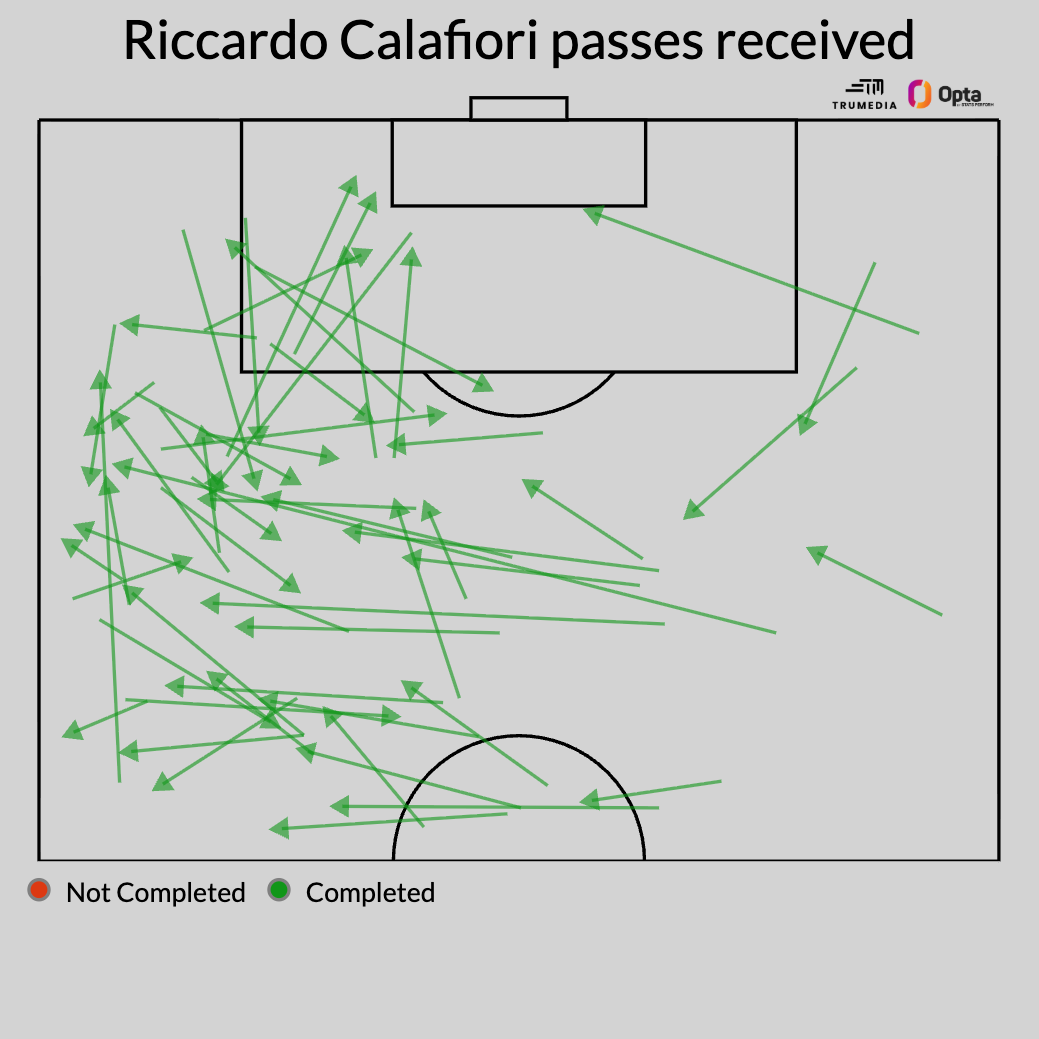
… and creating goals like these.
On the scoresheet again ⚡️
???? @BukayoSaka87 pic.twitter.com/lFCYnYAI0X
— Premier League (@premierleague) August 31, 2026
Jamie Carragher once remarked that fullbacks are either failed wingers or failed center backs. The rise of inverted fullbacks would’ve allowed Carragher to add “failed midfielder” to his jibe, while today, a middling inside forward can consider a successful career as an underlapping attacking fullback.
Central midfielders: Large spaces and generalists
In 2026, the most expensive player archetype to sign in soccer appears to be the generalist midfielder. Of the 10 most expensive transfers this summer per Transfermarkt, six were central midfielders. And among the major moves in midfield that big clubs made this summer, most midfielders are do-it-all generalists who, at least in theory, contribute to passing, carrying, winning the ball back and sometimes crashing the box. These include Elliot Anderson, Sandro Tonali, Ayyoub Bouaddi, Bruno Guimarães, Carlos Baleba and Andrey Santos.
This hasn’t always been the case. By 2009, the box-to-box midfielder had become a dying breed, superseded by specialists in midfield. In the late 2010s, the rise of pressing meant that press-resistant ball carriers in midfield became increasingly valued, epitomized by the summer 2019 transfer window, which saw Frenkie de Jong, Tanguy Ndombele and Mateo Kovacic move for sums exceeding €40 million. But now, every big club is willing to spend astronomic sums on their own equivalent of Declan Rice or Moisés Caicedo; athletic midfielders who can cover lots of ground and do a bit of everything.
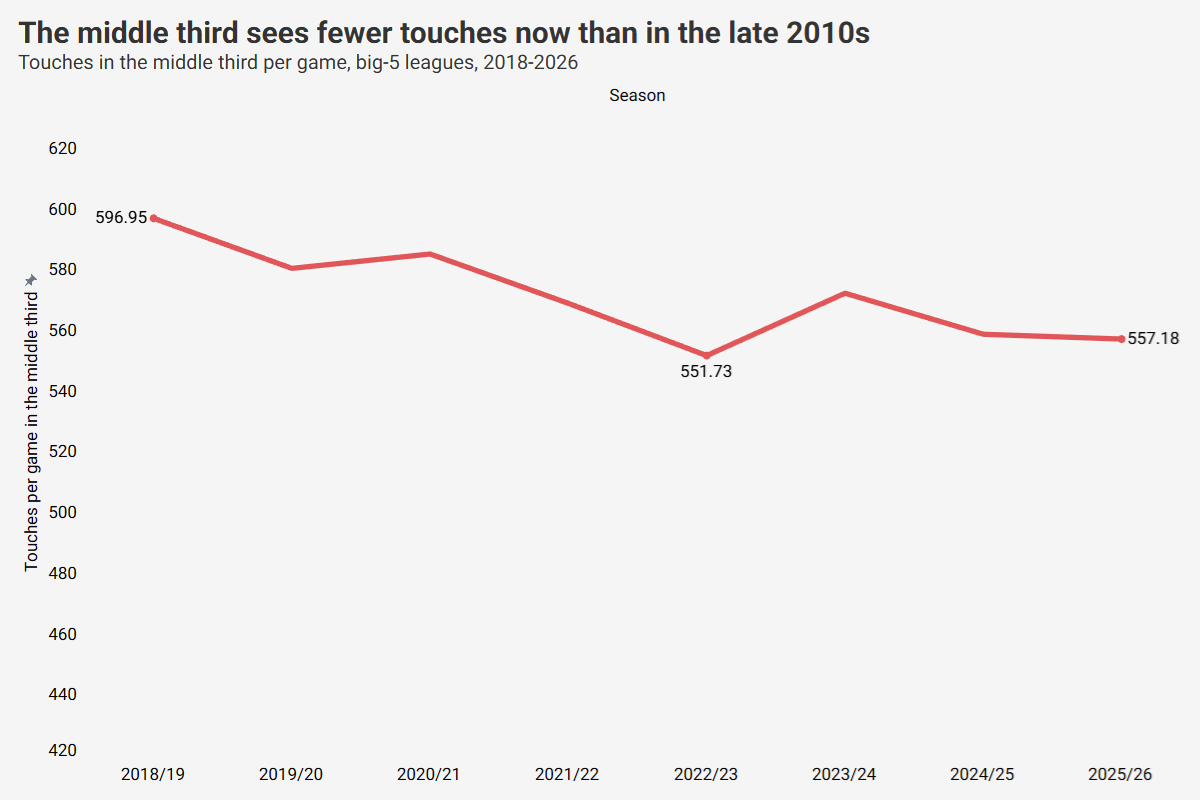
Counterintuitively, this might be happening because less of the game is happening in midfield. With the rise of situational player-marking, the middle third sees larger spaces opened up between lines of pressure, while space becomes more constricted in teams’ own thirds. As a result, moving the ball from defense to midfield becomes a harder task, while the spaces opened up in the middle third mean teams don’t pass the ball around as much there, instead moving the ball through it more quickly.
Jon Mackenzie and Jake Entwistle have discussed the relevance of “small spaces” — where the player on the ball has little room to work with in the face of pressure — and “large spaces” — where players need to cover ground quickly, especially during transitions or when a line of pressure is broken — in midfield, which influences how midfielder profiles are valued today. A player like Anderson, who combines small-space and large-space skills, becomes priceless, but the broader emphasis shifts from small-space specialists to large-space generalists who can cover ground and offer control in the center of the park.
As a result, affecting the pace of the attack, rather than just exerting control over space, becomes a key consideration in midfield. The rise of artificial transitions in response to pressing also means central midfielders are key to moving the ball from small spaces to large spaces, as Carlos Baleba did adeptly while at Brighton.
Run, Carlos, run! ???????? The best of Baleba’s trademark driving runs during his first season! ???? pic.twitter.com/CjOYEfnN4h
— Brighton & Hove Albion (@BHAFC) June 4, 2024
The middle of the park is integral to controlling a game of soccer, and as we’re seeing the very notion of “control” change in the middle of the 2020s, the traits associated with the most highly valued midfielders are transformed, too.
Strikers: Physicality and pinning
While the first two decades of top-level soccer in the 21st century saw increasing versatility at the center forward position, the opposite is happening in the third decade. So far, the 2020s have seen taller, faster and stronger strikers being valued more than their smaller, more technical counterparts. Of course, Erling Haaland represents the platonic ideal of a striker — in this era and in any other — but the players who spearhead attacks in the middle of the 2020s tend to be 6-foot-2 or taller, and combine their size with pace.
Today’s strikers are also less involved in link-up play than their equivalents at the turn of the 2020s, with the average striker in the Big Five leagues completing 16% fewer passes in 2025-26 than in 2018-19.
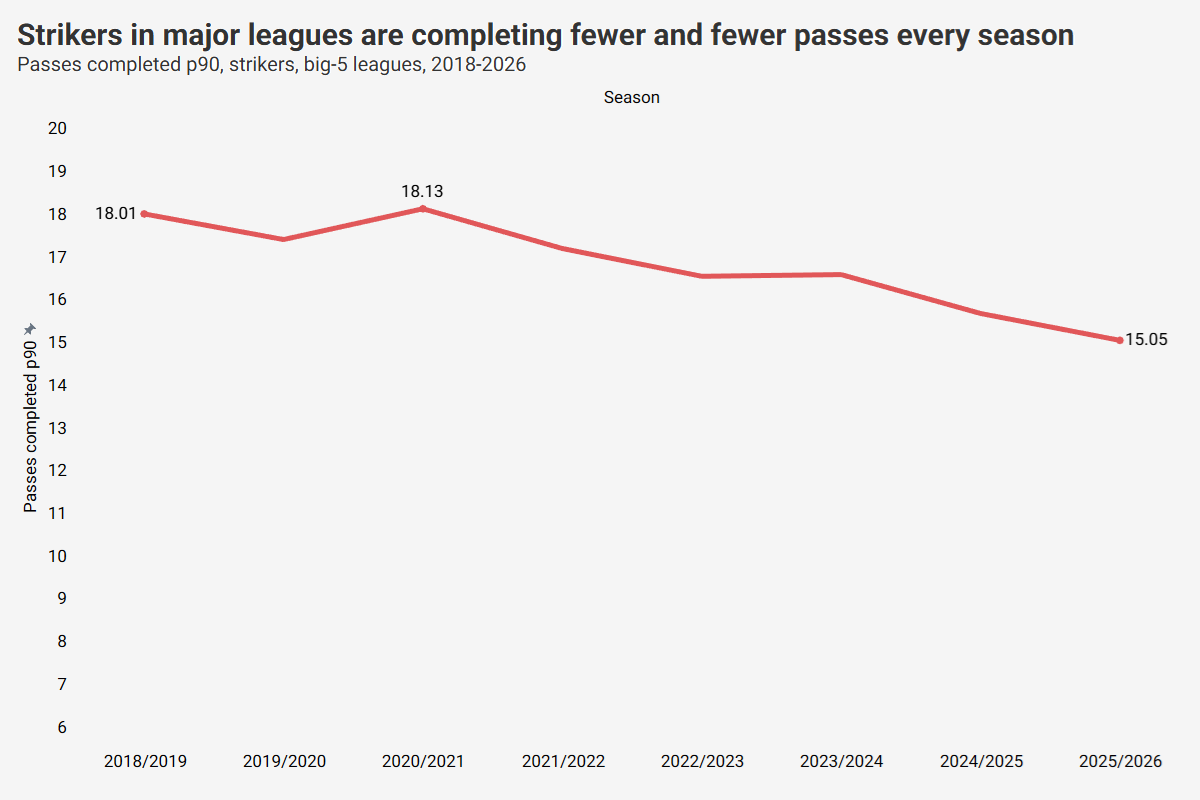
As discussed earlier, with attacks becoming more direct, the established strategy of pushing teams back and overwhelming defenses with patient play in the attacking third is falling out of fashion, which means strikers don’t need to be as involved outside the penalty area. Instead, strikers increasingly spend most of the game pinning back defenders and stretching back lines, attempting to find space within settled defensive blocks. Plus, an increased emphasis on transitions correspondingly makes outlets to hit on the break becoming more valuable, and some extra size certainly comes in handy while trying to score goals from set pieces.
However, the players who currently lead most big clubs’ front lines indicate the trend might be reversing at the upper echelons of the game. Harry Kane drops deeper than ever and conducts passing moves from midfield at Bayern, PSG won the Champions League with Ousmane Dembélé as a false 9 last season, Mikel Arteta appears to favor Kai Havertz up front over Viktor Gyokeres at Arsenal, and Barcelona currently deploy Raphinha at the No. 9 spot.
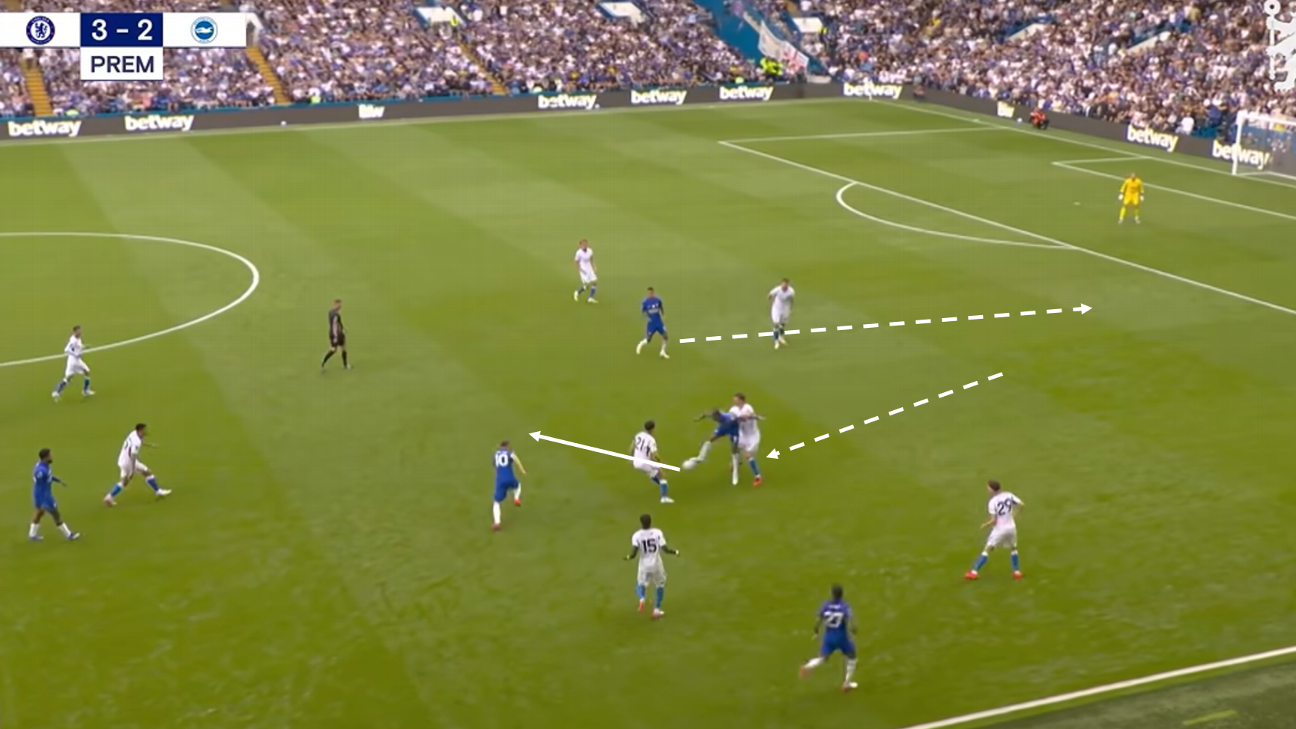
This might be because teams are finding alternate ways of manipulating player-marking strategies, picking holes in defenses with positional interchanges. By dropping deeper, a striker can bring the defender assigned to marking him along and create space for teammates. For example, in this case, João Pedro dropping deep to receive a throw-in pokes a hole for Morgan Rogers to run into, who in turn creates space for Cole Palmer‘s carry and goal.
For now, specialized, physically gifted strikers may have their time in the sun, but we’re likely to see many approaches at the center forward position as the decade progresses.
What to make of 2026 trends
Many soccer fans view today’s tactical landscape as being one of stasis or even regression. It’s tempting to view the rise of directness and set pieces, as well as do-it-all midfielders and big strikers, as the return of older approaches. But this might be a reductive view; as Mackenzie notes in his book “The Spectre of Pep,” presenting changes in the tactical landscape as purely being “cyclical” makes it “very difficult to speak of the ‘new’ in any meaningful way at all.”
All the smaller tactical shifts we’re seeing across the pitch are happening in relation to broader changes in the tactical environment of the 2020s. With the rise of man-to-man pressing approaches and the resulting revival of direct attacking, accompanied with the resurgence of ground-eating midfielders and big, physical strikers, these very same trends have brought about the rise of playmaking goalkeepers, attacking center backs, and underlapping fullbacks.
If a Premier League manager from 2006 drove a plutonium-powered DeLorean to 2026, he might find the first five minutes of play recognizable, but would be scandalized by the time he reaches the 10-minute mark. Welcome to elite soccer in the 2020s.