
The pasta that starts in the freezer
For most of last fall, kielbasa was always on sale at my local Mariano’s.
Not dramatically on sale, in the way of a holiday ham wearing a fluorescent sticker that announces some brief and glorious collapse in the market. Just quietly, persistently cheap: usually less than $2.50 for a hefty rope, week after week, as though someone in purchasing had made a tremendous kielbasa-related miscalculation and the rest of us were being invited to help clean it up.
It didn’t even live with the other sausages.
Instead, the kielbasa occupied a low, open refrigerated case near the eggs, one of those cases where you occasionally find yourself reaching a hand all the way toward the bottom, just to reassure yourself that, yes, everything still feels properly chilled. It was a strange little society of meats that belonged neither behind the butcher counter nor among the premium lunch meats — the thin-sliced turkey in its tidy package, the glossy hunk of honey ham. There were cubes of ham. There were anonymous packages of bologna. There was kielbasa, in several permutations: smoked, turkey, pork-and-beef.
I don’t exactly dream of kielbasa.
A golden roast chicken is dream-worthy. A roast chicken can be imagined burnished and fragrant, surrounded by little potatoes, perhaps with thyme involved. Kielbasa is harder to romanticize. Growing up in the Midwest, then eventually finding my way back to Chicago for what is now the third time, I had always known it mostly as sauerkraut’s companion: browned sausage, heap of cabbage, mustard somewhere nearby.
Which meant, in another sense, that it was almost blank space.
And at $2.50, blank space begins to look awfully compelling.
So I bought one.
Then, after I’d done something reasonably tasty with it, I bought another. And somewhere around kielbasa number two or three, I noticed that the same two ingredients kept turning up beside it: peppers and onions.
Peppers and onions with sausage over rice. Peppers and onions tucked with sausage into bread. Peppers and onions destined for beans, or soup, or pasta. Apparently, for the foreseeable future, these three ingredients were going to be spending a great deal of time together in my kitchen.
Want more great food writing and recipes? Sign up for Salon’s free food newsletter, The Bite.
As someone who is a commitment-phobe about nearly everything but relationships, I found this realization oddly consequential.
But what if I want the sausage another way?
This is the sort of question I am capable of posing to myself while standing in my own kitchen, knife in hand, as though I am negotiating a binding contract.
The answer, eventually, was: Then I could finish the peppers and onions and make it another way.
So I sliced the kielbasa into coins, cut up one red pepper and one medium onion, tucked the whole thing into a reusable freezer bag and flattened it out. No blanching. No cooking. No complicated prep. Just sausage, pepper, onion: one future dinner, still undecided.
Then I made another.
By winter, I had about six of these packs stacked flat in the freezer like little files, assembled for less than $20 total. They became one of those domestic systems that is so modest you almost feel silly describing it as a system at all, until you realize how often you use it.
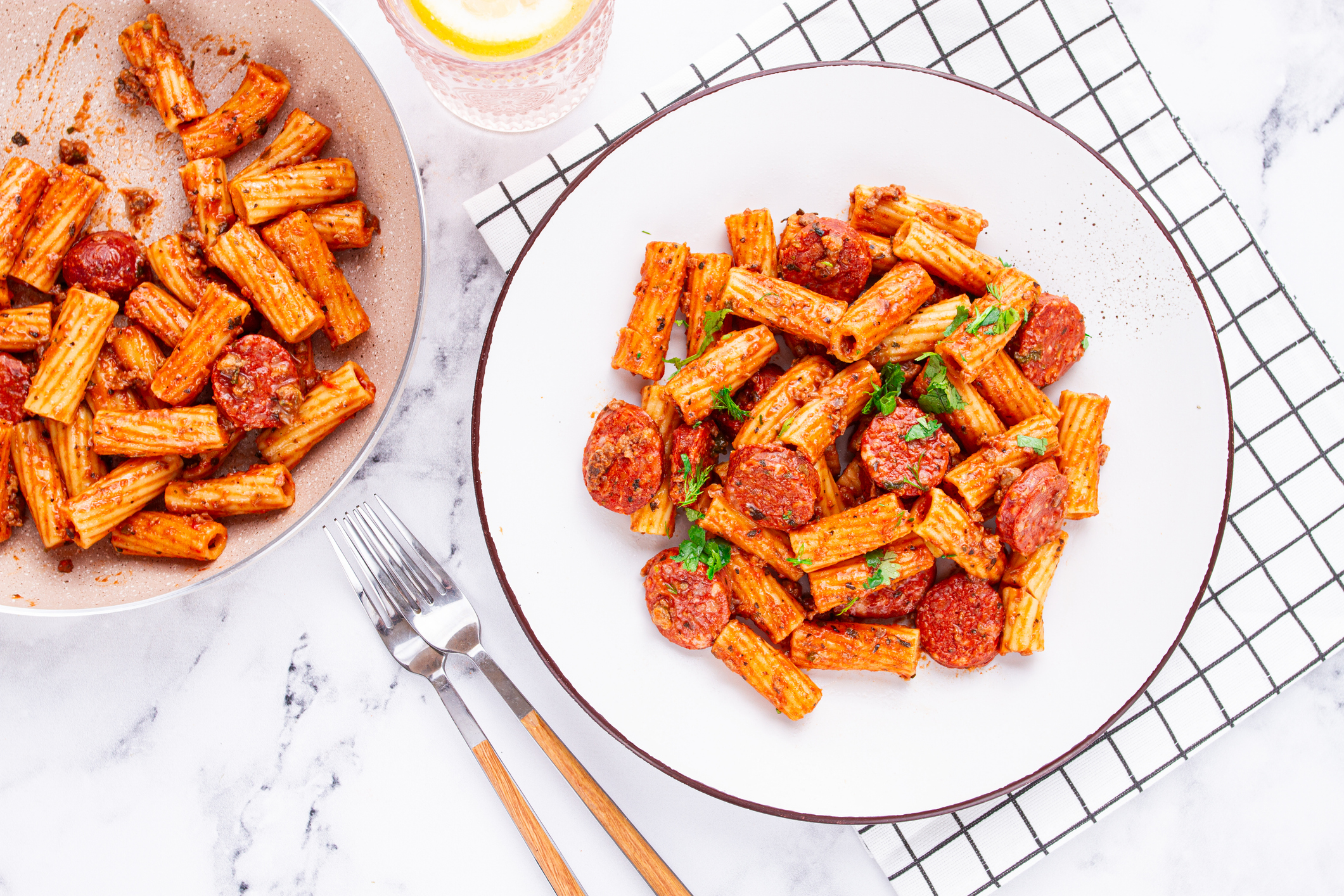
On one night, I’d empty a pack into a hot skillet, let the sausage crisp at the edges and spoon everything over spiced rice with a fried egg and a mess of fresh herbs. Another night, the same pack might go into red beans, taking dinner vaguely in the direction of Louisiana. White beans, rosemary and Parmesan sent it somewhere else entirely. Sometimes it ended up piled high on a hoagie roll. And, often enough, it became the one-pot sausage and pepper pasta I’m sharing with you this week.
What I liked about those packs was that they removed one decision, but not all of them.
This is, I have realized, the point at which most traditional meal prep loses me. Meal prep often asks us to make an absurdly confident prediction about our future appetites. On Sunday, I shall manufacture five identical lunches, and by Thursday afternoon I will apparently still be delighted to encounter a lentil-and-quinoa bowl.
Maybe you possess this kind of consistency. I do not.
Sometimes I want soup. Sometimes I want pasta. Sometimes I want an egg over rice. Sometimes a sandwich is the only reasonable dinner that has ever existed.
A finished freezer meal has already made that decision for me. A meal starter hasn’t.
That was the small revelation buried inside my stack of bargain kielbasa: perhaps I didn’t need to just prep meals. Perhaps I just needed to prep beginnings.
A useful meal starter is really just a combination of ingredients that already have some chemistry together—a little unit of future possibility. Kielbasa, peppers and onions. Chicken, scallions and ginger. Mushrooms, shallots and thyme. Corn, poblano and onion. Ingredients that can head in several directions once they meet heat, a pantry and whatever you happen to be craving that evening.
It is enough preparation to help on the nights when I still want to cook, but would appreciate an assist. It is also enough preparation to save me, occasionally, from the particular 7 p.m. brink where ordering takeout begins to feel less like a choice than an inevitability.
The pack doesn’t tell you what dinner is.
It just gets dinner halfway across the bridge.
Building your own meal starters
The easiest way to build your own meal starters is not to begin by asking what you should freeze. Instead, work backward from the meals you already make and love. Think of it as the culinary equivalent of shopping your pantry: What two, three or four ingredients keep appearing together in your cooking? What do you find yourself chopping at the same time, over and over?
For me, that has meant chicken with scallions and frozen ginger cubes; shaved corn with poblano and onion; butternut squash with thyme and shallots; grated tomato with basil and garlic. One slightly stranger favorite is ground beef mixed with minced mushrooms and a little mushroom gravy powder, which can become an excellent head start on stew, meatballs, meatloaf or cottage pie.
There are only a few real rules. The ingredients should freeze reasonably well—otherwise you won’t be particularly thrilled to meet them again—and at least one of them should eliminate a meaningful bit of weeknight prep. If I can open the freezer and discover that someone has already chopped the onions and peppers, I am immediately more interested in cooking dinner. I tend to leave dairy, delicate herbs and most cooked grains out of these packs; their texture can go a little strange or mealy in the freezer. Besides, the purpose isn’t to erase every last bit of cooking. You’re making a foundation, not sealing dinner’s fate.
Portion accordingly. I tend to start with the protein and work outward: If two chicken breasts comfortably feed your two-person household, chop and freeze two with the scallions and ginger. If your household needs eight, freeze eight. The useful unit isn’t a prescribed number of ounces or cups; it’s however much your household ordinarily reaches for when making one meal.
In fact, I think becoming a more intuitive cook often involves this kind of looking inward. We tend to assume the next clever kitchen system will come from a new cookbook, a viral freezer hack or somebody else’s meticulously labeled meal-prep containers. Sometimes the answer is already sitting in our own cooking history.
Pay attention to what you reach for together, remove one or two of the repetitive steps in advance, and leave yourself enough unfinished business that, when Wednesday rolls around, dinner can still become whatever sounds good.
Sausage and Pepper Pasta with Sun-Dried Tomato Pesto
This is exactly how I like to cook on a weeknight: a little homemade, a little store-bought and just enough actual cooking to make dinner feel like dinner. A sausage-and-pepper meal starter eliminates most of the chopping; canned tomatoes provide the sauce’s backbone; and a few spoonfuls of prepared sun-dried tomato pesto pull everything into focus. A splash of cream mixed with starchy pasta water at the end makes the sauce surprisingly velvety, without requiring you to make a cream sauce at all.
Yields
4 servings
Prep Time
10 minutes
Cook Time
30 minutes
Ingredients
-
12 ounces short pasta, such as rigatoni, penne or cavatappi
-
1 sausage-and-pepper meal starter, thawed or mostly thawed (about 14 ounces sliced kielbasa, 1 red bell pepper, sliced, and 1 medium onion, sliced)
-
1 tablespoon olive oil, plus more as needed
-
8 ounces mushrooms, sliced
-
Kosher salt
-
Freshly ground black pepper
-
½ teaspoon red pepper flakes, or to taste
-
1 teaspoon Italian seasoning
-
1 (14- to 15-ounce) can diced tomatoes
-
2 tablespoons heavy cream
-
2 packed cups baby spinach
-
3 tablespoons prepared sun-dried tomato pesto (I like Rao’s), plus more to taste
-
Grated Parmesan, for serving
Directions
- Bring a large pot of well-salted water to a boil and cook the pasta until just shy of al dente. Before draining, reserve 1 cup of the pasta cooking water. Drain the pasta and set aside. While the reserved water is still warm, stir the cream into it.
- Return the pot to medium-high heat and add the olive oil. Add the sausage-and-pepper starter and cook, stirring occasionally, until the onions and peppers have softened and the kielbasa coins are beginning to brown and crisp at the edges, 7 to 10 minutes.
- Add the mushrooms and season with salt, black pepper, red pepper flakes and Italian seasoning. Cook, stirring occasionally, until the mushrooms release their moisture and begin to take on a little color, about 5 minutes.
- Add the diced tomatoes and their juices. Taste and season again with salt and pepper as needed. Bring to a lively simmer, then reduce the heat and cook for about 15 minutes, until the tomatoes have softened and the sauce has thickened slightly.
- Add the drained pasta and spinach and toss until the spinach begins to wilt. Stir in the sun-dried tomato pesto. Add the cream-enriched pasta water a splash at a time, tossing after each addition, until the sauce becomes glossy and velvety and clings easily to the pasta. You may not need the full cup.
- Taste and adjust the seasoning. Serve immediately with grated Parmesan, or, for a slightly more finished version, shower the top with Parmesan and place the pot under the broiler for about 3 to 5 minutes, until browned in spots.
This story originally appeared in The Bite, my weekly food newsletter for Salon. If you enjoyed it and would like more essays, recipes, technique explainers and interviews sent straight to your inbox, subscribe here.
Read more
about from “The Bite”