
YEDI holiday camp equips teens with life skills, HIV knowledge, financial literacy
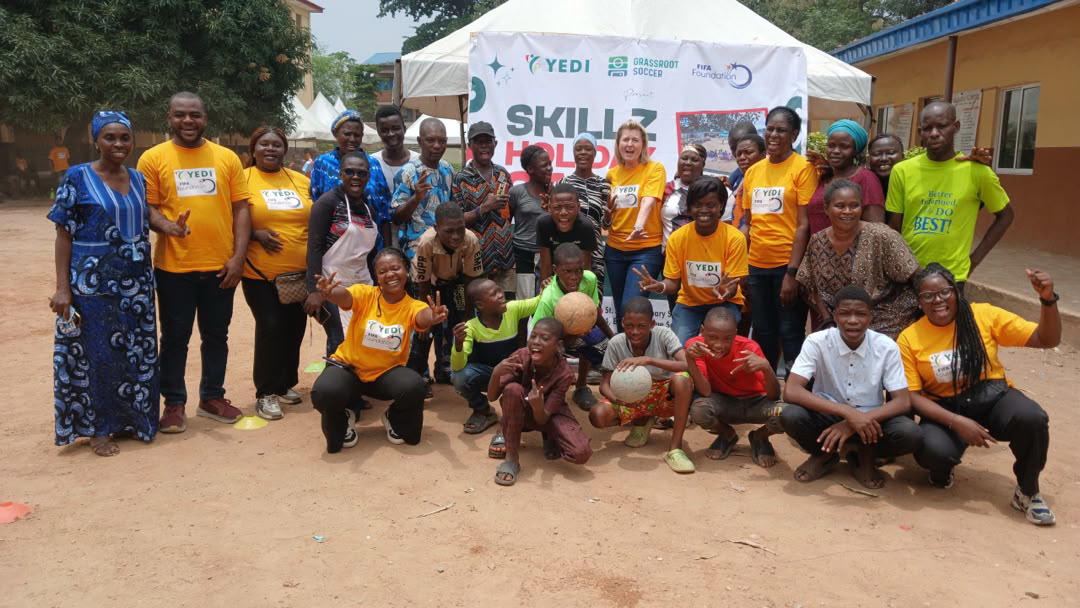
By Chioma Obinna
The Youth Development and Empowerment Initiative, YEDI, has used its holiday camp to equip teenagers with practical life skills, HIV knowledge, financial literacy and health education, as part of efforts to help young people make informed decisions and become healthier and more responsible members of society.
The weeklong YEDI SKILLZ Holiday Camp, held in Yaba, Lagos, is being implemented in collaboration with the FIFA Foundation and Grassroot Soccer, combining interactive learning, health education, sports and practical activities to engage teenagers during the school holiday.
Speaking to Vanguard, the Founder of YEDI, Charlotte Obidairo, said the programme was designed to provide young people with useful knowledge and skills while making learning enjoyable.
“We are here today for a holiday camp. That is when kids are out of school, and we are organising activities for them where they will come and learn about basic life skills and health skills,” Obidairo said.
She said the participants were learning about their bodies, communication, relationships, hygiene, mental health, physical health and financial literacy.
“They are going to learn how to communicate, how to become better friends, how to become better communicators. But also give them some life skills that they can take with them going on,” she said.
According to her, football and other fun activities were incorporated into the curriculum to make learning more interactive and memorable for the teenagers.
“Our whole curriculum for teaching the children is based on the football curriculum,” Obidairo explained.
She said the approach had helped participants retain what they were taught because they were actively involved rather than simply listening to lectures.
“I just had the opportunity now to talk with a number of the participants. Frankly, their ability to recollect facts and having internalised what they have learnt here today is quite incredible,” she said.
Obidairo added: “It is not just sitting down and learning and trying to remember a lot of facts. It is actually enacting the facts as they learn them. So that is really different.”
She disclosed that YEDI had also established a new headquarters in Yaba after 15 years of working in the community, with plans to deepen its engagement with young people through health services and a youth hub.
“Our hope is that we become part of the community and both the youth and the kids will use our health facilities here. And the youth hub that we have created, there is going to be a lot more activities for the young people,” she said.
Speaking, the Executive Director of YEDI, Mrs Adeoye Tomisin, said the organisation’s focus was to inspire young Nigerians through evidence-based health education and practical interventions.
“We are here to inspire young people in Nigeria,” Tomisin said.
She disclosed that participants were also offered HIV testing with parental consent, stressing the importance of helping adolescents understand their health status and access appropriate support where necessary.
“We are providing them full HIV testing, encouraging the young people, beyond having the information, also testing to know their status. And this we have done with their parents’ consent,” she said.
Tomisin said the programme was designed as a holistic intervention, covering sexual and reproductive health, mental health, menstrual hygiene, gender-based violence, financial literacy and technology.
“It is a holistic approach. We’ve been here since Monday. We provide them free breakfast and lunch. We also go through sessions… evidence-based curriculum,” she said.
She stressed the importance of involving parents in adolescent health education, saying young people need trusted adults with whom they can discuss challenges, peer pressure and other concerns.
“We tell them about the need for sexual education. We need for them to be friends with their young ones, so that even if they are going through any challenge or they are being pressured, they’ll be able to share with them,” Tomisin said.
According to her, YEDI had also created a youth hub where participants could continue to receive support after the camp, including counselling.
Also, the Monitoring and Evaluation Coordinator and Camp Manager, Mr. Ebenezer Chukwu, said the programme was structured to measure the knowledge gained by participants.
“We’re here to enlighten young minds around mental health, gender norms, sexual and reproductive health, and other good health practices as well, so that they will be upstanding citizens, live right, stay healthy, and be examples in their communities,” he said.
Chukwu explained that participants took pre-tests before the intervention and would undergo post-tests to determine changes in their knowledge.
“These questions are around what is going to be taught to them. At the end of the practice… we would also be issuing out a post-test to them for the same questions to see if there has been a change in knowledge.”
He added that the programme would continue beyond the camp through follow-up activities, including engagement with parents and participants.
The teenagers themselves said the camp had given them an opportunity to learn through activities they found enjoyable.
An SS1 student, Master Furua Olugbaju, said he enjoyed the interactive nature of the programme, particularly the games and football activities used to reinforce lessons.
“My experience is that there is so much interactive [learning] here, and I love the activities they do here, like the games they do to teach us about a particular topic, and the football they play,” he said.
According to him, the programme taught him how to manage anger and understand the transition from boyhood to manhood.
Oluwadarasimi, a JSS3 student of Mobalaji School, said she learnt about courage and peer pressure, while Sarah Idowu, a JSS2 student of Jibowu High School, said the programme helped her understand self-advocacy and her rights.
“I would tell them what I’ve learnt. I would tell them that it’s fun here,” Idowu said.
Some of the parents who spoke to Vanguard also welcomed the initiative.
A parent, Oluwabunmi Dagunduro, said she wanted her daughter to spend the holiday acquiring useful knowledge rather than simply playing at home.
“I want better things. At least I know she will gain some things here. A lot of things. And she has a good memory. Maybe next year, she will still want to participate,” she said.
Another parent, Mr. Omoshola Oluwatobi, said he had noticed positive changes in his daughter’s behaviour since she joined the programme.
“Since she arrived here yesterday, her behaviour is calm now. She is behaving normally. She speaks frequently. Now, everything has changed,” he said.
Other participants at the programme said the ultimate goal was to ensure that the knowledge and skills acquired during the holiday camp continued to influence the participants’ health choices, relationships and decision-making long after the programme ends.