
Jared Kushner’s Henry Kissinger cosplay should worry us all
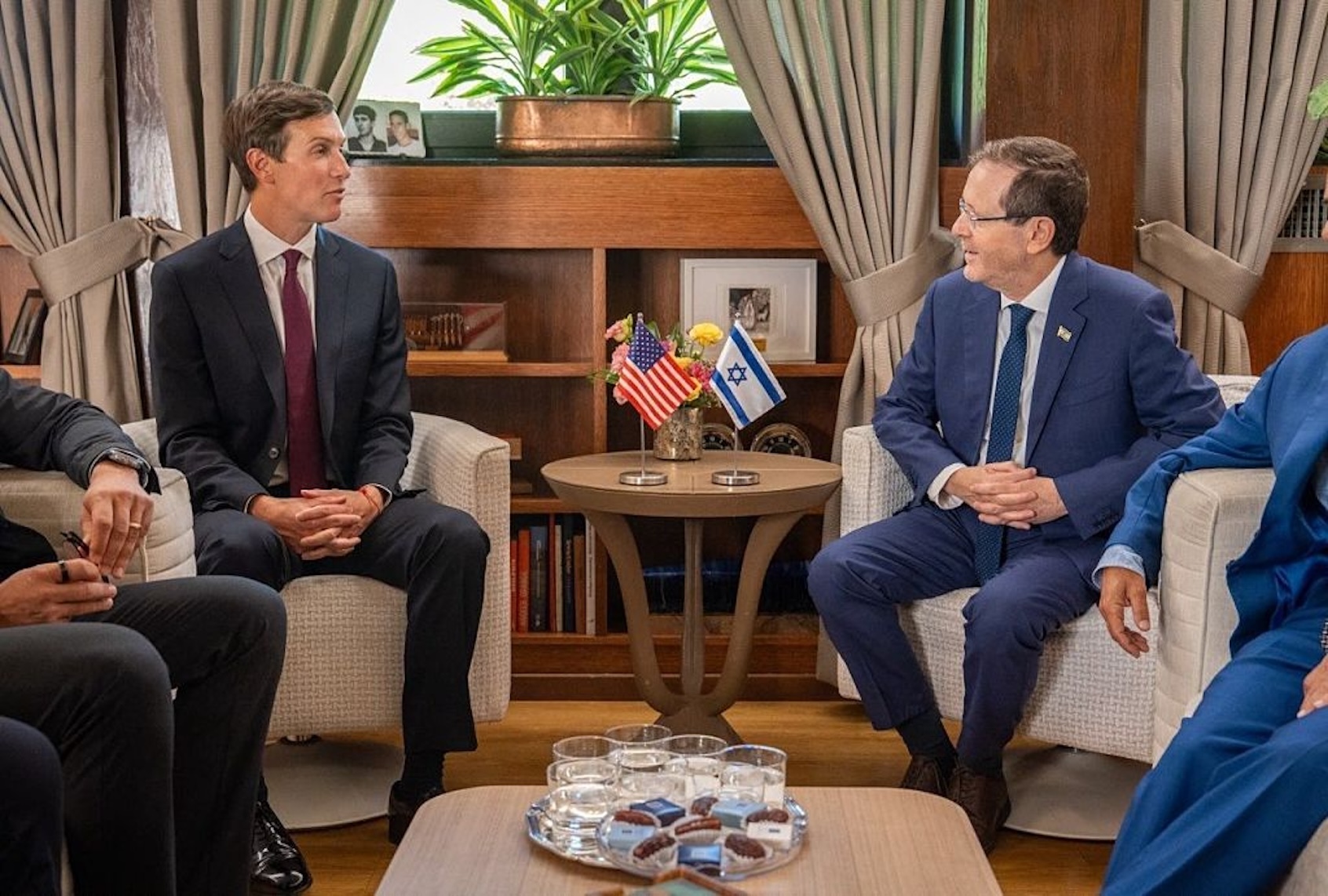
When TIME Magazine released their “100 Most Influential People” list in 2017, it stood to reason that Jared Kushner would be listed. After all, Donald Trump had brought his son-in-law into the White House and given him a broad portfolio which, as the husband of the president’s favorite daughter, made him very powerful. Kushner couldn’t be fired. But the question of whether he was up to the job was pretty well answered by the man TIME chose to write the required encomium: former Secretary of State Henry Kissinger. It’s hard to read the late secretary’s words as anything but damning with faint praise.
Kissinger opened his short two-paragraph tribute by essentially saying that the presidential transition process is difficult and that a president who doesn’t know anything must depend on his advisers to help him through it. Then he wrote:
This space has been traversed for nearly four months by Jared Kushner, whom I first met about 18 months ago, when he introduced himself after a foreign policy lecture I had given. We have sporadically exchanged views since. As part of the Trump family, Jared is familiar with the intangibles of the President. As a graduate of Harvard and NYU, he has a broad education; as a businessman, a knowledge of administration. All this should help him make a success of his daunting role flying close to the sun.
That was it. In Kissinger’s accounting, Kushner’s only qualifications were that he went to college, was a businessman and knew the president. And we all know what happened to the guy who flew too close to the sun.
As it happened, Kissinger had actually been quite involved with the Trump transition and knew exactly how ill-prepared they were. Shortly after the 2016 election, the 93-year-old had met with Trump, Kushner and retired Lt. Gen. Michael Flynn at Trump Tower and traveled at their behest to China to meet with Premier Xi Jinping and set up an early bilateral meeting between the two leaders. (Trump, ever the bull in a China shop, immediately fumbled the agreement by taking a call from Taiwan’s president. Apparently, no one in the president-elect’s circle knew about the One China policy, or that no president had spoken with a Taiwanese leader since 1979.)
Kissinger helped set up a so-called “Kushner channel” to certain powerful Chinese leaders — even as the young staffer was privately pursuing private Chinese business deals on the side. But by the time the secretary was asked to write that plaudit for TIME, it was pretty clear that he didn’t have much use for the new administration.
Trump’s son-in-law appears to see himself as the Kissinger of this era, consciously modeling himself on the notorious diplomat, perhaps not realizing that the secretary’s foreign policy achievements were tempered by his reputation as a ruthless, immoral purveyor of realpolitik who left millions of dead bodies in his wake.
That apparently didn’t matter to Kushner. Trump’s son-in-law appears to see himself as the Kissinger of this era, consciously modeling himself on the notorious diplomat, perhaps not realizing that the secretary’s foreign policy achievements were tempered by his reputation as a ruthless, immoral purveyor of realpolitik who left millions of dead bodies in his wake. Then again, it’s also possible Kushner knows that very well and is fine with the comparison.
While Kushner’s approach to world affairs is remarkably similar to Kissinger’s, the older man’s worldview was shaped by his ideology and academic understanding of world power dynamics. Kushner’s, on the other hand, is primarily influenced by his alleged business savvy; like his father-in-law, he sees everything through the lens of a win-win real estate deal.
Kushner’s portfolio during the first Trump administration was wide-ranging. But his heart was in international relations, particularly the Middle East, where he had an intense interest in resolving the ongoing Israeli-Palestinian conflict. By the end, he managed to orchestrate the Abraham Accords, an agreement normalizing diplomatic relations between the United Arab Emirates, Bahrain, Morocco and Israel. The accords were controversial, with some calling it a useful first step, while others viewing it as a sop to commercial interests that ignored the Palestinians altogether.
Although Kushner chose not to officially rejoin his father-in-law’s second administration, he is serving, along with Trump’s real estate buddy Steve Witkoff, as its special diplomatic envoy. So far, the duplicitous duo have tried and failed to achieve a ceasefire in Ukraine and failed to stop the war with Iran. The Gaza Peace Plan that had everyone strutting around declaring victory just a few months ago is stuck.
Start your day with essential news from Salon.
Sign up for our free morning newsletter, Crash Course.
The exchange of prisoners took place as required by the agreement, and some aid has been allowed to flow, but the violence has continued. The current impasse hinges on Hamas disarming and Israel withdrawing, and neither side will make the first move. There appeared to be some movement a couple of weeks ago when Trump announced that his so-called Board of Peace had secured an agreement from Hamas to disarm and Israel to suspend all military strikes. Israeli Prime Minister Netanyahu’s immediate rejection of the idea brought Kushner back into the mix to see if he could resurrect a little of that old Kissinger magic.
After Israel’s surprise attack on Syria and Egypt in October 1973, Kissinger spent nearly two years on “shuttle diplomacy,” flying back and forth between Cairo, Damascus and Jerusalem in search of a lasting peace deal. If managing a fragile ceasefire counts as a win, he was successful. But it took Jimmy Carter to broker the Camp David Accords six years later, which brought a lasting peace between Egypt and Israel.
Over the past few days, in an attempt to salvage the obviously empty Board of Peace agreement, Kushner traveled to Egypt, along with his fellow board member and former U.K. Prime Minister Tony Blair, to meet with leaders of Hamas. The trip raised the ire of Israel’s supporters in the U.S., including former ambassador Eliot Abrams, who accused Kushner of legitimizing a terrorist organization. The leader of Hamas said they will not disarm unless Israel withdraws from Gaza, so Kushner shuttled to Jerusalem to meet with Netanyahu, who basically told him to pound sand; Israel will not withdraw until Hamas disarms. They decided to establish some working groups to talk further, and the next day Israel struck a seaside cafe in Gaza City, killing seven people.
Kushner gave the game away in an interview with Fox News, putting the full onus on Hamas to end the impasse. “If they don’t follow through now on their commitment,” he said, “everyone will see that they’re not genuine about peace, and then Israel will have a lot more support from the U.S. and others to go and finish the job.”
Trump’s special envoy for peace didn’t explain what he meant by “finish the job,” but considering what Israel has already done, it’s pretty clearly a terrifying threat. Even Henry Kissinger was more subtle than that.
Read more
about Trump’s foreign policy