
Nigeria needs better security leadership, intelligence fusion to tackle insecurity — Ex-US Army Officer
By Chimaobi Nwaiwu
NNEWI — A retired United States Army officer and military strategist, Col. Chukwuemeka Olumkwo, has identified disciplined security leadership, intelligence fusion, credible justice system, economic protection and community trust as key measures required to tackle Nigeria’s worsening insecurity.
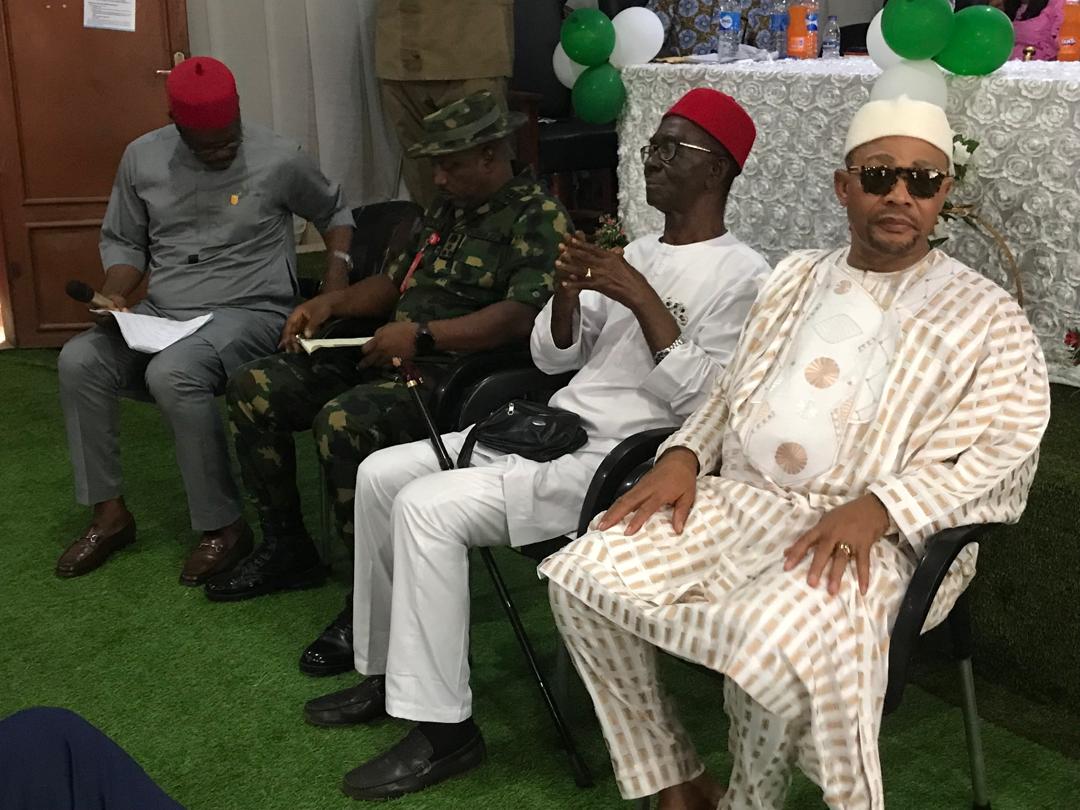
Olumkwo, an Iraq War veteran, made the submission while delivering the keynote address at the 6th Sam Momah Annual Lecture Series (SMALS6) and commissioning of the fifth library built by the Sam Momah Foundation in Nnewi, Anambra State.
Speaking on what he described as a “criminological analysis” rather than a military briefing, the former US Army officer said Nigeria’s security challenges could not be solved through military force alone.
He argued that insecurity was driven by a combination of political, social, economic and institutional failures, stressing that a comprehensive approach was required to defeat terrorism, banditry, kidnapping and other criminal activities.
“Nigerian insecurity challenge cannot be solved by military forces alone. Nigeria requires disciplined security leadership, intelligence fusion, justice sector credibility, economic protection and community legitimacy,” he said.
Olumkwo, who served as a liaison training officer with the Multinational Forces in Iraq, said his experiences from four deployments each in Iraq and Afghanistan showed that criminal networks thrive where poverty, unemployment, weak institutions and poor governance exist.
He alleged that the kidnapping economy in Nigeria had become a major source of revenue for some criminal elements, describing the situation as a shameful development.
“The urgent subject, living subject, the consequential subject is Nigeria. The subject is banditry consuming our communities, the jihadist insurgency that has infiltrated our communities, cult and religious violence in our universities and communities, and the kidnapping economy that is now generating more income for some people than the petroleum industry,” he said.
The retired colonel said the military contributes only a fraction to resolving insecurity, arguing that political leadership, policing and intelligence play more significant roles.
He estimated that military influence accounts for about seven per cent in addressing insecurity, while political action accounts for 43 per cent and policing and intelligence 40 per cent.
Olumkwo urged political leaders to invest more in empowering youths and communities, saying such measures would encourage public cooperation with security agencies.
“If politicians use their funds to empower the youths and communities, the government will get cooperation in the fight against insecurity and the system will change,” he said.
He noted that Nigeria’s insecurity crisis had resulted in thousands of deaths, millions of internally displaced persons and significant economic losses, warning that weak prosecution of criminal cases was also contributing to the persistence of the problem.
The GOC 82 Division of the Nigerian Army, Enugu, Major General Oluremi Fadairo, who was represented by Brigadier General Solomon Julius, called for stronger cooperation among government, citizens and security agencies in the fight against insecurity.
He commended the Sam Momah Foundation for promoting education through the establishment of libraries across the country, describing education as a critical component of national security.
“Leaders are readers and education is security for the state to succeed,” he said.
Also speaking, pioneer Director-General of the National Orientation Agency (NOA), Prof. Elochukwu Amucheazi, blamed political leadership for worsening insecurity in the country.
Amucheazi alleged that some politicians were detached from the security challenges confronting ordinary Nigerians because of the protection they enjoy.
“It is unfortunate that the people at the upper class, particularly the politicians, do not care about insecurity in the country because somehow they are protected,” he said.
He called for a change in the attitude of political leaders, describing some of their actions as unacceptable.
“Nigerian politicians should get new orientation; their behaviour these days are irritating,” he added.