
Trump’s great private school handout
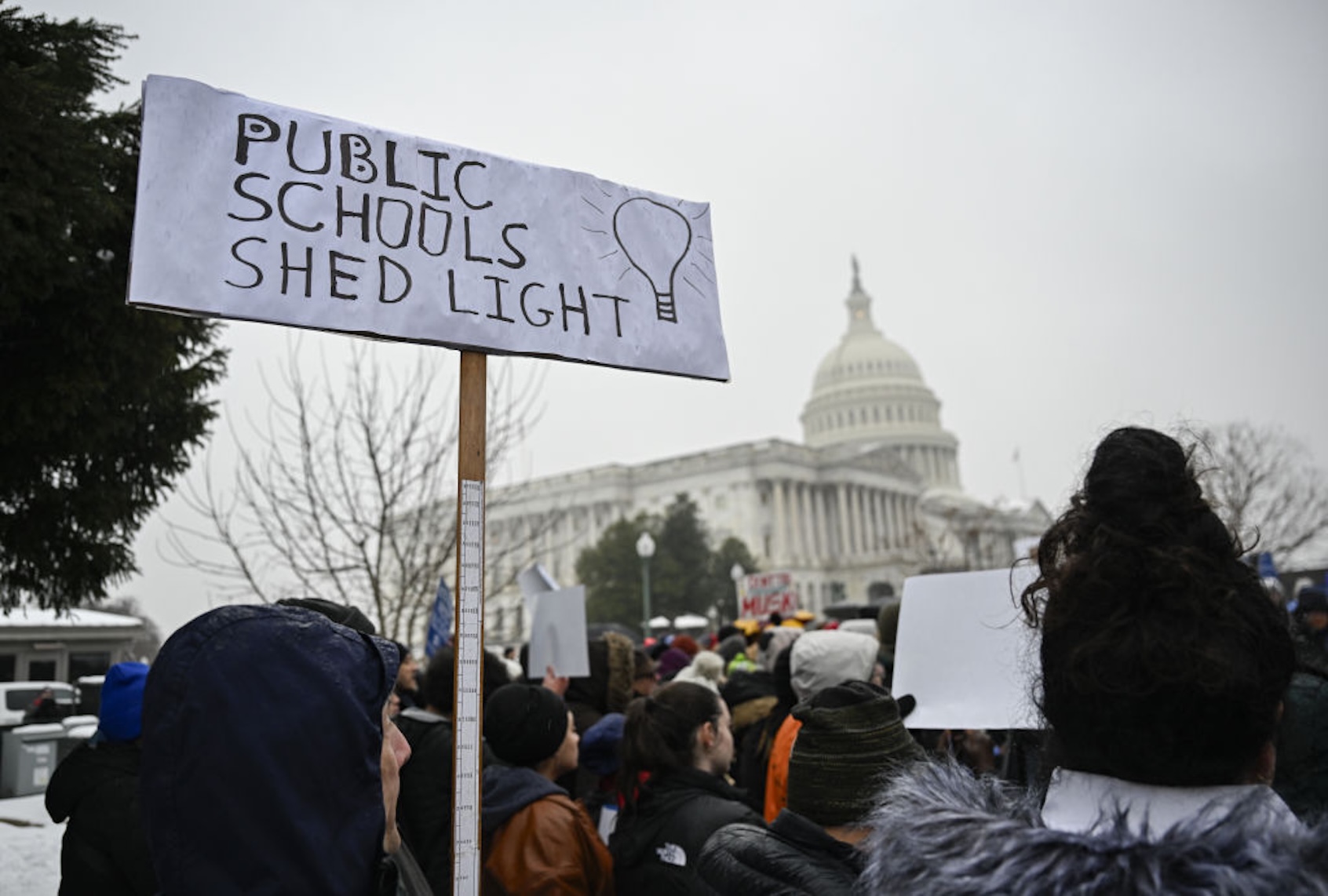
The new federal Education Freedom Tax Credit will soon allow parents, including parents earning $500,000 a year or more, to send their children to private schools at public expense. In fact, many of them already send their children to private schools, and they will now be reimbursed by federal tax dollars.
According to the Department of Education, students “from a household with income not greater than 300% of the area’s median gross income qualify.” The EFTC, part of the One Big Beautiful Bill Act passed in 2025, defines “area” as any county, including those with median incomes upwards of $200,000. This encompasses an estimated 18 million school-aged children. EFTC funds will come from donations repaid in full by federal tax credits — money that would have been paid to the federal government in taxes but will now be diverted.
What will this taxpayer money be buying? In North Carolina, which has had a program broadly similar to the EFTC since 2014, 74% of the 143,998 private school students receiving state-funded scholarships had already been attending private schools. A Rand Corporation study of a similar Arizona program found that, just like North Carolina, nearly 75% of the 64,000 students who were awarded money had already been enrolled in private school, or were already being home-schooled, before participating in the program. According to the Brookings Institution, under Arizona’s Empowerment Scholarship Account program, “more advantaged communities are securing a highly disproportionate share of the funds” while “families in the poorest communities are the least likely” to get them.
Over the past five years, the number of states implementing some form of voucher or ESA program has swelled. A 2025 Brookings Institution analysis of six of them found that the problematic enrollment patterns prevalent in North Carolina and Arizona hold true for state programs in general.
Supporters see the EFTC as a remedy for what they often refer to as “failing public schools.” Conservative syndicated columnist Star Parker recently asserted that teachers unions have a “vice grip” on public schools and parents need the opportunity to get their children out of them. As evidence of America’s failures, she pointed to the Organization for Economic Cooperation and Development’s Programme for International Student Assessment, an examination in reading, science and math given annually to 15-year-olds in 80 countries. “The US, she wrote, “ranks 18th behind Poland, Czechia, and Denmark.”
The statistics Parker cites put U.S. students in the top quantile. In 2022, out of 37 OECD countries, American students ranked sixth in reading, 13th in science and 28th in math.
Start your day with essential news from Salon.
Sign up for our free morning newsletter, Crash Course.
While America’s education system has problems, these scores are hardly indicative of “failing public schools.” This is particularly true since, unlike most of the countries ranked by the OECD, the student body in major American school districts is overwhelmingly low-income and heavily immigrant. Moreover, our students have to contend with high levels of crime and violence in their neighborhoods; the U.S. has the seventh highest murder rate among the OECD countries. All of these problems inevitably drag down students’ test scores.
Proponents of the EFTC assure concerned lawmakers and parents the move won’t harm public schools. Yet schools have many fixed costs, such as maintaining, repairing, heating and cooling school buildings, operating cafeterias and managing many administrative functions that cannot easily be scaled down when enrollment declines inevitably reduce funding.
In 2018, one detailed study of the Los Angeles Unified School District found that 55% of its costs were fixed. While that figure is higher than most, school districts’ fixed costs have been found to be a third of overall district costs at minimum, and generally higher. Moreover, when students leave public schools for private academies, the students left behind are disproportionately special needs students who cost more to educate.
The EFTC’s supporters are correct that schools’ variable expenses — which is primarily the cost of educators and administrators — can be adjusted downward. But they often make this process sound simple and painless. At the Los Angeles Unified School District high school where I teach, this exact type of “adjustment” is happening for the 2026-2027 school year because of declining enrollment. The students’ process of losing teachers they had bonded with, come to trust and looked forward to having again is anything but painless. There were a lot of tears at my school on June 10, the last day of school, not just from students but from many teachers as well.
With messianic zeal, conservatives have long sold school choice programs as a way to liberate low-income and minority children from “failing” public schools. But state school choice programs have turned out just as teachers unions and other critics predicted — as little more than a way to subsidize well-off families whose kids are already in private schools, or who seek to place them there.
For opponents of public education and teachers unions, these programs come with the added benefit of undermining public schools. The EFTC threatens to expand and accelerate this destructive process.
Read more
about this topic