
The golden ambition of “Legally Blonde” can’t be tarnished
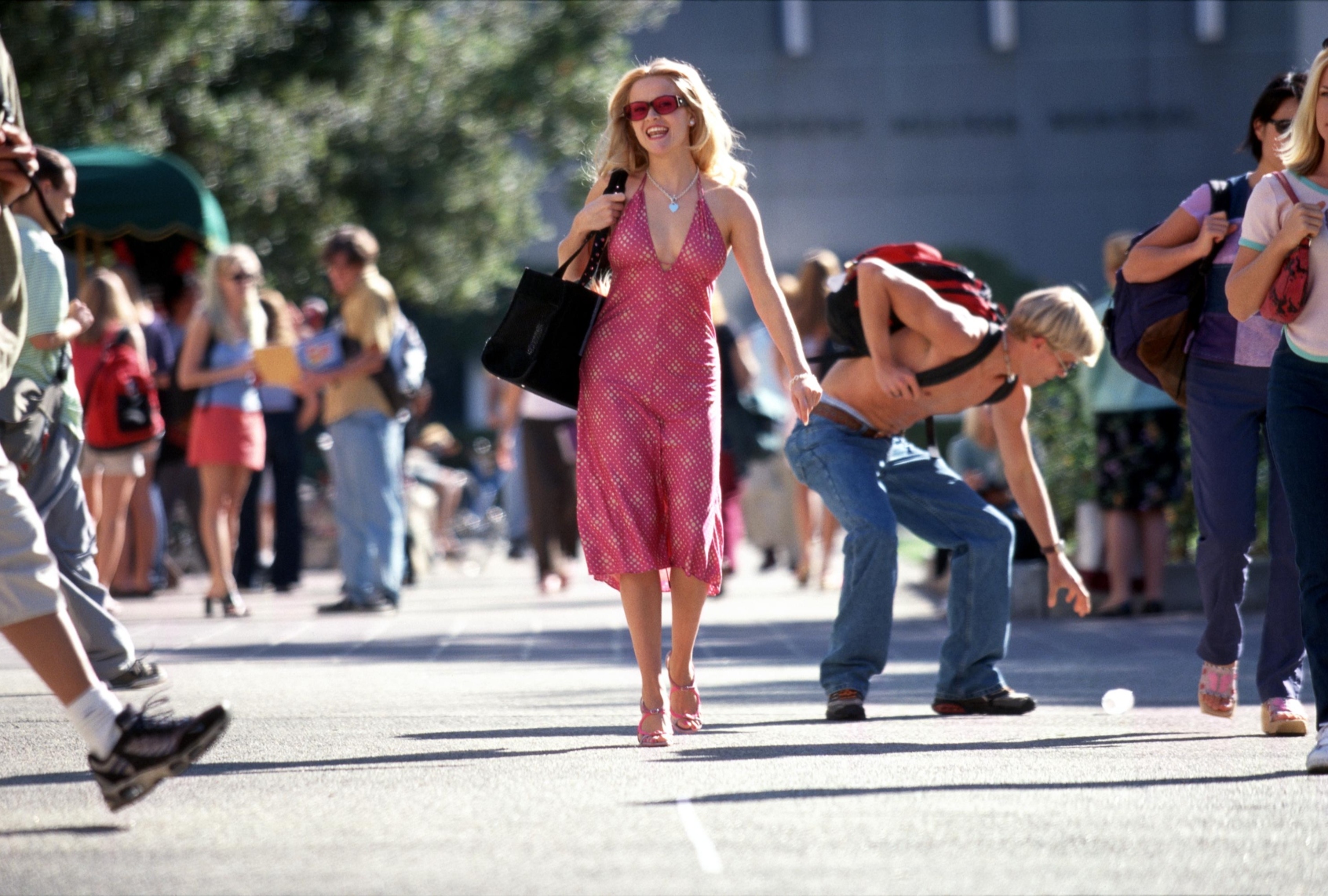
When “Legally Blonde” first came out, I was ready to write off Elle Woods for similar reasons many first- and second-wave feminists dismissed Marilyn Monroe. Gloria Steinem spoke at length about her early presumptions about Monroe in a 2006 interview, admitting that one of the few films in her life that made her walk out of the theater was “Gentlemen Prefer Blondes.”
“I was embarrassed by her because she was a joke,” Steinem told Gail Levin, who directed a documentary about the screen icon for “American Masters.” “She was vulnerable. She was so eager for approval. She was all the things that I feared most, being a teenage girl.” Only much later in life did Steinem, who wrote a biography about Monroe, realize her initial disdain wasn’t the actress’ fault. Monroe was simply playing the part assigned to her by a patriarchal society, capitalizing on a male-approved artificial creation that made her a star.
Elle Woods, as Reese Witherspoon originated her, posed a similar psychological obstacle for me, only the challenge was getting me into the theater as opposed to keeping me there. She’s everything I wasn’t and never would be: aggressively pink, fluffy and wrapped in an impenetrable privilege that appeared to reward her ditziness. But I reluctantly gritted my teeth and joined whichever friends selected “Legally Blonde” as that week’s movie pairing with dinner – and against all expectations, emerged from the darkness a full-throated fan of its stealthy genius.
“Legally Blonde” sets up Elle to be underestimated by everybody, including the audience.
Twenty-five years after “Legally Blonde” introduced Elle Woods to the world, she’s raised several generations of women and redeemed a terrible stereotype long cemented into American popular culture. Several, actually. Years before “Barbie” stormed movie houses, Elle was the subversive answer to whether a woman’s love of makeup, pastel colors, skirts and heels negated her feminism. Where Monroe was a golden goddess whose beauty camouflaged pain and shadow, Elle is a creature of hidden depths illuminated by an inner sunshine, all of which is clearly visible to any who bothers to take a closer look.
We first meet her in her inner sanctum, her extremely girly bedroom in the depths of her extremely girly sorority, Delta Nu.
She’s nearly at the end of her college days and assumes she’s sailing into the post-graduate world as the fiancée of her boyfriend, Warner Huntington III (Matthew Davis), the smug Ken doll to her bright-eyed Barbie. At the dinner where she thinks he’s going to pop the question, Warner blindsides her instead when he announces he wants to break up. He’s on his way to Harvard Law School, he explains, the first step in his plan to enter politics. And if he’s going to be a senator, he says, he needs to lock down a Jackie O. – not a Marilyn.
People cite a lot of moments from “Legally Blonde,” but that line quietly tips its hand about Elle’s superpower. Monroe’s personal legacy is like a charm bracelet hung with more unsubstantiated rumors than genuine facts, but one undeniable trait was her thirst to defy the world’s expectations. She never finished high school, but compensated for her incomplete education by devouring books and absorbing ideas. To break out of the “dumb blonde” mold into which the Hollywood studio system pressed her, Monroe employed Paula Strasberg to be her acting coach and taught herself to sing by listening to the jazz greats of her era. A recent Prospect article marking what would have been her 100th birthday, which was June 1, describes Monroe as “an autodidact who made it.” That also sums up Elle Woods.
Then again, not even Elle thought of herself that way while she was still reeling from the news that she would not be graduating with her MRS., as her Bel Air parents intended (and, many years later, right-wing podcasters are advising young women to do). Instead, she does a hard pivot and decides that if Warner is looking for wife material at Harvard Law, she is just going to have to get into that Ivy League leadership factory and win him back.
“Legally Blonde” sets up Elle to be underestimated by everybody, including the audience, although the movie drops small hints from the very start that perhaps everyone misjudges her at their peril. It’s a small moment in a designer dress boutique, where a clerk assumes she’s another Bel Air brat with daddy’s credit card who can be hoodwinked, only to have Elle sweetly explain why she can tell that the dress the clerk is trying to pawn off as new and exclusive is cheap and from last season. “So if you’re trying to sell it to me for full price,” she says nicely, “you’ve picked the wrong girl.”
Elle knows this because she studies fashion magazines with the same riveted attention she devotes to preparing for the LSATs, so she can score the 179 she needs to qualify for admission consideration. What puts her over the top is a video essay that shows her floating in her pool while wearing a sparkly bikini and striding down the street while claiming she uses legal jargon in everyday life. To wit, a man catcalls her as she walks past and she yells, “I object!”
The gobsmacked roomful of old professors who see this decide to let her in for the sake of adding diversity.
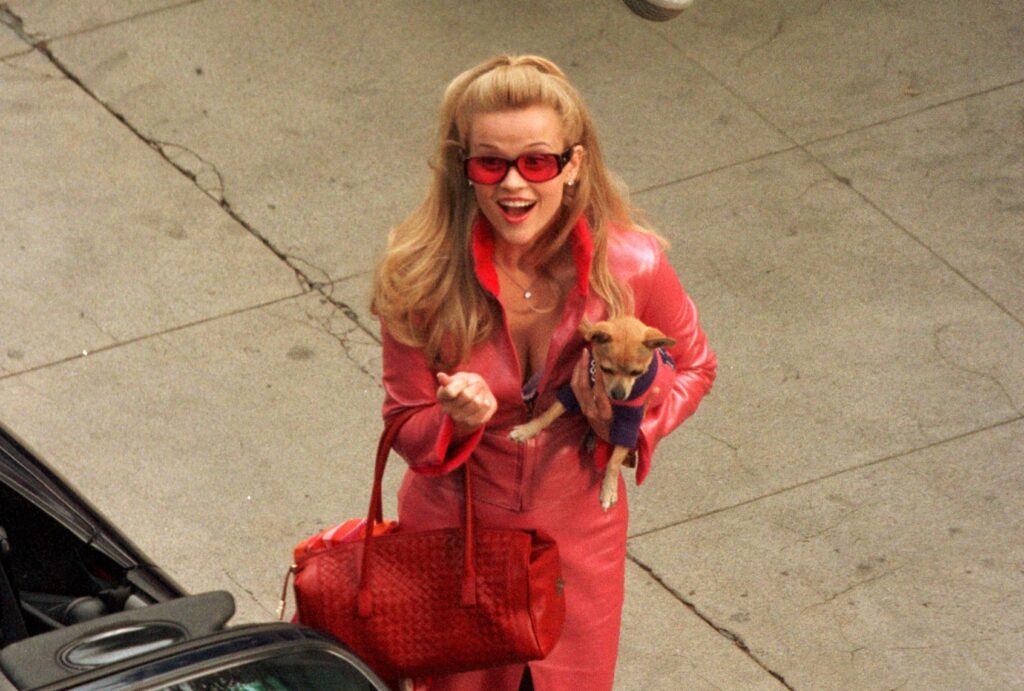
(Eric Ford/Online USA via Getty) Reese Witherspoon in “Legally Blonde.”
“Legally Blonde” is ridiculous and certainly imperfect, to put it mildly, when viewed from an inclusivity perspective. The diversity line is a solid joke, even now, but the movie’s blinding whiteness was tough to ignore even a quarter of a century ago, when homogenous casting in major studio comedies was the norm.
But the story still holds up all these years later because Elle Woods never tried to be anything other than herself. OK, the fact that Jennifer Coolidge steals the show also helps, as does the stunning cuteness of Buster the teacup chihuahua, along with the evergreen pizazz of the bend-and-snap sequence.
All these are adorable accessories to the character’s brave insistence on betting on herself in a world of naysayers set on diminishing her brightness. Elle Woods is a lighthouse in the murk of sexist cultural opinion and legislation bent on driving women out of positions of power and influence, and trying to condition young women to equate femininity and desirability with submission and dependence on a man.
Elle may be a rich girl from Bel Air, but she’s also kind and compassionate, even toward the women who men like Warner and her lecherous professor, Aaron Callahan (Victor Garber), try to pit against her. She’s privileged but never above helping someone like Coolidge’s Paulette to reclaim her self-respect – and her beloved bulldog – from the abusive, diminishing ex who kicked her out of the trailer they once shared.
The story still holds up all these years later because Elle Woods never tried to be anything other than herself.
When Elle wants something, she figures out a way to get it and comes by her success honestly and with nobility. And when, in a particularly demeaning moment at a law school mixer, Warner tries to tell her she isn’t smart enough to win an exclusive internship position, she puts him in her place not just with words, but with action. “Wait, am I on glue, or did we not get into the same law school?” she asks, quickly figuring out from there that the real competition she’s in isn’t a game to win his or any man’s approval but a contest to see just how much she can succeed, for the sake of her own satisfaction.
Once Elle has succeeded at everything, including winning an acquittal for a sorority sister accused of murder, Warner reappears and hands her the declaration of love she originally wanted when she followed him to Harvard. “Oh, Warner! I’ve waited so long to hear you say that!” she coos happily. “But if I’m going to be a partner in a law firm by the time I’m 30, I need a boyfriend who’s not such a complete bonehead.” She’s not giving up her bridal dreams, but she’s absolutely done being played for a fool.
Amazon’s recently debuted “Elle” prequel series seeks to capture the essence of what made “Legally Blonde” superb, but unfortunately stumbles into a puddle of high school tropes that dilute the radiant joy Lexi Minetree tries to recreate as the younger Elle.
Want more from culture than just the latest trend? The Swell highlights art made to last.
Sign up here
Maybe the setup itself is the problem: It relocates the Woods family, out of necessity, from sunny Southern California to a sunny Southern Californian’s nightmare concept of Seattle in the 1990s – a place where it always rains and everyone wears black and exudes disdain. Chronologically speaking, this is the first time in Elle’s life that her rosy outlook and zealous reverence for Cosmopolitan are powerless to melt the Seattle freeze. That is a real social phenomenon, by the way, but nowhere as farcical as it’s depicted here.
More disappointing is watching a role held aloft by Witherspoon’s charisma and unsinkable pep be submerged in attitudinal gloom despite Minetree’s best efforts.
But the road to the Elle Woods who graduates at the top of her law school class, storms Capitol Hill and inspires a Broadway musical has to start somewhere. And perhaps we’re even meant to be guided by the character’s philosophical compass, the one that comforts her onlookers to demonstrate what it looks like to never lose faith in people while always having faith in yourself — and trusting others will come around to believing in you, too.
Read more
about this topic