
Texas GOP civil war gives Democrats an opening
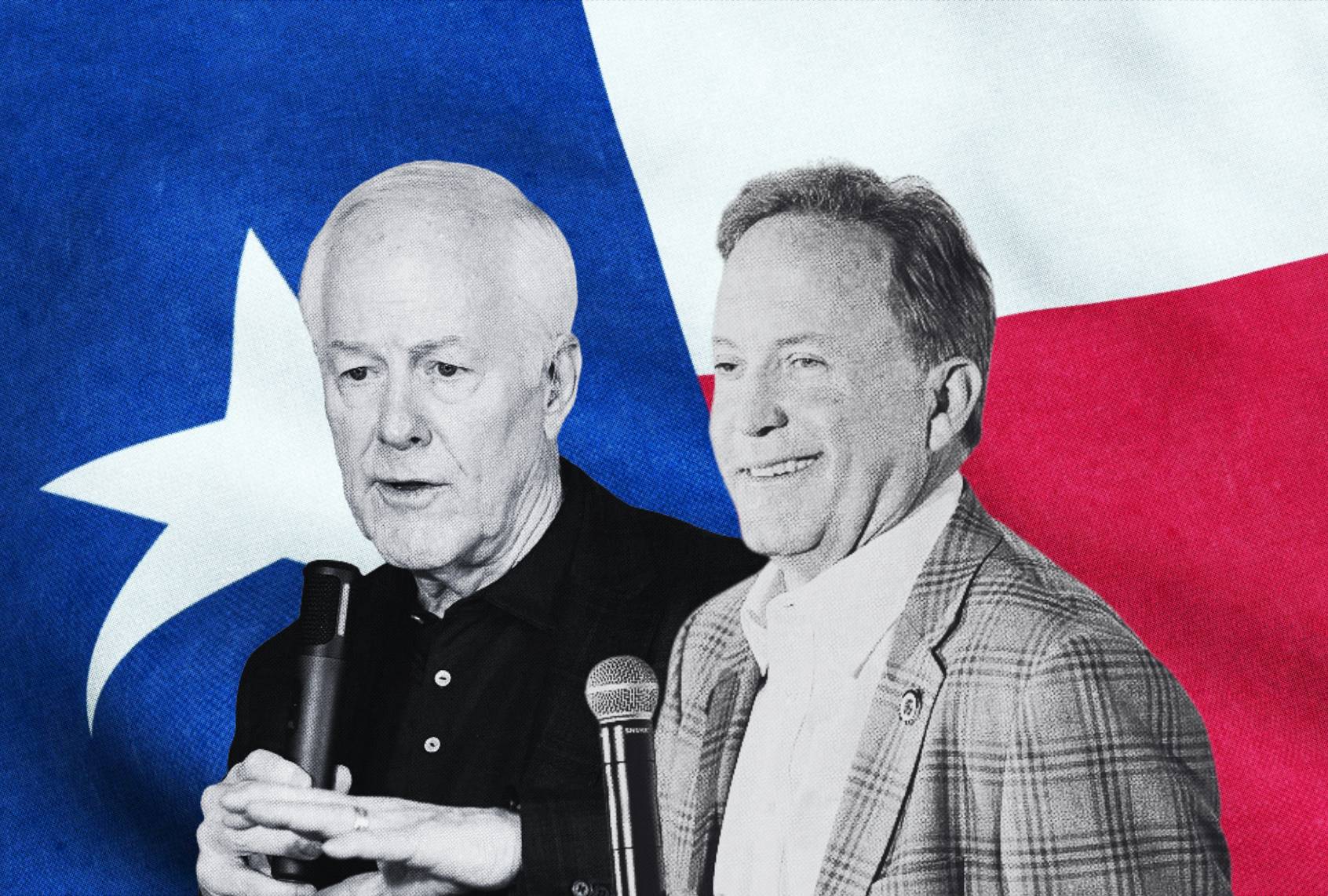
The Republican Senate primary runoff in Texas isn’t looking as high-stakes as it did at the start of the race two months ago, with the bruising primary leaving both Texas Republicans, Sen. John Cornyn and former Attorney General Ken Paxton in a worse position than where they started. They’re also evenly matched against the Democratic nominee, state Senator James Talarico.
Ahead of the initial March 3 primary, when Paxton and Cornyn first faced off and Talarico defeated Rep. Jasmine Crockett, D-Texas, there was significant debate over which potential matchup gave Democrats their best chance to flip the Senate seat, which will be crucial to Democrats’ plans to retake control of the Senate come November.
Now, however, it seems like whoever prevails in the GOP runoff will have their work cut out for them.
New polling indicated that Paxton and Cornyn perform statistically identically when facing off against Talarico. A recent Barbara Jordan Public Policy Research and Survey Center and Texas Southern University poll found that in a matchup against Talarico, Cornyn would lead him 45% to 44%, and Paxton would be tied, with both at 45%. Both results are well within the poll’s plus or minus 2.8% margin of error.
Polling from the Hobby School of Public Affairs at the University of Houston also found that Republican primary voters see both candidates as equally strong for the general election context. When asked which candidate they believed was a stronger candidate for the general election, 43% said Paxton and 43% said Cornyn, with another 14% saying neither one was stronger than the other.
This is a subtle but notable shift from earlier in the cycle, when it seemed like a Talarico versus Paxton matchup would be the Democrats’ best chance. A January Emerson College poll, for example, found that Cornyn led Talarico by 3 points, 47% to 44%, whereas Paxton and Talarico were tied at 46% support.
Chuck Rocha, a Democratic strategist working on Talarico’s campaign, told Salon that he thinks this shift is the result of at least two trends. The first is that the national environment for Republicans has become far less favorable, even since the initial primary, and certainly since the beginning of the year.
This trend is demonstrated by the change in the generic ballot. At the beginning of March, Democrats led in the generic ballot by about 5 points, according to DecisionDeskHQ’s polling average. Now, that lead is 7 points, and growing.
The second factor, according to Rocha, is that this GOP primary has been damaging to both candidates.
“They both have exposed each other’s Achilles heel. In my world, even when I go and talk to my Republican counterparts, the old adage is, ‘Steel sharpens steel,’ which means the best of the best makes the best better,” Rocha said. “But in this case, they used the best research against each other — research that Democrats would have used — to beat the teetotal shit out of each other, and that is not good when you run tens of millions of dollars of advertising. There’s nobody in the state who doesn’t know the rampant faults of both of these candidates, because the other Republican has told all of us.”
For context, the Texas GOP Senate primary has become the most expensive Senate primary in U.S. history, with more than $122 million spent just ahead of the initial primary, with $95 million of that spending being on the GOP side, according to AdImpact, an ad spending tracking firm. Another $21 million has been spent on the GOP runoff.
The ads have gotten personal, not to mention overwhelmingly negative, with anti-Paxton ads painting him as an incompetent and corrupt adulterer and anti-Cornyn ads painting him as a failed and a Republican in name only or “RINO,”. The upshot of all of this for Democrats is that Republicans have deployed significant resources in tearing down both of their potential nominees, making easy work for the other party.
Joshua Blank, the research director of the Texas Politics Project at the University of Texas at Austin, told Salon the intraparty attacks probably carry more weight with more voters than the same attacks would coming from Democrats. He also pointed out that at this juncture, there is an asymmetry in terms of how unified the party-aligned voters are.
“Democratic support is much more unified behind Talarico at this point in time than Republican support is unified behind either of those candidates, which is translated into the trial ballots showing Talarico in some cases in the lead,” Blank said. “That’s largely because Democrats know who their candidate is, and Democrats are also largely unified in this election cycle because of Trump.”
The key metric to watch out for, in Blank’s analysis, was what portion of Cornyn or Paxton voters would refuse to vote for the other candidate if they did become the nominee. In survey data from the Texas Politics Project poll from May, 10% of Republicans said they would support Cornyn over Talarico but not Paxton, while 13% said they would support Paxton versus Talarico, but not Cornyn.
If this trend holds, Blank said, this means that Paxton is probably the better general election candidate instead of Cornyn, despite the conventional wisdom that Cornyn would be more palatable in the general election.
Blank tied this to another point, which is that, in his view, Paxton has a better chance of tapping into Trump’s base of infrequent voters than Cornyn does. While both have been loyal Republicans, Paxton has branded himself as a diehard Trump loyalist and pitched his own impeachments and legal troubles in the same way that Trump branded his own impeachments as political persecution. This is despite the fact that the vast majority of Texas state House Republicans voted to impeach Paxton. Paxton’s Trumpian appeal, Blank noted, is only underscored by Trump’s late-in-the-race endorsement of Paxton.
“I think there’s a case to be made that Paxton is closer to the modern-day Republican party, and may be the better vessel to generate mobilization among base voters that Republicans will desperately need in order to maintain their advantage in this cycle,” Blank said. “Most elections in the modern era are not about persuasion; they’re about mobilization. Democrats don’t have enough voters in the state to mobilize all their voters and rely on that alone. They need an election cycle like this, in which they can count on a significant share of independent support, but also some share of Republicans staying home.”
Read more
about this topic