Bob Ross still helps us paint a better world
“Hey, can I ask you something?” Oh, lord. When a stranger says that out of the blue, it tends to be followed up with some inquiry about my relationship with Jesus. But this believer wanted to share the good news about a different savior. “Do you guys like Bob Ross?”
We had just stepped into our local pet store, and our questioner was the clerk behind the counter – the kind of guy we could picture befriending a few of our local cedars, like the iconic host of “The Joy of Painting.” Anyway, before we could respond, he gestured at a TV mounted on the wall, level with the highest shelves groaning with organic kibble and handmade toys, and sang out, “Because there he is!”
We looked up, taking in Ross in all his Afro-permed glory, manifesting a leafy forest out of what had been a mountain’s dense shadow. My husband and I burst out laughing – not at that scene, or the clerk’s impromptu theatrics, but at this injection of delight into an otherwise mundane errand. We never had to give him an answer because he already knew. Just about everyone likes Bob Ross. Or is it the case that we like the idea of him?
Ross died in 1995 at the age of 52, when he’d only begun to enjoy true celebrity status. But he’s never really left us. “The Joy of Painting,” which originally ran from 1983 to 1994, can be found everywhere. Several seasons reside on Hulu, with many others streaming on PBS.org and on the service’s app, as well as YouTube. It’s a public television mainstay that plays well with niche audiences too, as Twitch discovered when a nine-day marathon in 2015 proved to be enormously popular.
Ross has been lovingly parodied many times, with bits on “Family Guy” and within Ryan Reynolds’ “Deadpool” series probably being the best known. My favorite tribute is the surprisingly moving episode of “The Boondocks” called “Riley Wuz Here,” which presents its version of him as an undercover revolutionary called the Art Teacher.
As he tutors eight-year-old Riley Freeman (voiced by Regina King) after Riley is caught graffiti tagging a neighbor’s house, the Art Teacher sagely suggests, “As an artist, you must ask yourself, ‘Why should they care that I was here?’” Ross gave us plenty of answers to that, with new ones popping up all the time. Not only was he America’s most famous art instructor, he was also our unofficial art therapist, evangelizing painting as a way to find solace in our imagination.
“This piece of canvas is your creation, and you can do anything on here that you want to do,” he said in the 1985 episode titled “Blue River.” “The only prerequisite is, it should make you happy. If it makes you happy, then it’s good.”
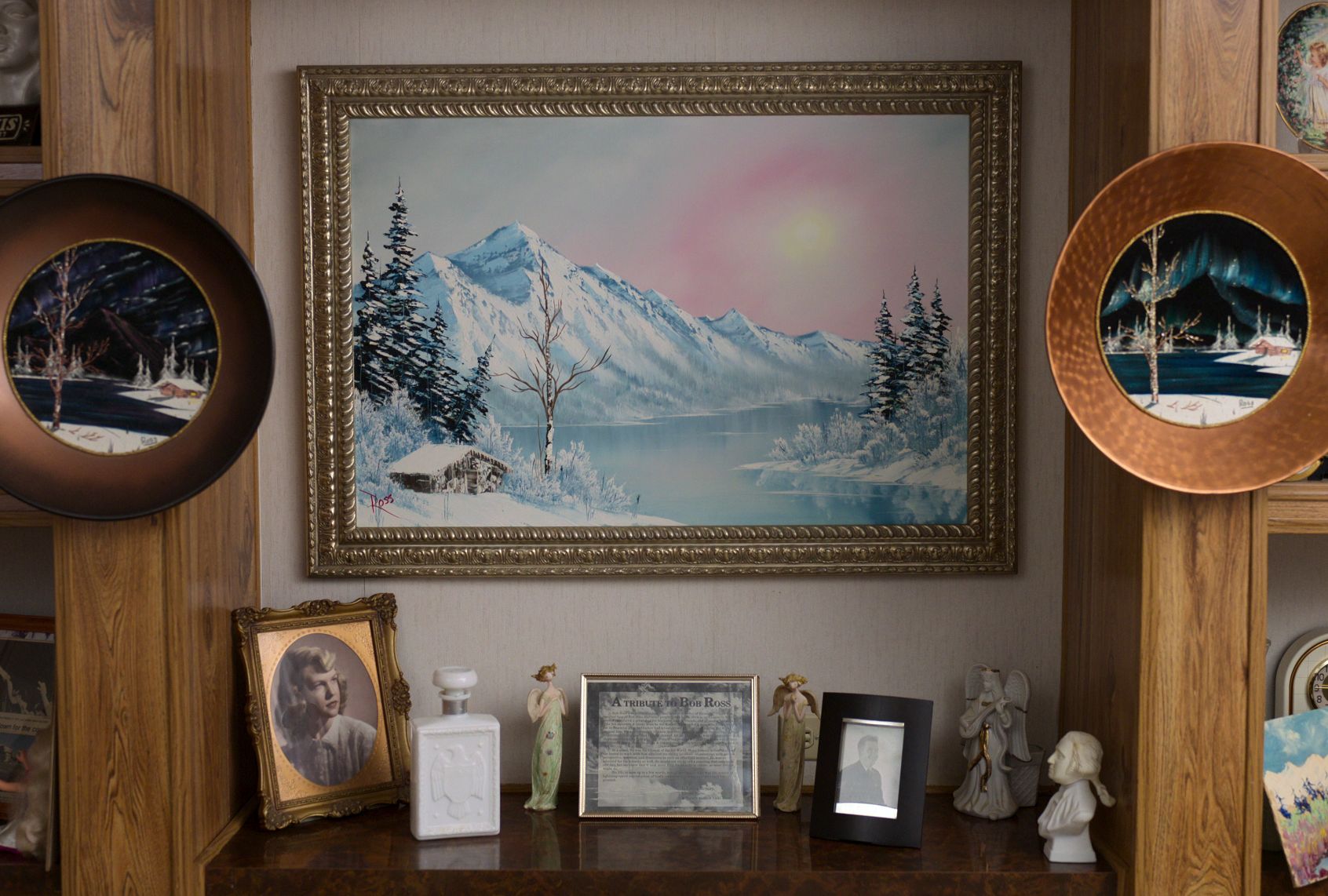
(Netflix) Bob Ross in documentary “Happy Accidents, Betrayal & Greed”
Encountering a “Joy of Painting” episode in a pet food store, then, is not out of character. Ross adored animals, frequently bringing a few of his favorite furry friends on camera with him – including Peapod, his “pocket” squirrel.
Animals were his friends. So were trees.
Ross’ dedicated focus on landscape painting has deep roots in his time spent stationed in Alaska with the United States Air Force, where he eventually rose to the rank of master sergeant. Throughout his time here, he painted whenever he could, memorializing the lakes, forests and mountains that surrounded him. Wednesday, April 22 was Earth Day, which made me wonder how many of his admirers thought about that part of his story – especially at a time when the Trump administration is pushing to open tracts in the Coastal Plain of the Arctic National Wildlife Refuge for drilling. Some of those very same vistas may have inspired the works he rendered for our astoundment and pleasure on his show.
Ross serenely demonstrated how to carve out serenity and beauty for ourselves, one canvas at a time.
We live in anxious times. But when hasn’t that been the case? When Bob Ross was a public television fixture in the 1980s and 1990s, the United States shuddered through a Cold War with what was then the U.S.S.R. before hurtling into the hot conflict of the Gulf War. Reaganomics punished the middle class, made the working class even poorer and rewarded the wealthy.
Amid all this, Ross serenely demonstrated how to carve out serenity and beauty for ourselves, one canvas at a time.
Recently, I wrote about the death of instructional culinary series. That longtime staple of educational and informational TV programming has been kicked to the curb in favor of competition shows. Citing “The Joy of Painting” as a forebear of, say, “Project Runway” or “Blown Away” may strike some as preposterous, but it was one of the earliest and most popular shows to demystify the creative process. Among the many quotes Ross left with his audience is one that dismantles intimidating concepts about natural ability, the kind of artistic gatekeeping we often impose on ourselves.
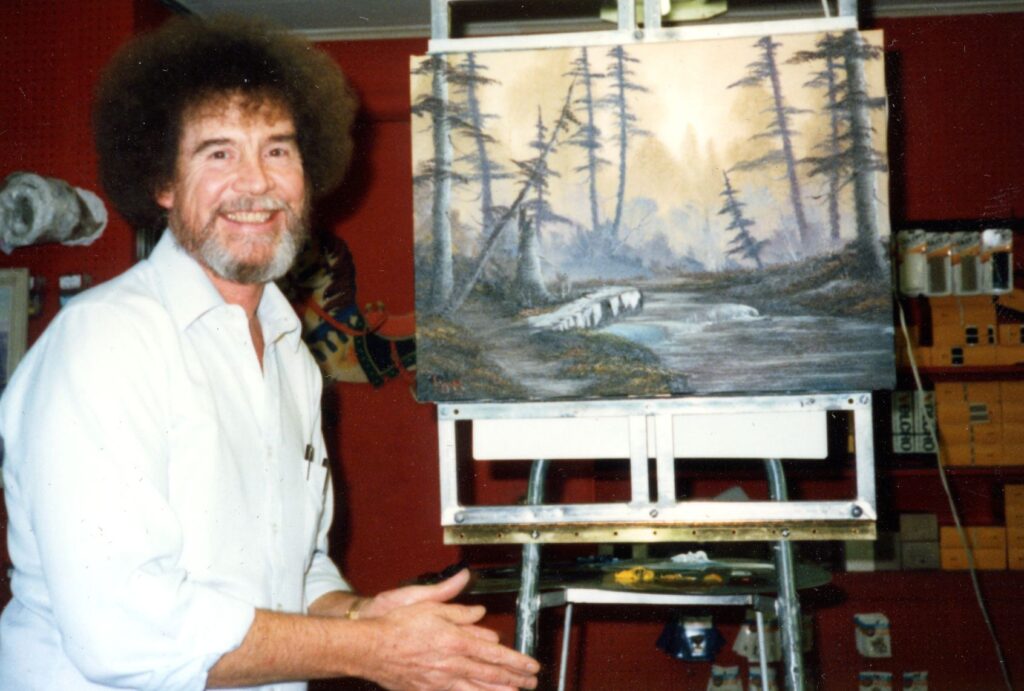
(Netflix) Bob Ross in documentary “Happy Accidents, Betrayal & Greed”
“Talent is a pursued interest,” Ross preached. “Anything that you’re willing to practice, you can do.” Hence, “The Joy of Painting” enjoyed a vigorous revival during the pandemic’s lockdowns, when hobbies assumed central importance in daily life. So did tending to our mental health: The therapeutic value of Ross’ low, soothing voice and the rhythmic sh-sh-sh sound of his paintbrush dabbing against canvas led researchers of Auto Sensory Meridian Response (or ASMR) to label his presentation style as “the Bob Ross effect.” Combined with his inspiring observations about embracing the healing power of artistic control, it mixes up a cocktail of feel-good brain chemistry that can be a powerful antidote to our worries.
Our enduring affection for Ross may be hardwired into our collective psyche, in other words. Ultimately, that’s to our benefit. Ross’ popularity at the time of his death, along with his prolific output, translated into an afterlife associating him with kindness and encouragement. A 2021 Netflix documentary, “Bob Ross: Happy Accidents, Betrayal & Greed,” called into question the circumstances by which his business partners Annette and Walter Kowalski came to obtain sole ownership of Bob Ross Inc., which generates millions of dollars in revenue each year, none of which flows to his son, Steve.
Want more from culture than just the latest trend? The Swell highlights art made to last.
Sign up here
Thirty-three seasons and 429 episodes of “The Joy of Painting” transformed his weekly art-hobby tutorials into a sales pitch for all kinds of products, including in-person classes. Bob Ross’ name drives a potent brand, even more than three decades after his death. Some of that power has been used to financially benefit the public: Recently in New York, four of his original works were auctioned off on behalf of American Public Television, which has pledged to use 100% of the net proceeds to support public TV stations nationwide. A January auction of Ross’ paintings raised $1.27 million for public media, eclipsing the $662,000 raised at a November 2025 auction in Los Angeles.
That figure, the total raised for three paintings, was outdone by John Oliver promoting the auction of one more during the 2025 finale of “Last Week Tonight.” Thanks to his mention, the estate sold the 10th season work “Cabin at Sunset” for $1,044,000 at the close of 35 bids.
Stripping away all that returns us to Ross’ philosophy about art’s accessibility. With a few tubes of paint, brushes and putty knives you might find at your local hardware store, fearless creation is something anybody can do.
If you don’t want to paint, watching Ross whisk landscape masterpieces into being within 30 minutes, exercising a sorcerer’s assuredness, is diversion enough. Either way, the real magic was in his soft, persuasive screen presence and gentle wisdom. “There are no mistakes,” he famously said, “only happy accidents.” Like, say, walking into the right place during the right art lover’s shift and finding a reason to smile about a friend we have in common.
Read more
from Salon’s culture newsletter, The Swell