
“Beef” grills capitalism’s trap for women

At Monte Vista Point, the country club setting for the second season of “Beef,” every familiarity is an illusion, a game of appearances that its general manager, Josh Martín (Oscar Isaac) and his wife, Lindsay Crane-Martín (Carey Mulligan), are experts at playing.
Josh pals around with the club’s impossibly wealthy members, serves them rare brown liquors and flies off with them to exotic locales at a moment’s notice. He and Lindsay pretend to be a happily married couple. In private, Josh shows more passion toward cam girls he patronizes online while Lindsay pines for the status she once enjoyed among Britain’s upper crust.
Meanwhile, low-level staffers like Ashley (Cailee Spaeny) and Austin (Charles Melton) carry out their plebeian tasks with grins on their faces and a bounce in their step, pleased as punch to be a part of such an exquisite slice of Montecito luxury. The club’s regulars would never guess or care how precarious the engaged couple’s lives are, with Ashley carrying the financial burden of their household while Austin, who works part-time as a fitness trainer, posts videos online.
To the club’s new Korean billionaire owner, whom everyone calls Chairwoman Park (Oscar winner Youn Yuh-jung), all of them might as well be ants. (Creator and showrunner Lee Sung Jin puts a fine point on that idea by opening the season with the image of said insects industriously marching in a line, only to be crushed underfoot by a human worker unaware they were in his path.)

(Netflix) Charles Melton as Austin Davis, Carey Mulligan as Lindsay Crane-Martin, Oscar Isaac as Josh Martin and Cailee Spaeny as Ashley Miller in “Beef”
Nevertheless, the Chairwoman is also tied up in a loveless marriage to a cosmetic surgeon, Dr. Kim (Song Kang-ho, star of “Parasite”), who’s too arrogant and insecure to retire despite the risks he poses to his patients.
“You know, as you get old, friends go away. Parents die. Even children leave,” she cheerfully tells Ashley in an early scene, when she finds out she and Austin intend to marry. “The only person by your side is your spouse.” A few scenes later, we question whether that companionship is worth the trouble when her husband’s mistake threatens to undo her empire.
“Beef” links the potential liabilities women face by locking into long-term relationships to the realities of the capitalist trap, which draws women into not only unpaid housework but uncompensated emotional labor, too.
The second season’s inciting incident occurs after a successful fundraising event, when Josh and Lindsay’s domestic bickering quickly deteriorates into a knock-down physical altercation just as Ashley and Austin stumble up to witness it, phones recording away. They capture enough of Josh and Lindsay’s confrontation for Ashley to use to blackmail her way into a better job with healthcare benefits, which she needs to afford a surgery that could save her life and her fertility.
Of course, this is only the beginning of a tit-for-tat spite fest that yields terrible collateral damage.
If “Beef” were solely about the corrosiveness of rage, this season’s rivalry wouldn’t be worth slicing into. But Lee marbles other theories and indictments into his meat concerning the privilege of extreme emotion and behavioral honesty. Both seasons of the show demonstrate that only the wealthy can afford to indulge in extreme emotional displays or cheapen honest ones. Josh and Lindsay, who still grind for their bread, must smile brightly in public while their private lives fall apart. Similarly, Austin grins as Ashley barrages him with her insecurities. Once he’s by himself, he screams out his frustration while pumping iron.
Anger, like love, is an entitlement the well-to-do define for themselves in ways middle and working-class couples can’t afford.
While it would appear the Chairwoman doesn’t have much in common with a social climber like Lindsay or Ashley, whose instinct to embroider her meager administrative qualifications earns the owner’s respect, each has chained their lives to a man who, in some way, elevated himself on their backs.
Between Ashley and Austin, he’s the one who attended college while she never finished high school. Yet she’s the one who maneuvers him into a better job, where he accidentally fails upward into more responsibility thanks to his himbo charms.
Posh Lindsay’s family was well-off enough to leave her an inheritance. As she bitterly reminds Josh, they spent most of it on his mother’s medical bills in her final days — that, and their massive home, which they locked themselves into with dreams of transforming it into their own bed and breakfast. But they can’t build that if he’s indulging in gambling nights with buy-ins costing thousands of dollars, hoping to fool his rich clients into seeing him as one of their own.

(Netflix) Cailee Spaeny as Ashley Miller and Carey Mulligan as Lindsay Crane-Martin in “Beef”
Between “Beef” and a few other TV shows and movies, the marriage industrial complex is really taking it on the chin this spring. Never mind the recent Pew Research study confirming what women have long suspected – that on a daily average, they do more than 40 additional minutes of housework compared to men.
Adding unpaid labor onto one’s daily workload is draining and, provided your domestic partner is open to ameliorating the imbalance, solvable. In most cases, it won’t kill you outright. Films like “Ready or Not 2: Here I Come,” on the other hand, present marriage as a potentially fatal error that begins the moment a woman says, “I do.” Running from murderous in-laws is nothing compared to the threat at the heart of “Something Very Bad is Going to Happen,” which depicts exchanging vows with a presumed soul mate as gambling with a curse.
Even couples who make it well into a marriage contend with all the perils born from romance gone stale, including the functional discord clumsily realized in the sight-gag metaphor of “The Miniature Wife.” In that Peacock series, Elizabeth Banks’ Lindy Littlejohn is a best-selling author tired of diminishing her well-earned reputation to placate her husband, a bumbling scientist. But before she can abandon her flatlined marriage, he physically shrinks her down to six inches. That’ll teach her!
People marry for love, but just as often for a better shot at financial stability.
Such cautionary fantasies attach relationship failures to supernatural forces. With “Beef,” Lee links the potential liabilities women face by locking into long-term relationships to the realities of the capitalist trap, which draws women into not only unpaid housework but uncompensated emotional labor, too. Many articles, papers and books have been written about this, but “Beef” boils it down to the system’s inevitable perversion of simple affection.
Ashley and Austin take comfort at first in their professed love for each other, but quickly figure out that the only way they can afford to have a child is through fraud.
Josh and Lindsay’s high society Kabuki theatrics don’t save their union or replenish her bank account. In her view, she was shafted into the “what’s mine is yours” agreement. At least he has a job title he can add to a resume. All she can point to is a garage stuffed with throw pillows, remnants of her shriveled dream to design interior spaces for affluent clients. An attempt to impress the Chairwoman by adorning a space at the club in colonial chic backfires. Not only does the Korean magnate understandably detest that style, she has no love for Lindsay either.
People marry for love, but just as often for a better shot at financial stability. The Chairwoman’s astronomical wealth, however, makes a husband unnecessary. The cruel part is that her own husband points this out when she asks him, tenderly: “Do you even love me?” in response to his fretting over whether her money can cover up his latest blunder. If this were another series, his answer would be simple.
Instead, he stammers, “Wow, this is . . . I mean, it’s been a while since I’ve heard you talk like that. Love! . . . I know you’re struggling, but I didn’t mess up like that on purpose. I’m the one having the hardest time here. Me!”
She takes in more of his deflating stalling before saying to him, in English, “Dr. Kim, I love you.” Whether he understands isn’t clear. But he warms right up again when she reverts to Korean to assure him she can pay for the trouble he’s created.
“Maybe you put others over self a few times, but only when it is easy. The universe is not designed for this,” the Chairwoman says in the finale’s defining speech about the ravages of late-stage capitalism, which Youn delivers with chilling precision. Our selfishness, she continues, is the reason capitalism works. “It is a system of nature. System of the self. Love lives in this system. All relationships exist in this system. They are all the same, another way to serve the self. That is why I’m not crying right now.”
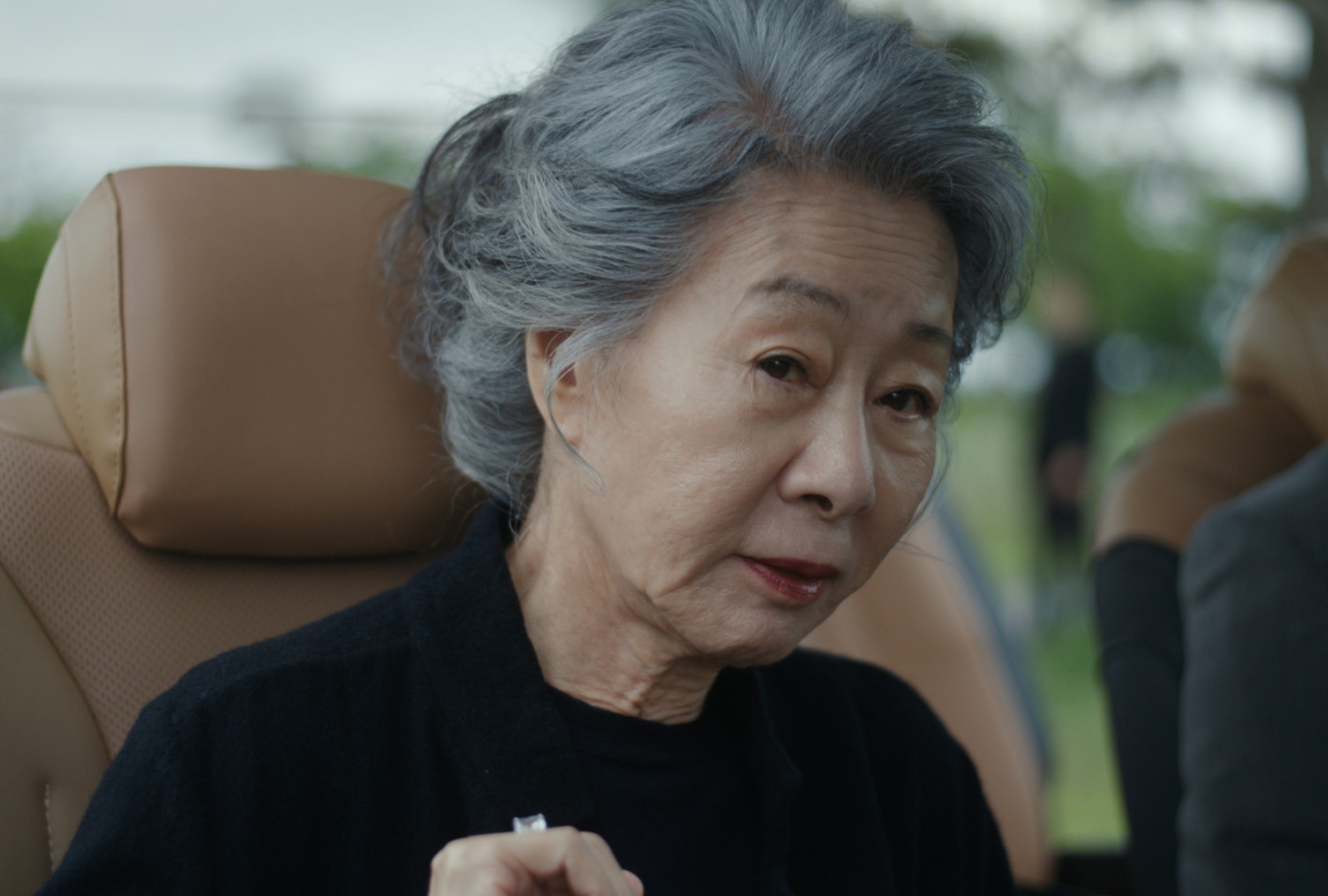
(Netflix) Youn Yuh-jung as Chairwoman Park in “Beef”
Want more from culture than just the latest trend? The Swell highlights art made to last.
Sign up here
To call “Beef” cynical about love and relationships isn’t quite right. Recall that the first season ends with Amy Lau (Ali Wong) spooning her one-time enemy, the man she nearly kills with her hatred. But this happens after she’s destroyed the opulent life she had with her husband, one entirely paid for by her striving.
In one of Austin’s more pathetically brainless second-season moments, he tries to comfort Ashley by blaming their lot on late-stage capitalism while misinterpreting the definition of disparity. “The system is designed to make you feel despair. Like, the disparity is systemic!” he says with the misbegotten confidence of a podcast bro. Ashley understands he’s floundering toward some understanding of income inequality, although he never quite gets there. Not without her help.
Youn’s billionaire, meanwhile, ends her marriage with a bullet fired during an outbreak of violence that doubles as a reckoning for Josh, Lindsay, Austin and Ashley. All their relationship flaws create opportunities for the Chairwoman to exploit: She discovers Josh’s failed attempt to embezzle funds and pin the blame on Ashley, his underling, and traps him and Lindsay in her employ until she deems them to be disposable. Everyone underestimates Ashley’s intelligence and Austin’s willingness to sell out justice to ensure they’ll get ahead. Eventually, those two attain the life they assumed was permanently out of reach by bending to the Chairwoman’s will. Of course, their elevated rank requires Ashley to bring home so much work that she doesn’t have the energy or time to read to their kid.
In the end, the latest “Beef” lesson, served cold, is that the system guarantees we’ll feast on each other while the rich watch from a distance, not the other way around. If that’s so, then women, rich and poor alike, will be the appetizer.
“Beef” is streaming on Netflix.
Read more
about this topic