
Not even Christmas can escape America’s war fetish
The USS Joseph P. Kennedy — a Gearing-class destroyer once equipped with Mark 32 torpedoes, anti-submarine missiles, and nuclear depth charges — has been decorated for Christmas. A string of bright white lights hangs from bow to stern, their reflections dancing off the waters of Mount Hope Bay, where the retired naval ship sits just off the shore of the faded mill town of Fall River, Massachusetts.
To the extent it’s known at all, Fall River is generally known for two things. In the summer of 1892 it was the site of the most notorious axe murders in U.S. history, when wealthy mill owner Andrew Borden and his wife Abby were allegedly bludgeoned to death by their daughter Lizzie. Later, it would gain fame as the hometown of Chris Herren, a preternaturally talented but troubled point guard who, while playing with the Boston Celtics, once left the pregame layup line in full uniform to buy drugs on the street outside the Garden.
Fall River is one of those northern post-industrial cities that’s been futilely trying to reverse decline for decades, first by bulldozing historic neighborhoods to build highways, and now by constructing breweries and farmer’s markets. But for as long as I’ve known Fall River, it’s always been proud of Battleship Cove, a memorial and museum that includes the world’s largest collection of World War II-era naval vessels, which I passed by hundreds of times as a child on my way to doctor’s appointments or to PawSox games across the bay in Rhode Island.
As a kid rumbling by “the Joey P” in the backseat of my mom’s minivan, I never thought about what it really means to decorate a warship for Christmas. But my grandfather did. As a young man, he’d manned the tail gun of a B-24 in World War II. Later, he lived at a retirement home less than a knot or so up the bay from the destroyer, and he could see the ship out the window whenever he looked up from his book.
My grandfather was very much in the lion in winter stage of his life when he lived by the destroyer. No longer was he the stern, serious man who intimidated me when I was a young child, who read the National Review and scolded me and my cousins for leaving the ice dispenser on crushed instead of cubed. As he was reaching the end of his life, and just as I was starting to make my own, we’d developed a genuine relationship.
I helped organize his bookshelf when he moved into that old folks home. I drove him to visit his brother, or picked him up for a family barbecue. He started reading the Harry Potter books on top of his historical biographies and conservative magazines, and chided me for acting like I was too cool for Hogwarts. And even though we approached them from opposite sides of the ideological divide, we had an easy, respectful rapport about politics, history and current events.
“Disgusting,” he said. “How could somebody put Christmas decorations on a machine that was built to kill people?”
One Christmas night, as we drove him back to Fall River from the family party, he gazed out the car window at the festooned Joseph P. Kennedy before suddenly turning away and shaking his head. “Disgusting,” he said. “How could somebody put Christmas decorations on a machine that was built to kill people?”
As an American who came of age in the 1990s, I grew up believing that war — real war — didn’t exist for us anymore. This is not to say that the U.S. military stopped killing people while we were busy watching “Friends” and waiting to dial up using AOL. Far from it. Depending on whom you ask, America was responsible for the deaths of upwards of 200,000 Iraqis in the first Gulf War alone, to say nothing of the conflicts in the former Yugoslavia, Somalia, and other places most Americans forgot about.
But those weren’t real wars, were they? Not for us on the home front, where we watched them in six-minute segments on CNN and the evening news that aired between commercials for credit cards. Since the fall of Saigon in 1975, America has increasingly become a country that conducts war without really knowing what war is. Less than one percent of American adults are active-duty service members in the military, with an even smaller fraction of that percentage seeing combat. Hell, we usually don’t even have the nerve to call our state-sponsored projections of violence wars. Operations and strikes sounded so much more modern, cleaner.
Want more sharp takes on politics? Sign up for our free newsletter, Standing Room Only, written by Amanda Marcotte, now also a weekly show on YouTube or wherever you get your podcasts.
But my grandfather knew real war, and he opened my eyes to one of its gory truths that Christmas night. I’d seen the Joey P. my entire life; I had visited it on field trips and picnicked in a park that stands in the shadow of its gun mounts. But until that moment I hadn’t actually seen it the way someone who’d been to war saw it. I hadn’t seen it for what it really is: a machine built to kill people.
It’s been 82 years since we last formally declared war, yet we still have too many killing machines to know what to do with. When we’re not using them to kill people, we trot them out for football games, air shows and parades. And we decorate them for Christmas.
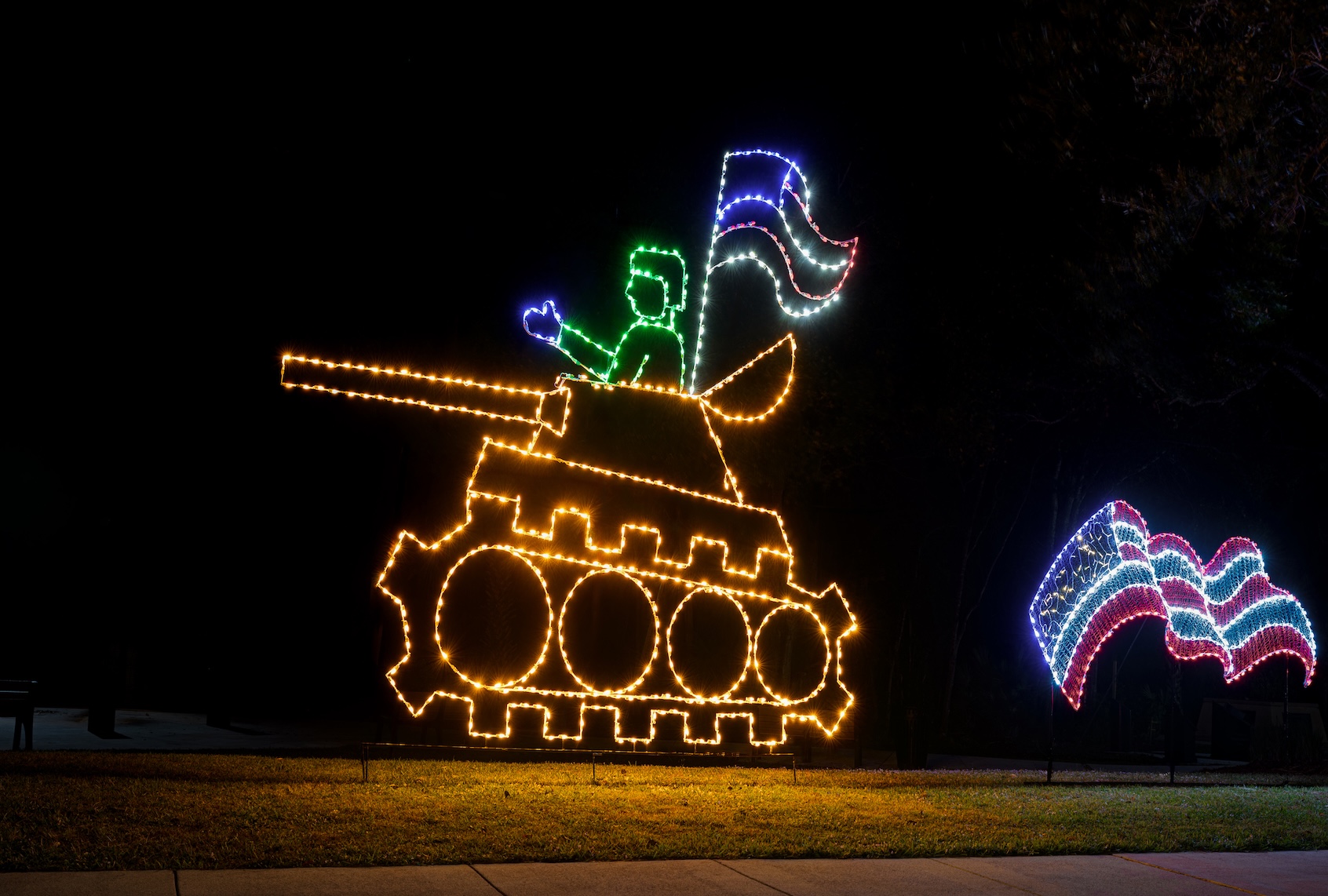
The Joseph P. Kennedy isn’t even close to the biggest offender of this grotesque phenomenon. America is a country absolutely stuffed with killing machines strung with Christmas lights.
At the Detroit Arsenal in Michigan, an M-1 Abrams tank is festooned with lights and made to look like it’s being carried by flying reindeer, the implication being that Santa may need to blast someone into oblivion while delivering presents.
Originally built to carry long range nuclear bombs and now used for everything from conventional weapons to hypersonic missiles that travel faster than the speed of sound, the B-52 is known as perhaps the deadliest aircraft ever to take to the skies. The seventh one ever built is now on display at the Wings Over The Rockies Museum in Denver, where each year it is covered nose-to-tail in Christmas lights. Red lights are on the nose, of course, to echo Rudolph.

(Getty Images) The USS Wisconsin is decorated in Christmas lights in Norfolk, Virginia, in November 2020.
In Norfolk, Virginia, the USS Wisconsin, which participated in the gruesome battles of Okinawa and Iwo Jima, among others, is now the centerpiece of a winter festival featuring visits from Santa and purportedly boasts more Christmas lights than Disneyland. There’s even a bar on board where visitors can sip holiday-themed cocktails.
At the White Sands Missile Range in New Mexico, the site of the first atomic bomb detonation in human history, a ballistic missile that once carried a nuclear warhead capable of incinerating entire cities is decorated to look like a Christmas tree. Girl Scouts sing carols as onlookers sip cocoa at the annual lighting ceremony. The rocket is lit using an oversized lever designed to look like a “Looney Tunes” version of a TNT detonator.
And on the banks of the Delaware River in Camden, you’ll find the USS New Jersey. Known as the most decorated warship in U.S. naval history, the New Jersey served in the Pacific during World War II, bombarded the North Korean coast in the Korean War and deployed to Vietnam in 1967, when it was the world’s only active battleship. But its most recent heavy action came in the Lebanese Civil War in the 1980s. For six months she sat off the shore of Beirut, bombarding supposed militia positions in the hills encircling the city. Later, an investigation revealed that the guns of the New Jersey were so inaccurate that they sometimes missed their targets by 10,000 yards, likely resulting in the deaths and maiming of hundreds, if not thousands, of civilians. Today, there’s a Christmas tree fashioned out of communication antennae on her bow. Below deck are several more Christmas trees that have been decorated by local nonprofit groups, including one school that serves children with severe disabilities.
These tableaus take place against the backdrop of an increasingly militarized vision of Christmas that permeates American pop culture. Movies like “Arthur Christmas” and streaming specials like “Prep & Landing” depict the North Pole as if it’s a base under the North American Aerospace Defense Command’s (NORAD’s) chain of command, with elves who wear military fatigues and rappel down chimneys while wearing night vision goggles. The heroes of the 2024 film “Red One” are members of a secret military force who run the North Pole as a police state where the reindeer are kept in an aircraft hanger alongside fighter jets. Even the comparatively benign “Christmas Chronicles” franchise includes one scene in which an elf attempts to cut a young girl in half with a chainsaw (and is disappointed when he’s told he can’t because she knows Santa), and another scene in which Goldie Hawn, portraying Mrs. Claus, supplies a young boy with a Christmas cookie that explodes when it’s thrown. Something that explodes when it’s thrown is also known as a grenade. In other words, Mrs. Claus gives a nine-year-old boy a grenade.
If Christmas is a celebration of life, as well as a time to seek peace and human understanding, then war, naturally, is its opposite. In our grotesque attempts at combining the two, we blunt the meaning of both.
If Christmas is a celebration of life, as well as a time to seek peace and human understanding, then war, naturally, is its opposite. In our grotesque attempts at combining the two, we blunt the meaning of both.
But America in 2025 is a country of overstuffed suburban scrollers who, for the most part, have no idea what real war looks like. Ignorant to its horrors the way my grandfather decidedly was not, we’ve made it part of our holiday decor.
Meanwhile, the U.S. military is once again killing in our name. Since early September, the Pentagon has launched at least 29 strikes on purported drug smuggling boats in the Caribbean and Pacific, resulting in at least 105 deaths.
Troops and warships are also mobilizing off the coast of Venezuela. One of those is the USS Gerald R. Ford, a nuclear-powered aircraft carrier that is the largest warship ever built. As it is currently active, the Gerald Ford is not home to a public display of Christmas lights. But a few years ago it posted a digitally-altered image on its Facebook page depicting Santa’s sleigh taking off from its deck.
What actually takes off from the deck of the aircraft carrier, though, are Super Hornet fighter jets and Seahawk helicopters. And two weeks ago, a few of those helicopters took off carrying U.S. soldiers who rappelled down to the deck of a Venezuelan oil tanker and seized it in advance of a military operation against a country most of us know solely through its baseball players — a country that George Bailey couldn’t even correctly pronounce when he floated the idea of working in its oil fields to Uncle Billy.
The Trump administration has released video footage of the raid against the tanker. You can watch our soldiers rappel out of one of the Seahawks just like Santa’s elves. What you can’t see is footage of the November drone strike that ended the lives of two men who were desperately clinging to the wreckage of a ship in the middle of the ocean. The administration is fighting the release of those images. Apparently we don’t have it in us to see what war looks like when it’s not served with hot cocoa.
Personally, I don’t want to see the drone strike footage. But I can’t help feeling that I should — that we all should. Before we add to our body count with another war that we’ll once again watch in sanitized clips from our couches, we should, at the very least, respect war by reckoning with what it really means. What if we were made to understand the consequences of the violence perpetrated on our behalf? What if we knew what war truly looks like when it’s not strung with Christmas lights?
Read more
about Trump’s actions against Venezuela