
Rubio’s Greece speech is MAGA’s latest classical cover story
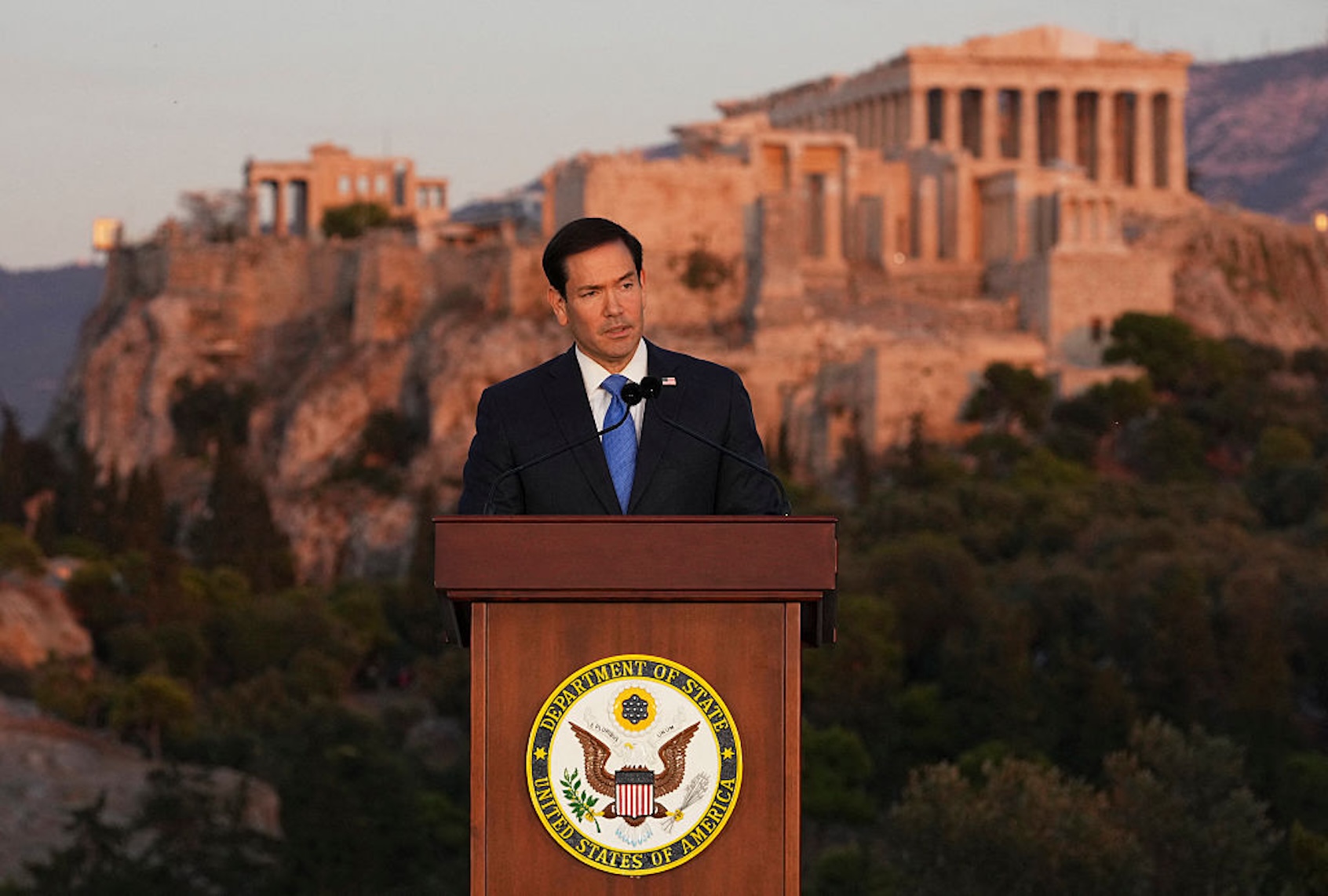
It’s really hard to take Secretary of State Marco Rubio seriously. He’s a child of immigrants who has cynically sold his political soul to the most anti-immigrant administration in modern American history, one headed by the man from whom Rubio endured humiliating verbal abuse during his failed bid for the Republican presidential nomination in 2016. But Rubio is all-in for Donald Trump and his MAGA movement. Last week he was on the world stage in Athens, Greece, for the sixth U.S.-Greece Strategic Dialogue, trying to put a good spin on what he called the Trump administration’s “unapologetic pursuit of national power.”
The hollowness and hypocrisy of this boasting is plain to see: When Rubio warns that such pursuit of power is justified because “there is war again,” it’s impossible not to think of the administration’s needless war of choice against Iran and its catastrophic impact on the global economy. Same with his attempt at celebrating Trump’s investment in the “new frontier” of “super intelligence,” the president’s favored term for the deeply unpopular products of the environmentally and economically disastrous artificial intelligence industry. The lengths to which Rubio has to go to try to praise this administration’s unpopular policies would be laughable if they hadn’t all been so harmful on a global scale.
There’s a time-honored and finely tuned template for trying to make the ideas that define the administration’s worldview seem respectable, natural and desirable: Linking those ideas to a period of history you believe most of your audience has been taught to admire and take seriously.
Where does a high-ranking representative of a failed administration turn when they’re in an impossible rhetorical situation like Rubio’s? As I argued in “The White Pedestal: How White Nationalists Use Ancient Greece and Rome to Justify Hate,” there’s a time-honored and finely tuned template for trying to make the ideas that define the administration’s worldview seem respectable, natural and desirable: Linking those ideas to a period of history you believe most of your audience has been taught to admire and take seriously. A speech at the Pnyx, where Athenians once gathered for popular assemblies that birthed democracy, provided a perfect opportunity to link America First to ancient Greek statecraft. Framed against the Acropolis, Rubio trotted out a whole raft of old slogans about how lofty ideals like “heroism,” “honor,” “duty,” “virtue” and “courage” characterize both the culture of “the West” and, by extension, the Trump administration’s supposed reclamation of those “not just for our country, but for the whole of our civilization.”
But scratch the surface of the history Rubio cited, and those ideals look about as worthy of celebration as a new data center being built in your hometown or having to pay $6 a gallon for diesel.
The secretary’s examples of Western heroism were the Spartans at Thermopylae and the philosopher Socrates, both of whom, he said, illustrate the “Western” willingness to “pay any cost for a cause worthy of his loyalty.” But the Spartan militarism that Rubio so admires came to define the city state’s culture only because they had no choice but to devote all state resources to maintaining an army sufficient to suppress the revolts of the massive number of enslaved fellow Greeks upon whom the Spartan economy depended. And the most plausible explanation for why Socrates was executed is that he had been an intellectual mentor to several of the men who ruled Athens as a violent, dictatorial junta in the aftermath of the Peloponnesian war; it was Socrates’ student Plato, who devoted his talent to sanitizing the political reputation of his teacher by painting him as a courageous free-thinker.
Rubio mentioned the influence of Plato as a key link between ancient Greece and the founding of the United States. But Plato’s influence upon the framers of the U.S. Constitution consisted primarily in legitimizing their conception of the new nation as an inegalitarian state in which only those whom they deemed worthy would have access to political power.
Yes, Socrates taught and Plato wrote, as Rubio said, in the Parthenon’s shadow. But when ancient Greeks looked at that temple they saw a monument not to democracy but to the wealth and power Athens had amassed for itself by its coercive, imperial treatment of their fellow Greeks. The construction of the Parthenon was funded by income from the lopsided, extortionate alliances into which Athens bullied other city-states on the pretext of providing protection against the defeated Persians coming back to impose slavery upon the Greeks. It almost seems that Rubio knows this, because his warning to Europe sounds a lot like that ancient Athenian propaganda: “The course we take will determine whether the West . . . resigns itself to a future of atrophy and servitude and decline.”
Want more sharp takes on politics? Sign up for our free newsletter, Standing Room Only, written by Amanda Marcotte, now also a weekly show on YouTube or wherever you get your podcasts.
Oppression and exploitation of marginalized groups, promotion of authoritarian rule, imperial domination and wealth extraction; these aren’t aspects of “Western Civilization” that anyone should be proud of. But Rubio is, or said he is, because these are the aspects of that heritage that correspond most closely to the Trump administration’s view of the world.
In fact, the secretary’s speech was pretty direct about this. When Rubio decried how, before Trump, “we tore down our monuments; we condemned our own history,” he can only be referring to the removal of Confederate statues that served to celebrate white supremacy. His grandiose description of America before European colonization as “an open and wild land” that “became the site of a great revival of Western imagination and ambition” erased the role of genocide and displacement of Native Americans people in this process.
But why should anyone be surprised to hear something so egregiously shameful from a Trump administration official? This is the very history that Trump has worked to suppress in museums, including the Smithsonian, and national parks nationwide.
You can sense the desperation for legitimacy in Rubio’s choice to give this speech in Athens, where he hoped the ruins of the parthenon would lend prestige to his claims. You can sense it in the fulsomeness of his praise of “Western Civilization,” as if just repeating “virtue” or “honor” enough times will paper over the corruption scandal surrounding U.S. Ambassador to Greece Kimberly Guilfoyle. These visual and rhetorical clichés are intended to make Trump’s policies look respectable, but all they do here is reveal the profound weakness of the administration. They can’t point to any genuinely positive accomplishments. Going into the midterm elections Trump and his party have nothing to run on. So instead we get a speech like this — a ham-fisted appeal to the die-hard MAGA base, the kind of people who actually want to live in a dictatorial, corrupt police state and to delude themselves about history.
But polls show that group is growing smaller every day. Americans aren’t falling for it anymore.
Read more
about America’s foreign policy