Top court upholds South Korean ex-president Yoon’s 7-year jail sentence
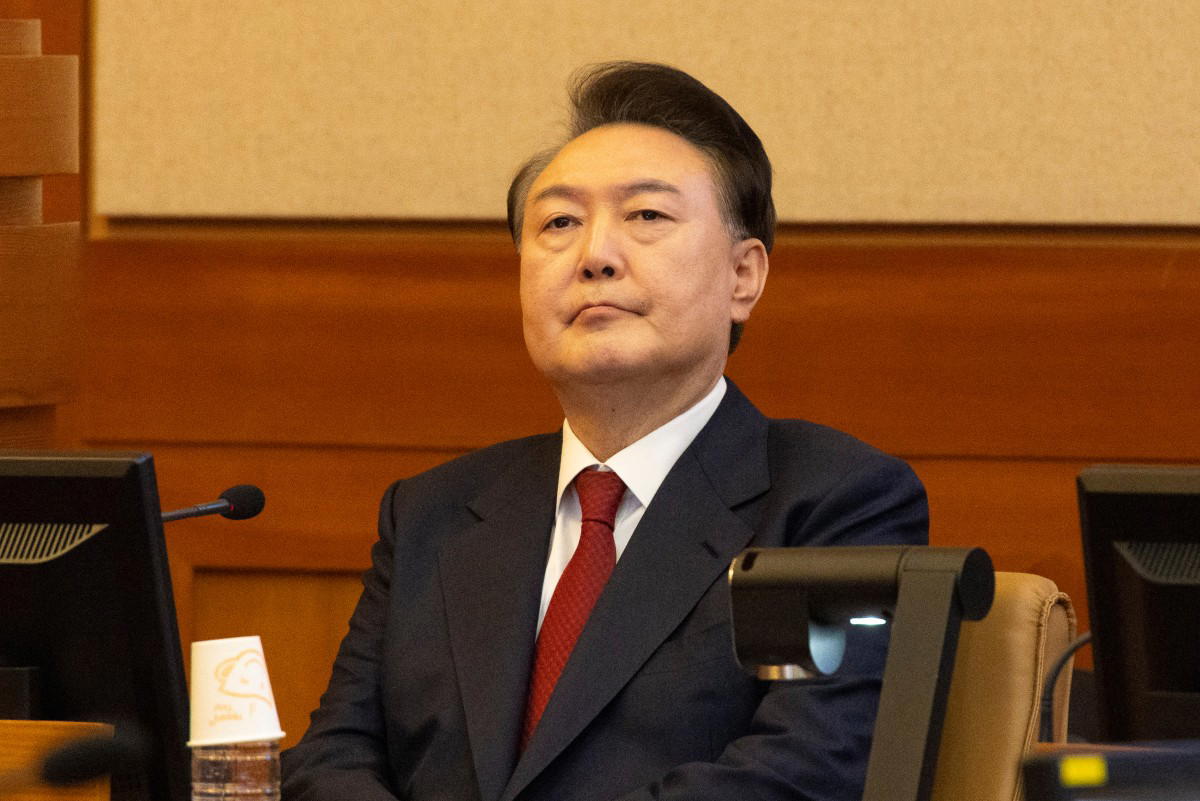
(FILES) South Koreas impeached President Yoon Suk Yeol attends a hearing of his impeachment trial at the Constitutional Court in Seoul on February 13, 2025. A South Korean court will rule on February 19, 2026 on insurrection charges against ex-president Yoon Suk Yeol, weighing whether he should be sentenced to death for his failed bid to impose military rule. (Photo by JEON HEON-KYUN / POOL / AFP)
South Korea’s highest court upheld ex-president Yoon Suk Yeol’s seven-year prison sentence on Thursday over crimes tied to his botched 2024 martial law declaration and its chaotic aftermath.
The case covered accusations that Yoon had obstructed cabinet deliberations and used forged signatures of the prime minister in the lead-up to the declaration, as well as using presidential security agents to block his own arrest after lawmakers had nullified it.
The disgraced former president is already in detention while he appeals a separate life sentence for leading an insurrection with his martial law declaration, which he insists was motivated by the public interest.
In the case brought before the Supreme Court, Yoon was accused of obstructing deliberations by convening only a select group of ministers for a meeting shortly before he declared martial law.
Other charges included allegedly creating and destroying a false martial law decree bearing forged signatures from the prime minister, ordering officials to distribute a misleading press release to foreign media and directing an army commander to delete records from secure military phones.
Prosecutors had sought a 10-year prison sentence for Yoon.
In January, a lower court had sentenced Yoon to five years in prison after convicting him on most charges.
In April, an appeals court upheld the ruling, added a guilty verdict over the misleading press release, and raised the sentence to seven years.
Both prosecutors and Yoon’s legal team had appealed to the Supreme Court, whose rulings are final.
“All appeals are dismissed,” a Supreme Court judge said in a televised ruling, adding that the lower court’s judgment “contained no errors”.
The ex-president did not attend Thursday’s hearing.
Yoon’s legal team expressed “deep regret”, accusing the Supreme Court of concluding the case “without sufficient deliberation”.
The ex-president’s lawyers plan to challenge the ruling on constitutional grounds and said they would raise a complaint.
Prosecutors said they respected the top court’s decision, adding they would do their “utmost to successfully prosecute the remaining cases related to insurrection.”
– Political crisis –
The shock late-night national televised address in December 2024 that suspended civilian rule plunged South Korea into an unprecedented political crisis.
Martial law lasted only about six hours as lawmakers raced to vote it down in an emergency session.
However, Yoon’s move triggered protests, sent the stock market plunging and caught key allies like the United States off-guard.
In a separate case, a court handed Yoon a 30-year prison sentence for sending drones into North Korea to “manufacture” a crisis ahead of his martial law bid.
In January, a lower court said Yoon abused his power by turning officials of the Presidential Security Service against the state, by using them to block investigators from detaining him.
The top court said Thursday that measures by Yoon’s presidential security team, including human-chain drills and barbed wire, to obstruct a court warrant could not be justified as legitimate security activities.
The former president has insisted his martial law declaration was “solely for the sake of the nation”.
In 2024, he also defended it as necessary to root out “anti-state forces” and quash what he claimed were threats from North Korea.
Yoon was ousted over the martial law bid in April 2025, triggering elections that gave the presidency to Lee Jae Myung of the centre-left Democratic Party.
AFP