
The gentle 15-minute kitchen reset that makes a difference
Often, I feel the need for a kitchen reset in my body before my brain quite catches up. Maybe you know the feeling, too.
This isn’t the moment for a full seasonal purge. Not a spring clean, not a weekend overhaul. It’s the reset I reach for when I know groceries are en route and the counters feel a little gritty, a little sticky from a day of recipe testing. Or when I want to make myself a nice lunch, but last night’s dishes are still in the sink—now layered with breakfast’s. Or when I’ve cooked in someone else’s kitchen — my mom’s, my sister’s, a close friend’s; not a stranger, to be clear — and they say, “Oh, just leave it!” (I’m sorry. I can’t. I simply can’t.)
You may have intuited this already (this is, after all, a weekly dispatch about cooking), but my kitchen is, in a very real way, my office. Metaphorically, yes — it’s where the ideas that end up here begin. But also literally: my desk is a repurposed stainless steel prep table, set beside the stove, facing a window that’s often full of light.
It’s a high-touch space. I cook there, I work there, I linger there.
Maybe that’s true for you, too. It’s a cliché, sure, but for good reason: the kitchen really is the heart of the home. And maybe that’s why, as I’ve started collecting advice questions from readers, the conversation has widened a bit — from how we cook to how we care for the place where we cook.
So: this is my 15-minute kitchen reset. The one that clears the decks and softens that low-grade “it’s messy in here” itch, so you can get back to living.
What this is (and isn’t)
Before we get into the mechanics of a 15-minute reset, it’s worth pausing on what we’re actually talking about here.
Because when we talk about “resetting” a kitchen, we’re not just talking about dishes or countertops. We’re also talking about a set of cultural expectations that many of us have absorbed, often without realizing it.
For a lot of people, domestic care tasks like cooking and cleaning carry a certain moral weight. Do them well, and you’re disciplined, capable, put-together. Let them slide, and suddenly there’s shame, stigma, a sense that you’re falling short. It’s a dynamic that’s been reinforced everywhere, from childhood messaging to entire genres of television built around spectacle: “Hoarders,” “How Clean Is Your House?,” “Filthy House SOS.” The underlying premise is the same: cleanliness as virtue, mess as failure.
So it makes sense that a 15-minute reset might not feel like “enough.”
If the kitchen feels far gone — trash, dishes, that low-grade sense of overwhelm — it’s easy to assume that anything short of a full clean won’t make a meaningful difference. I’ve been there. As someone who manages an autoimmune condition, anxiety and the kind of executive dysfunction that can sometimes come with both, I know how quickly things can tip from “a little messy” to “I don’t know where to start.” And when you’re in that place, a full reset can feel not just daunting, but impossible.
Want more great food writing and recipes? Sign up for Salon’s free food newsletter, The Bite.
Which is why this reframe matters.
One of the most helpful shifts for me came from “How to Keep House While Drowning” by KC Davis (which I mentioned in last week’s issue). Her central idea is simple, but radical: your home is not a reflection of your worth. It’s a functional space meant to support your life. A sink full of dishes doesn’t mean you’ve failed. It might mean you fed yourself. A pile of laundry doesn’t mean you’re behind. It might mean you’re living.
That same thread runs through the work of Kristin Neff, whose research on self-compassion offers a way out of the shame cycle that so often keeps us stuck. And in “The Lazy Genius Way,” Kendra Adachi makes a case for something both practical and freeing: start small, and let that be enough.
Which brings us back to the kitchen.
A reset is not a deep clean. It’s not a seasonal overhaul (If you’re looking for something more in that vein, check out my guide to spring cleaning your kitchen). It’s not “fixing everything.”It’s a short, strategic intervention; a way to shift the energy of the space just enough that you can move forward again. Because the truth is: you don’t need to do everything to feel better.
Sometimes, making a dent is enough.
And more often than you’d think, that small reset is what makes the rest of the day — cooking dinner, sitting down to work, even tackling a deeper clean later — feel possible again.
My 15-minute framework
So here’s how I think about it.
Air in, grit out
If I have 15 minutes, I’m not trying to clean everything. I’m targeting impact. And the first move is what my grandmother would call “air in, grit out.” Open a window (or a few, if you have them) in or near your kitchen. Then do a quick sweep of your surfaces: crumbs, scraps, stray La Croix cans, to-go coffee cups, bits of plastic wrap or parchment. All of it goes straight into the trash.
This gives you two easy wins, right away.
First, it shifts the atmosphere. One of the most underappreciated ways to make a kitchen feel clean is simply to make it smell fresh. A good air-out gets you most of the way there. (If your kitchen is windowless, a box fan stationed at the edge of the room to push stale air out works surprisingly well.)
Second, it clarifies the scene.
Once the dry clutter is gone, what remains tends to sort itself into a few familiar categories:
-
Dishes (the main event, coming up in a moment)
-
Wet or sticky messes (we’ll get to those shortly)
-
Things that belong in the kitchen
-
Things that don’t belong in the kitchen
Take a moment to dispatch the easy wins: anything that belongs in the fridge, freezer or pantry goes back to its place, focusing especially on perishables that need to get back to their homes. Anything that doesn’t belong gets gathered into a single bin or basket. You can deal with those later. The trick is not to wander off. You’re not returning each object to its rightful home like a dutiful museum docent. You’re clearing the stage.
Now you’ve got a slightly cleaner slate — and you’re ready for the main event: dishes.
Or, more specifically, making a dent in them.
Depending on the state of your kitchen, dishes can easily take more than 15 minutes. No shame — we’ve all been there. But in this reset, the goal isn’t to finish everything. It’s to reduce the visual clutter as much as possible in the time you have.
For me, that means focusing on cookware first. Pots, pans, sheet trays — anything bulky that’s been used and left out. They make a kitchen look messier than it is, they can develop an odor, and they’ll only get harder to clean tomorrow.
What this looks like will vary from kitchen to kitchen. You might:
-
Hand-wash what’s in the sink to clear space
-
Load everything into the dishwasher
-
Corral dishes from the counter into the sink for later
-
Set large items (a Dutch oven, a sheet pan) to soak
But I’d say seven to ten minutes of my 15-minute reset is, almost always, spent sudsing and scrubbing.
One small restaurant-inspired tip that might make things even easier: a bus tub. You can find them at restaurant supply stores for about $10, the kind servers use to clear tables. If you’ve ever hit that moment of “there are too many dishes in the sink to deal with the ones on the counter, and too many on the counter to get to the sink,” a bus tub gives you a way out.
Sometimes it’s enough to simply move a pile of dishes out of the way, just for a bit — after a dinner party, a holiday meal, or at the start of a reset like this — so you can create space to begin.
Double wipe-down
At this point, the kitchen should be smelling fresher, the counters a little clearer, the dishes at least more manageable.
Now it’s time to close the loop. To deal with any remaining sticky or dried-on gunk, I do a simple two-pass wipe-down.
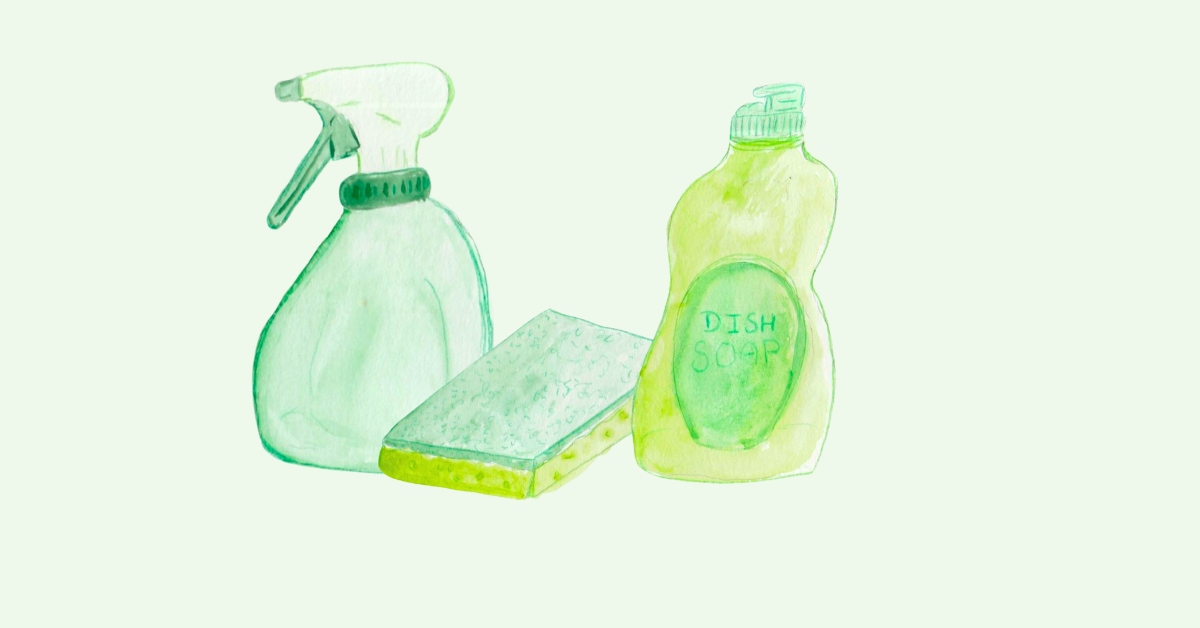
First, a soapy sponge—nothing fancy, just one of the cheap ones, sudsed up with a dish soap that smells good. I go over the countertops once, then let them air dry for a minute. Then I come back in with a second pass: an all-purpose spray. Yes, it helps with disinfection. But for me, this step is mostly about scent.
A few years ago, I fell hard for a grapefruit-scented cleaner, and I’ve never really looked back. It’s a small thing, but it changes the experience of the space in a way that feels immediate and lasting. If you take one note from this, it’s this: find a cleaner you actually want your kitchen to smell like.
That second pass is what shifts the space from “technically clean” to something closer to fresh.
And then, importantly, the cleaning stops.
If you have an extra minute or two, you can add a small finishing touch — something that signals, to you, that you’re done. Light a candle or a bit of incense. Water your plants. Put on a kettle, or set a quick simmer pot on the stove.
None of this is required. It’s just a way of closing the ritual. What you’re left with is a kitchen that feels reset — not perfect, but usable. A space that’s easier to step back into, whether that’s to cook dinner, sit down to work, or tackle a deeper clean tomorrow.
Because that’s really the point. It’s just 15 minutes. It’s not about doing everything. It’s about making it easier to come back.
This story originally appeared in The Bite, my weekly food newsletter for Salon. If you enjoyed it and would like more essays, recipes, technique explainers and interviews sent straight to your inbox, subscribe here.
Read more
from “The Bite”