
Mainstream media rallies for war, again
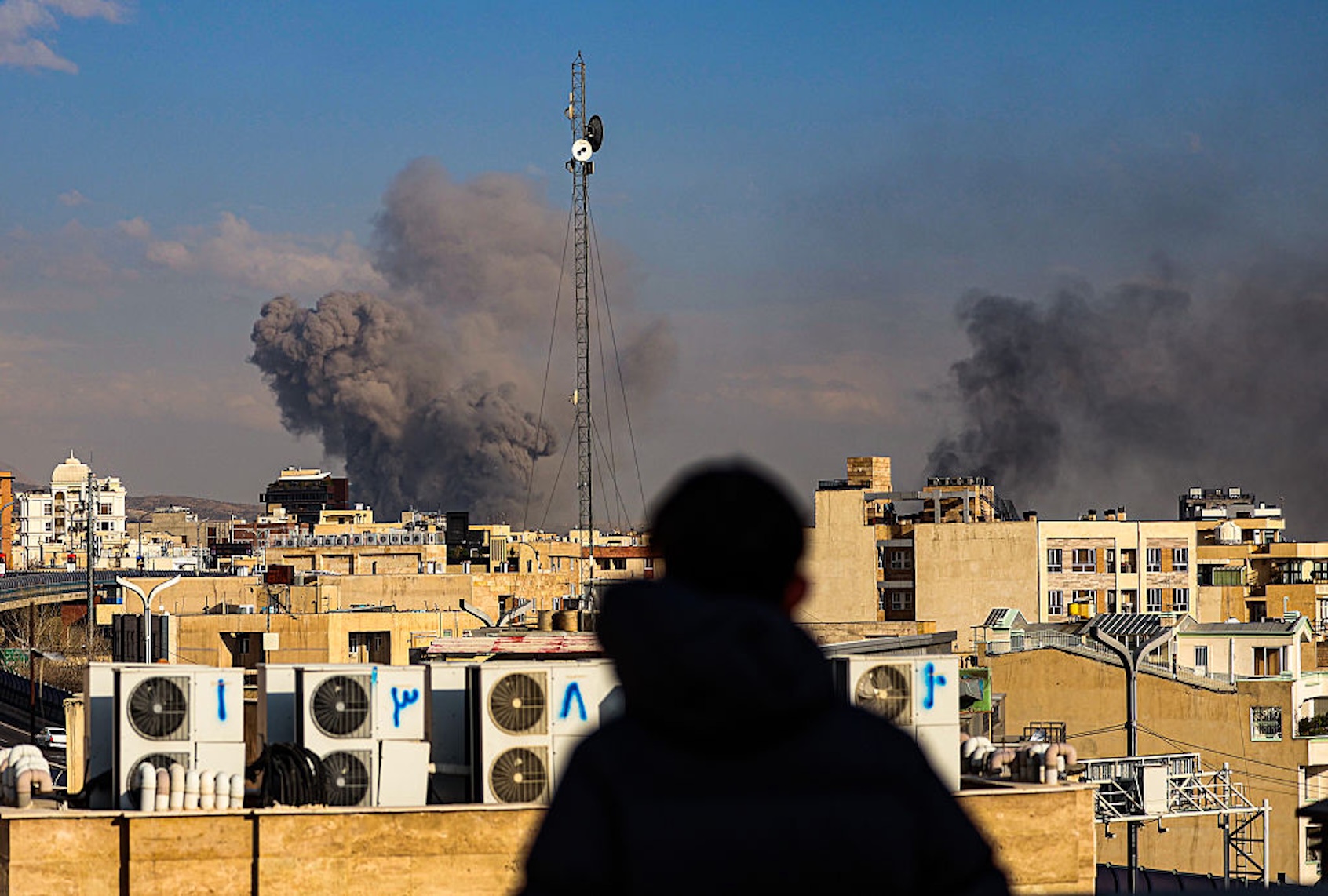
Donald Trump may be a world-upending political force, but in the end, even he could not resist the gravitational pull of American militarism. The lure of legacy, regime change and perhaps political distraction proved too strong when it came to Iran, which the president, in partnership with Israel, attacked with a brutal series of air strikes on Saturday. The campaign, which has continued, is already engulfing the entire Middle East.
There is a ritual in American war-making that predates the particular pathology of Trumpism. The targets shift and the platforms move from broadcast television to social media, but the punditry lusting for regime change fantasies feels eerily familiar.
As if on cue, Bret Stephens is once again cheerleading for intervention on the opinion pages of the New York Times, invoking the language of resolve and credibility that lubricated the invasion of Iraq. On CNN, chief national security analyst Jim Sciutto claimed that U.S. military veterans “are likely welcoming these strikes tonight,” a sweeping assertion offered with the same confidence that once accompanied talk of “shock and awe.” On Fox News, chief political analyst Brit Hume is claiming, like he did in 2003, that Americans support this war of choice. We have been here before: an American president launches strikes in the Middle East, elite opinion closes ranks, the ghosts of quagmires past hover unacknowledged in the studio lights.
Still, there is something disturbingly surreal about this moment.
The president did not deliver a traditional address to the American people on network television, instead posting a hastily-edited eight-minute video statement to Truth Social. Israel assassinated Ayatollah Ali Khamenei, the leader of an adversarial state. American service members are dead — and the president has acknowledged there will likely be more to come. Iranian missiles are flying, hitting Israel and U.S. military outposts and interests throughout the Middle East. And the best the American people receive is a 3 a.m. Truth Social announcement delivered in a MAGA hat. No senior administration officials have appeared on the flagship public affairs programs that, for all their flaws, have long served as a forum for democratic accountability.
Instead of structured briefings, Trump spent the weekend personally calling journalists — more than a dozen of them — fielding one or two questions at a time from the comfort of Mar-a-Lago. He spoke with reporters from The Atlantic, the Washington Post, Axios, the New York Times, ABC News and other media outlets, offering a scattershot array of justifications and timelines. To one outlet, the aim is “freedom for the people” of Iran. To another, perhaps this can end “in two or three days” with a deal. To a third, it might take “four to five weeks,” and he has “three very good choices” to take control in Tehran — until, in another conversation, he suggests those choices are dead.
This is an impulsive president workshopping his war in real time, throwing spaghetti at the wall to see what sticks and knowing full well that rapid-fire phone calls leave no opportunity for sustained follow-up from reporters on the other end of the line.
This is not a commander-in-chief laying out strategy or telegraphing that he has a plan for what comes next for Iran. This is an impulsive president workshopping his war in real time, throwing spaghetti at the wall to see what sticks and knowing full well that rapid-fire phone calls leave no opportunity for sustained follow-up from reporters on the other end of the line. Vague answers go unchallenged, and the public is left with fragments instead of anything remotely coherent. This, of course, is the point.
Meanwhile, Israeli Prime Minister Benjamin Netanyahu has appeared on CNN and the BBC, and has answered questions before the Knesset. It took Trump two full days to offer what could barely be called an update to the American people from the East Room of the White House, saying “We will easily prevail” against Iran. When the president finally addressed the cameras live late Monday morning, he was quickly distracted by talk of the new drapes he planned to install as part of his White House renovation.
For days, Trump had decided to simply outsource that work to his Republican allies in Congress. On CBS News’ “Face the Nation,” Sen. Tom Cotton of Arkansas declared that an eight-minute social media address was “in keeping with presidential custom.” South Carolina Sen. Lindsey Graham — a man who has advocated bombing Iran for years — insisted on NBC’s “Meet the Press” that it does not matter what kind of regime ultimately governs Tehran, so long as “the threats to American interests are gone.” When pressed about whether Trump had a plan to help Iranians achieve regime change after the strikes, Graham bristled. “No, it’s not his job or my job to do this!” he snapped. “You break it, you own it? I don’t buy that one bit.”
That phrase — “you break it, you own it” — was former secretary of state Colin Powell’s famous shorthand for the Iraq debacle, a warning that toppling a regime without a plan invites chaos. Yet on much of mainstream television, the war is being framed less as a constitutional crisis than as a tactical debate. At CBS News, the coverage at times feels reminiscent of how Fox News treated George W. Bush’s march to Baghdad. “60 Minutes” misleadingly asserted on its X account that Iran has nuclear weapons, a claim that goes far beyond the consensus of U.S. intelligence assessments and echoes the faulty certainty about weapons of mass destruction that paved the road to Iraq. Newly installed Editor-in-Chief Bari Weiss appended a fire emoji to a retweet of a clip featuring Masih Alinejad, an Iranian dissident journalist who has been criticizing New York City Mayor Zohran Mamdani after he described the strikes as “a catastrophic escalation in an illegal war of aggression.”
“Mr. Mamdani, you are more than welcome to come to one of my safe houses,” Alinejad wrote.
Want more sharp takes on politics? Sign up for our free newsletter, Standing Room Only, written by Amanda Marcotte, now also a weekly show on YouTube or wherever you get your podcasts.
The Pentagon, for its part, went more than 36 hours without a briefing after major military strikes, bucking a practice of speaking to the press at a time of conflict that goes back to the Vietnam War. When Defense Secretary Pete Hegseth finally addressed reporters on Monday morning, the gathered press included a Jan. 6 rioter who pleaded guilty to disorderly conduct on the grounds of the Capitol in an illustration of the press access the administration has curated: permissive and stripped of institutional accountability. Even when asked a basic question from a friendly outlet — “What are the U.S. objectives in Iran?” a Daily Caller reporter pressed — Hegseth grew defensive. The fact that the war’s primary proponents and leaders can’t or won’t simply answer the question is a problem.
On the battlefield, the situation is far more complex — and dangerous — than the administration’s bravado suggests. Iran has launched relentless missile barrages against American bases across the Middle East and has escalated to targeting airports in allied countries. Bahrain and the United Arab Emirates have faced continuous bombardment. Hundreds of missiles have struck Israel in waves, at times overwhelming the country’s famed air defenses.
Against this backdrop, the MAGA media ecosystem is fractured. Outkick founder and frequent Fox News guest Clay Travis engaged in baseless denialism after reports that a strike hit a girls’ elementary school, killing dozens. Manosphere influencer Andrew Tate boasted online about “dancing” as bombs fell over Dubai, while Nick Fuentes fumed about a betrayal of “America First.” Erik Prince expressed disappointment, questioning how the strikes align with MAGA commitments. Daily Wire co-founder Ben Shapiro, by contrast, hailed the operation as “extraordinary” and praised its branding as “top notch.”
Even Elon Musk found a way to monetize the moment, boasting that the bombing campaign drove record traffic to X.
When we talk about media failures and war, we refer to them in the past tense. The lessons of Iraq, we say. The failures of the press corps to challenge the Bush administration’s weapons of mass destruction claims. But something gets lost in that framing and choice of verb tense. It’s as if those lessons were learned and filed away, and the profession moved on.
But the profession did not move on. Despite all the changes that have happened since 2003, including the rise of social media, citizen journalists, the decline of legacy media and an unrelenting news cycle, the same incentive structures have endured. The same access journalism — the implicit bargain in which reporters trade critical distance for proximity to power — remains.
Donald Trump’s war on the media has paid off. When the president bypasses traditional forums, it feels like just another norm shattered in an endless stream of shattered norms. When he declines to brief the public in a sustained way, it barely registers. When contradictions pile up, they are chalked up to style rather than substance. In the end, however, the punditry did not need to be coerced into cheerleading. It just needed, as it always has, the opportunity.
Read more
about Iran