
What “Marty Supreme” loses in its quest to be the best
One Friday morning last November, A24 and Timothée Chalamet cross-posted an 18-minute-long video to their respective social media platforms. The clip, cleverly titled
“Timothee_Chalamet_internal_brand_marketing_meeting_MartySpreme_11.08.2025.mp4,” sees Chalamet playing a version of himself in a fake Zoom meeting with what is ostensibly A24’s marketing team for the actor’s latest film, “Marty Supreme,” ready to bounce their ideas off the Chalamet.
To the team’s surprise, Chalamet has come prepared with his own set of promotional tactics for director Josh Safdie’s breakneck-paced film about Marty Mauser, a fictional 1950s ping-pong prodigy who will stop at nothing to achieve greatness. Chalamet’s marketing deck is full of outrageous, sky-high ideas, like an orange blimp that drops ping pong balls as it sails over Los Angeles. When a member of the marketing team chimes in to suggest that might be a safety hazard, Chalamet volleys back: “If it’s the difference between someone losing an arm putting out the movie, but someone gaining an arm intellectually when they see it, I’m a fan of the latter.”
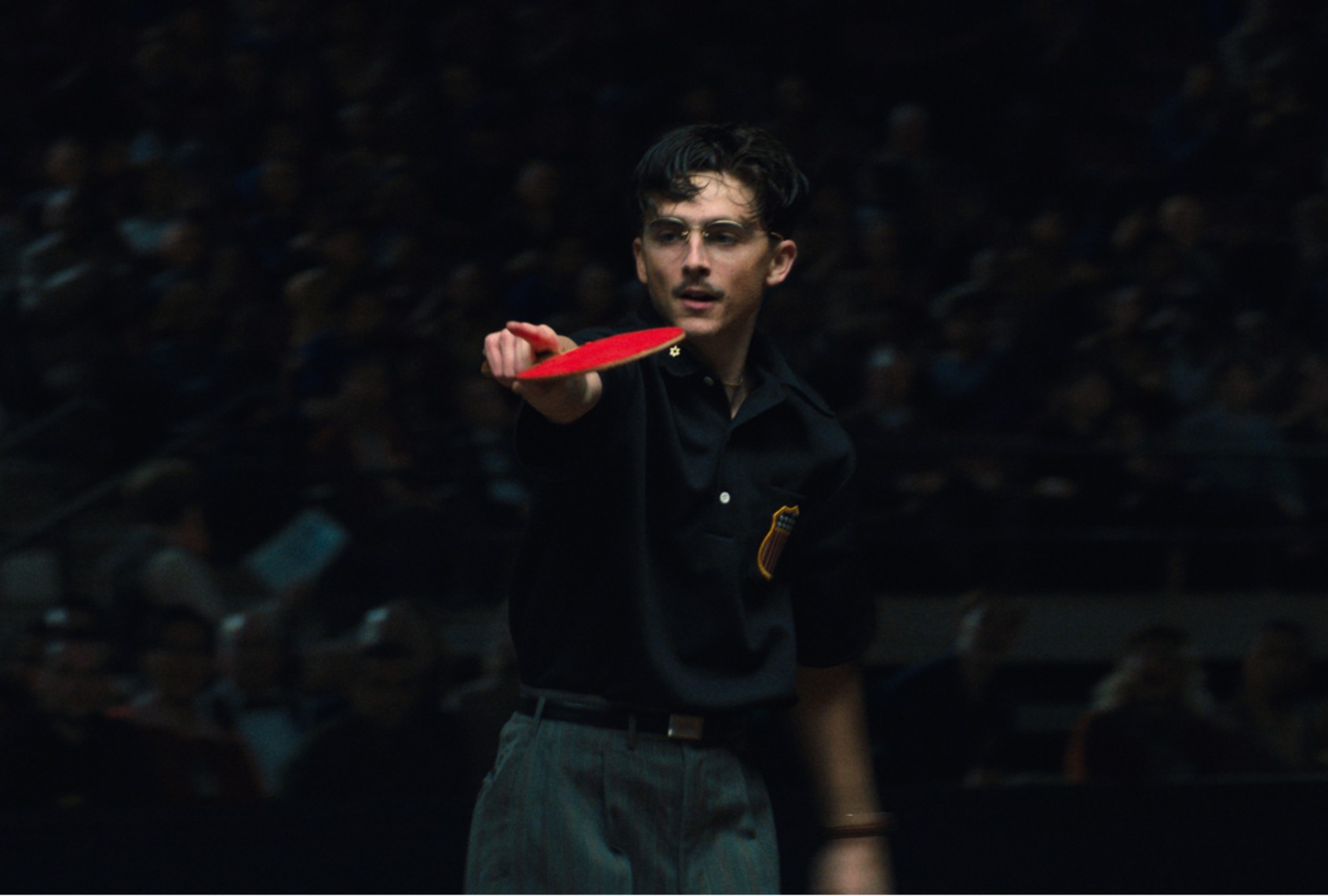
(A24) Timothée Chalamet as Marty Mauser in “Marty Supreme”
Chalamet’s shameless drive rubs some the wrong way. Pride can make the line between confidence and arrogance so thin it disappears. And in “Marty Supreme,” Chalamet has found an instantly career-defining role playing a version of himself, equally matched in fervor and sick persistence.
Chalamet is, of course, playing a character — an outsized version of himself, built atop the already aggrandized persona he’s become known for in his relatively short career. Earlier this year, I wrote about how Chalamet’s stunts promoting his Bob Dylan biopic, “A Complete Unknown,” were a refreshing take on the modern movie promo tour, complete with wigs, college campus rallies and abstract social media videos. Chalamet was going all-out, making an unabashed bid for his long-coveted Oscar, yet none of it worked. The film was a snooze, hardly worth the actor’s mighty talents. Chalamet, however, hasn’t been deterred, rightfully pushing his Oscar-hungry image to new heights in the “Marty Supreme” press tour, creating a symbiotic thread between the film’s ambitious table tennis star, the determined actor playing him, and the real Chalamet, who fits somewhere in between.
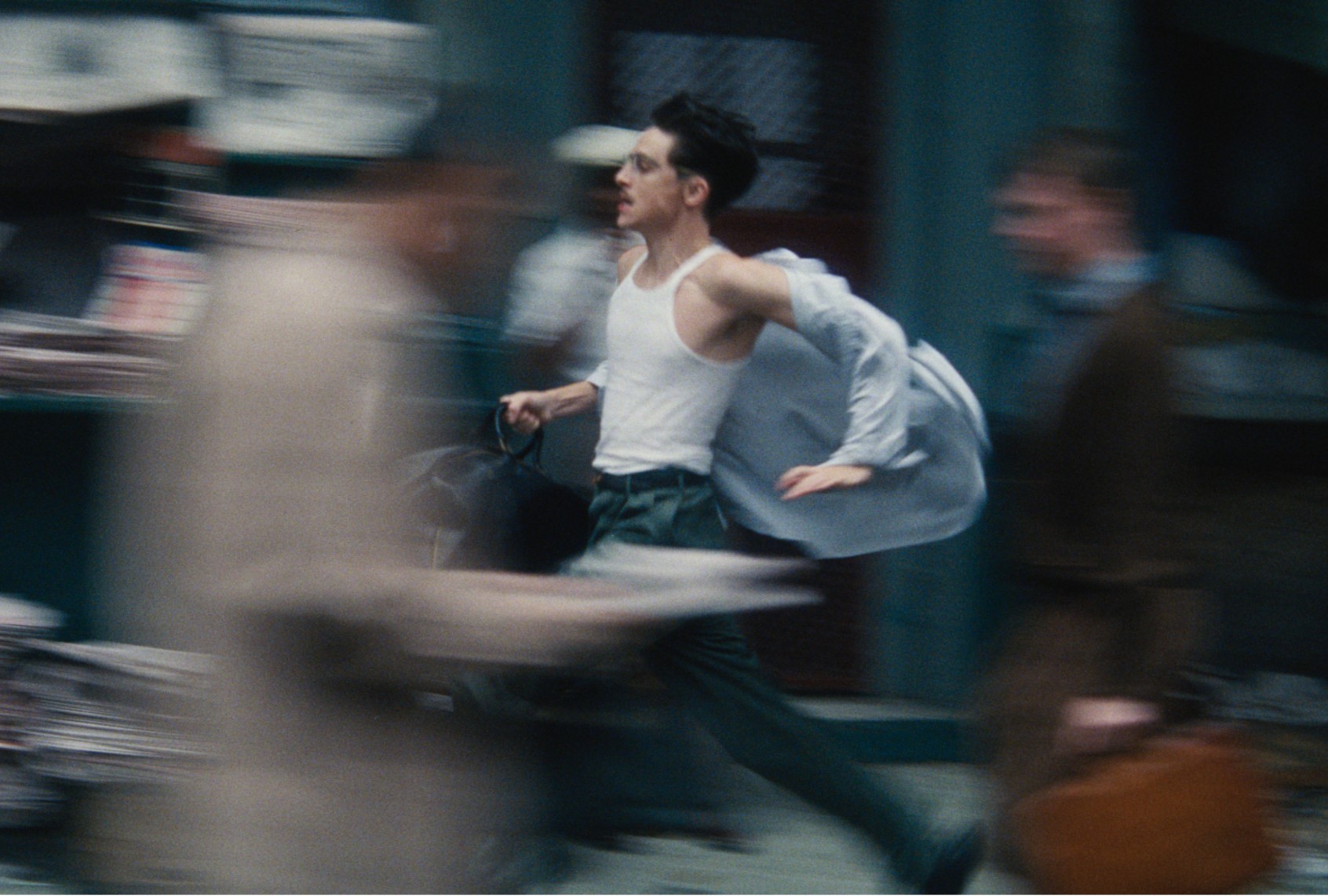
Unsurprisingly, Chalamet’s shameless drive rubs some the wrong way. By his own words, Chalamet is in pursuit of greatness and believes he’s been turning in “top-of-the-line” performances for almost a decade. (And, I’ll add, he isn’t wrong.) But knowing your talent, speaking to it, and refusing to apologize for it can be alienating and lonely. Pride can make the line between confidence and arrogance so thin it disappears. And in “Marty Supreme,” Chalamet has found an instantly career-defining role playing a version of himself, equally matched in fervor and sick persistence. It’s a gripping feat, watching Marty barrel through New York City streets, sprinting toward a question with no answer, wondering which direction will take him to the top. But amid all that crackling electricity, everything around Marty begins to blur. Characters who could sharpen the story into something even more emotionally potent are left in the dust as mere stepping stones to propel the film’s central narrative. In this way, “Marty Supreme” is a meta tale of what’s expendable on the quest for glory; not just what Marty loses, but what Chalamet and Safdie are willing to sacrifice to make one of the finest films of the year.
A little effusive charm goes a long way in dismissing all of the showboat swagger that Chalamet and Marty share, and that natural allure is what makes the actor and his latest — and perhaps greatest — character not just tolerable, but lovable. From the moment Marty, working as a clerk in a shoe shop, helps an elderly woman find the perfect pair of pumps in the film’s opening sequence, the starpower is undeniable. This kid’s got the stuff. He could sell a pair of Mary Janes to a giraffe if it meant earning an extra lick of commission to use for his trip across the pond for the table tennis semi-final tournament he believes will cement his name.
Want more from culture than just the latest trend? The Swell highlights art made to last.
Sign up here
But already, Marty’s dodging obstacles. Things don’t come easily for this scrawny, pimple-faced prodigy, especially when the goal is becoming the proud, Jewish face of a burgeoning sport. Marty’s uncle Murray (Larry Sloman) wants him to step up to manage the shoe store, which would conveniently keep him local to help his mother, Rebecca (Fran Drescher), with her many faux health scares and nagging requests. And then there’s Rachel (Odessa A’zion), Marty’s best friend since childhood, determined to lock Marty down despite living one story below him with her husband. None of this is any concern of Marty’s. Table tennis is the only thing on his mind, and not just table tennis, but being synonymous with the sport — of being the only player left standing as the opponents dwindle and the room quiets to a galvanized hush. In Marty’s mind, he’s already a star, and stars can take five-hour lunches from their minimum wage jobs. But when Uncle Murray refuses to pay up, and Marty has to pilfer the money for his trip, the road to global eminence takes some sharp turns.

(A24) Gwyneth Paltrow and Timothée Chalamet in “Marty Supreme”
The viewer’s in for an unexpected twist, too, seeing as all of these characters but Rachel will soon be afterthoughts, tossed aside to maintain a constant laser focus on Marty’s hijinks. One might assume Drescher’s presence on the call sheet would equate to a sizable role in the film. Frustratingly, that’s not so. By the time Marty’s competing in his tournament, family is the last thing on his mind. He tells reporters as much during a mini junket he organizes for himself over breakfast at the Ritz London, where Marty puts himself up despite having no way to pay for such luxurious accommodations. Marty tosses out the bald-faced lie that his mother died in childbirth with the nonchalance of ordering another coffee, before the orbital pull in the room shifts. Enter Kay Stone (Gwyneth Paltrow), a once-renowned, now-retired film actress waltzing across the lobby with her husband, the pen and ink magnate Milton Rockwell (Kevin O’Leary). All of the attention, including Marty’s, is on Kay, and when Marty Mauser sets his sights on something, he sees in tunnel vision. It’s not enough to be the best in the world; he has to screw the most adored person in the room, as if to subsume Kay’s glow. Everything — sex, sport and spite — is a means to an end.
Safdie and Chalamet work the same way. The film is as much a meta story of Chalamet’s ambition as it is Safdie’s. If you’ve been witness to what the director and his brother, Benny, did with their pair of raucous shockers “Good Time” and “Uncut Gems,” you can guess what might be ahead: The stakes must always get higher, no matter the cost. Safdie raises them once more when Marty battles Koto Endo (table tennis star Koto Kawaguchi), the highly ranked Japanese player poised to be Marty’s only competition. Both Marty and Endo have a chance to bring glory to their people in a post-war world. Marty sees winning as a much-needed public victory for the Jewish race, while Endo’s is a triumph for Japan after America’s relentless and atomic destruction. Their rivalry presents fascinating and dynamic challenges for the viewer to chew on, but only Marty’s character is truly rewarded with the extra depth. Endo is, by and large, a footnote in Safdie’s exploration of the perils of post-war nationalism, there to be Marty’s foil and another narrative inflection point.

(James Devaney/GC Images/Getty Images) Timothée Chalamet on the set of “Marty Supreme”
“Marty Supreme” is not just a film; it’s a hypothesis. Safdie and Chalamet are covertly pushing the limits. How much can the public, the press and the Academy voters take?
Though, as eager as I am to understand more about those standing in Marty’s way, the more I find myself thinking “Marty Supreme” wouldn’t be half the film it is if Safdie lingered on anyone but his titular striver for too long. Too much time spent on Marty’s mother or his fierce opponent would distract from the film’s momentum, reducing it to simply a sports movie, and not a conclusive treatise on the cruelty of desire.
These casualties are aggravating, sure, but they allow Chalamet’s star to shine so bright that it blinds. Marty lures his foes and his friends with the same ease that Chalamet draws the viewer. A simple, flirtatious phone call between Kay and Marty is Chalamet’s greatest proof of concept yet: a swooning, debonair and slightly arrogant display of wanton charisma. Safdie and Chalamet are showing off, and it works. This is Chalamet’s whole thing, his it factor in full, glorious view. The silver screen hasn’t seen such a cocksure performance since the tabloid heartthrobs from the turn of the millennium. And yet, never lose sight of the fact that Chalamet is exactly the same person when the director calls cut. To aim the spotlight anywhere else for too long would be a disservice to the world, just the way Marty feels about his talents being squandered by everyone back in New York, hoping he’ll conform to a life he doesn’t feel destined for. When Kay asks him what he’s thought about doing if he doesn’t win, Marty replies, “That doesn’t even enter my consciousness.” No doubt Chalamet shares this single-mindedness.
“Marty Supreme” is not just a film; it’s a hypothesis. Safdie and Chalamet are intent on making the best possible version of what this movie can be, yes, but they’re covertly pushing the limits. How much can the public, the press and the Academy voters take? Will the relentless pursuit of distinction in your field always alienate those around you — and in turn, keep your goals forever out of reach — as it does for Marty, or is this level of ambition so undeniable it must be rewarded? That orange blimp Chalamet jokingly suggested did, in fact, happen, just without the ping-pong balls dropped from the sky. And Chalamet has been hopping from New York to London to Brazil, touting “Marty Supreme” as his crowning achievement. The distinction between actor and character is hazy at best, and that’s all part of the experiment.
Whatever Oscars “Marty Supreme” happens to pick up next year will be the defining measure of what Chalamet and Safdie are doing together with this project. The film is a brilliant, madcap, offensive, all-American, seat-gripping crowdpleaser because Chalamet and his director are the way they are: motivated to a fault, happy to pad their film with all the right elements and disperse them when they’re no longer needed. While Safdie deeming those aspects disposable keeps “Marty Supreme” from being a truly perfect film, it wouldn’t be half as good if its concentration drifted from Marty for more than a minute. There’s a limit to how well-rounded this particular film can be. For Marty and his namesake film, perfection is not attainable. But sometimes, its pursuit delivers something even more interesting and memorable than a banal picture of perfection: someone to root for, flaws and all.
Read more
about movies that moved us in 2025