
Presidential Fertiliser Initiative generates ₦61.58bn savings – FG
By Gabriel Ewepu
The Federal Government, on Monday, disclosed that early procurement under the Presidential Fertiliser Initiative has generated ₦61.58 billion in savings as Nigeria targets the delivery of 1.1 million metric tonnes of fertiliser in 2026 amid renewed efforts to boost food production and strengthen the country’s agrifood system.
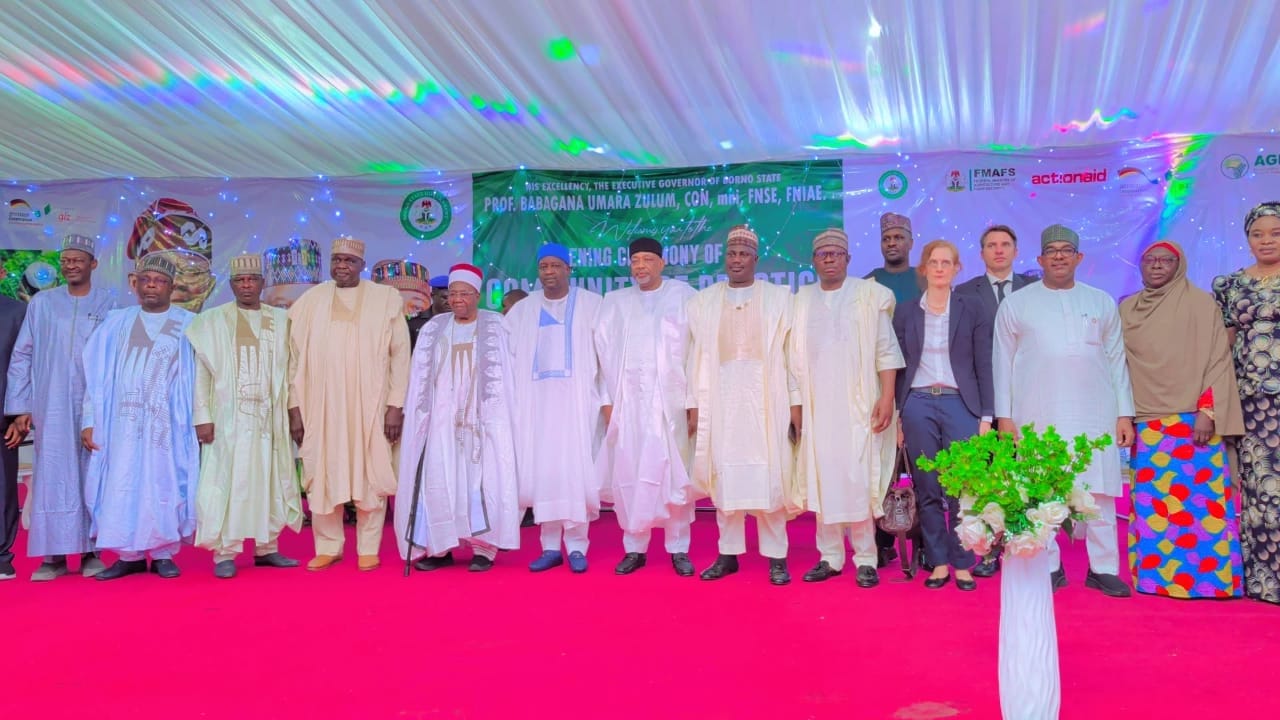
The disclosure was made by the Minister of Agriculture and Food Security, Senator Abubakar Kyari, at the Annual Community of Practice (CoP) Meeting on the implementation of the Comprehensive Africa Agriculture Development Programme (CAADP) Kampala Declaration, held yesterday in Maiduguri, Borno State.
Kyari also said the government targets the delivery of 1.1 million metric tonnes of fertiliser in 2026 amid renewed efforts to boost food production and strengthen the country’s agrifood system.
Kyari said the Federal Government, state governments, non-state actors and development partners were working together to translate the Kampala Declaration into concrete action capable of improving food security, strengthening rural economies and building resilience across Nigeria’s agricultural sector.
He said the collaboration had become more urgent as Nigeria begins implementation of the CAADP Kampala Declaration and its Strategy and Action Plan for 2026–2035, which adopts a broader agrifood systems approach covering sustainable production, investment and finance, food and nutrition security, trade, inclusion, resilience and governance.
According to the minister, the Federal Government’s efforts were already yielding results, with reductions of up to 50 per cent in the prices of some essential food commodities, alongside expanded input delivery, rural infrastructure investments and support for smallholder farmers.
“The task now is to sustain these gains and deepen their impact,” Kyari said.
He stressed that closer alignment between the Federal Government, states and development partners was critical to achieving sustainable food security.
“Alignment between the Federal and State Governments and partners is indispensable to sustainable food security and resilient livelihoods.
“That alignment must translate into compatible policies, reliable data, complementary investments and clarity of responsibility for delivery. We need one coherent agrifood system in which national direction and State-level execution reinforce one another,” he said.
The minister said Nigeria’s newly validated 10-Year National Agrifood System Strategy and Action Plan would serve as the vehicle for domesticating the Kampala commitments and harmonising implementation across the country.
He explained that the strategy integrates CAADP Biennial Review indicators into Nigeria’s planning, budgeting and reporting systems, while efforts were underway to align national and state budgets, reduce duplication and channel investments towards agreed priorities.
Kyari also announced that the government was pushing ahead with a new mechanisation drive following the unveiling of the National Agricultural Mechanization Policy and National Agricultural Mechanization Investment Strategy in August.
He said the framework would move the country away from fragmented equipment interventions towards a sustainable mechanisation ecosystem, including plans for a mega tractor assembly plant capable of producing between 2,000 and 4,000 tractors annually.
“We are also expanding all-season production through irrigation, improving access to quality seed, supporting our National Agricultural Research Institutes and strengthening the translation of research into practical solutions for farmers,” the minister said.
He added that the Special Agro-Industrial Processing Zones were designed to link production areas more effectively with processing facilities and markets, stressing that such investments must be integrated with rural infrastructure, extension services, agricultural finance, nutrition and sustainable management of land and water resources.
On the broader agricultural strategy, Kyari said Nigeria could not afford a one-size-fits-all approach, given the country’s diverse agricultural potentials.
He said the National Agricultural Technology and Innovation Policy recognises the distinct production potentials and natural-resource endowments of Nigeria’s five major agricultural zones.
“Our task is to build on those comparative advantages with adaptable technologies, infrastructure and market linkages, rather than expect every State to produce everything,” he said.
The minister also called for greater participation of women and young people across agricultural value chains, as well as stronger conditions for private investment and development finance.
He challenged state governments to ensure that their agricultural action plans were aligned with the Kampala commitments and national priorities, particularly in rural infrastructure, extension, credit, quality inputs, labour-saving technologies, post-harvest loss reduction and climate-resilient agriculture.
The Governor of Borno State, Prof. Babagana Zulum, represented by his Deputy, Hon. Usman Kadafur, described the meeting as more than a gathering of policymakers, development experts, researchers, farmers and private-sector actors.
He said the Community of Practice should serve as a platform for translating shared experience into practical solutions for Nigeria’s agricultural sector.
“A Community of Practice should not simply be a gathering where ideas are presented and applauded. It should be a platform where experience becomes knowledge, knowledge becomes action, and action produces measurable improvement in the lives of our people”, Zulum said.
Also speaking, the Head of Development Cooperation at the German Embassy in Nigeria, Dr Karin Jansen, said Germany welcomed Nigeria’s leadership in implementing the CAADP Kampala Agenda and remained committed to supporting the country in moving from commitments to coordinated action.
Jansen said transforming Nigeria’s agrifood system required stronger cooperation between the Federal Government and states, alongside active participation by non-state actors.
She identified the Community of Practice as a critical mechanism for linking national priorities with implementation at the state level, while providing room for knowledge exchange, learning and joint problem-solving.
She said Germany, through the Sustainable Agricultural Systems and Policies (AgSys) project, funded by the German Federal Ministry for Economic Cooperation and Development (BMZ) and implemented by the Deutsche Gesellschaft für Internationale Zusammenarbeit (GIZ), was supporting Nigerian partners to strengthen agricultural policy processes, scale successful approaches and deepen civil society participation.
In his closing remarks, the Minister of State for Agriculture and Food Security, Senator Aliyu Sabi Abdullahi, said Nigeria’s path to food security depended on states identifying and exploiting their respective comparative advantages.
He warned against the siloed approach of the past, arguing that agricultural development must reflect the specific strengths and potentials of each state.
Abdullahi also stressed the need for greater coordination among government ministries and agencies, particularly those responsible for agriculture, health, environment and rural development.
“The challenges facing our agrifood systems are multidimensional. They require the kind of integrated, multi-sectoral approach that we have championed here.
“The synergy between the Ministries of Agriculture, Health, Environment and Rural Development is not merely a bureaucratic ideal; it is a practical necessity”, he said.
He noted that the relationship between food production, nutrition, environmental sustainability and rural development remained central to Nigeria’s economic prosperity.
The Maiduguri meeting was attended by Commissioners of Agriculture, Livestock, Fisheries, Health, Environment, Commerce and Rural Development, as well as researchers, farmers, private-sector operators, development partners and other stakeholders in the agricultural sector.