
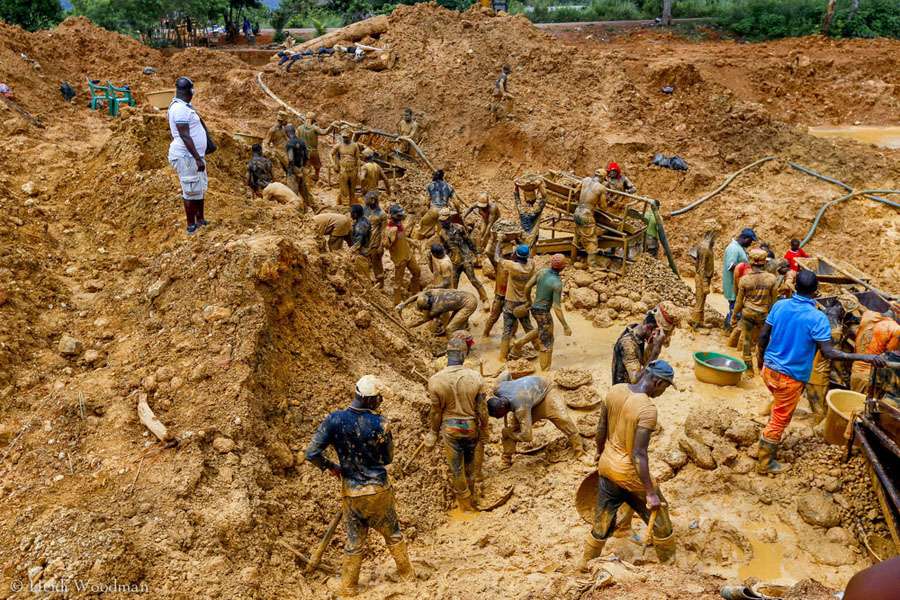
Mad rush into deadly pits for gold: 374 illegal mining sites in 17 states uncovered
•Reports say 156 dead
•NASS C’ttee: This is a sophisticated national threat…with implications for security, revenue generation
•How it fuels child labour
By Shina Abubakar, Femi Bolaji, Ibrahim Hassan-Wuyo, Golok Nanmwa, Jeff Agbodo, James Ogunnaike and Deola Badru
Illegal mining, an economic and environmental offence, has assumed a more troubling dimension in Nigeria, with security agencies, regulators and community leaders increasingly warning that the illicit exploitation of the country’s mineral resources is becoming a national security concern.
In parts of the North-West and North-Central, the activity has intersected with banditry, kidnapping and other forms of organised crime, while in other parts of the country, it is fuelling conflicts over land, destroying farmlands and forests, polluting water sources and leaving behind dangerous mining pits.
Recently, the Nigeria Security and Civil Defence Corps, NSCDC, which has responsibility for the Mining Marshals, described illegal mining as a major national security threat, saying the problem had gone beyond an economic crime and required intelligence-driven and coordinated enforcement.
Concern
The concern has also reached the National Assembly, with the House of Representatives Committee on Mineral Exploitation, Security and Anti-Money Laundering describing illegal mining as a “sophisticated national threat” with far-reaching implications for security, revenue generation, environmental sustainability and governance.
Concerned by the situation, the Federal Government responded with a combination of enforcement, prosecution and attempts to formalise artisanal mining.
However, concerns remain over the effectiveness of these measures.
Accordingly, Mining Marshals, established under the NSCDC, have been deployed across the country to identify and shut illegal sites, arrest suspects and protect licensed mining areas.
Last month, the Minister of Solid Minerals Development, Dele Alake, said the Mining Marshals had identified 374 illegal mining sites, cleared 108, arrested 743 suspects and prosecuted 165 cases involving 430 accused persons, with five convictions secured.
Operations
Also, NSCDC reported hundreds of arrests and the shutdown of numerous illegal sites, insisting that its operations are increasingly based on intelligence gathering and collaboration with other security and regulatory agencies.
But the actors behind the illicit trade are not limited to rural miners who wield shovels and pickaxes at the sites.
Checks by Sunday Vanguard showed a multilayered chain involving artisanal miners, labourers, mineral buyers, middlemen, financiers, processors and, in some cases, foreign nationals.
The authorities have particularly raised concerns about the participation of some foreigners in unauthorised mining and mineral trading.
In May 2026, Alake disclosed that more than 327 people, including foreign nationals, had been apprehended for illegal mining, with some cases involving suspected links to terrorism handed over to the Office of the National Security Adviser for further investigation.
He said the government had also revoked about 3,000 mining licences as part of efforts to sanitise the sector.
Among the foreign nationals repeatedly appearing in recent enforcement operations are Chinese nationals.
In May, the NSCDC Mining Marshals arraigned 15 Chinese nationals and nine Nigerians before the Federal High Court in Abuja over alleged illegal lithium mining in Kokona Local Government Area of Nasarawa State.
In September, four Chinese nationals were arrested in Maiya’aki, Lapai Local Government Area of Niger State, over alleged unauthorised mining activities at a site where they reportedly had no valid licences.
Earlier, an EFCC court filing alleged that Chinese and Nigerian nationals were involved in the illegal extraction and trading of mica and lithium, with some of the minerals allegedly moved to Ogun State for processing and export through Lagos.
Character
Sunday Vanguard observed that the scale and character of illegal mining vary from state to state. In Zamfara, gold mining has intersected with banditry and other forms of insecurity.
In Plateau, unsafe mining practices have been linked to repeated deaths, while Taraba has witnessed repeated government orders suspending mining activities.
In Osun, illegal gold mining has been associated with environmental degradation and clashes involving enforcement personnel.
Nasarawa has emerged as a major lithium-mining frontier, attracting both local and foreign operators, while in Benue, mining activities have taken place alongside displacement and insecurity.
State-by-state findings revealed the locations of mining activities, the minerals involved, the actors operating in the sector, the environmental consequences, reported deaths and the response of governments and security agencies.
ZAMFARA: Gold, banditry
Illegal gold mining remains a major concern in Zamfara State, particularly around Maru, Anka, Bukkuyum, Talata Mafara and Zurmi.
Not every miner operating in these areas is involved in criminal activity.
Many rural residents depend on artisanal mining for income.
However, security concerns become more pronounced where unregulated mining overlaps with armed groups and weak state control.
In April 2025, an attack in Gobirawar Chali, Maru Local Government Area, reportedly left at least 19 people dead, while Amnesty International said more than 20 people were killed.
There have also been reports alleging that a terror kingpin demanded protection levies from gold miners in Zurmi.
The allegations could not be independently verified.
In September 2025, a mining pit collapsed in Kadauri, Maru Local Government Area, with reports indicating casualties, although the exact number was not immediately established.
The environmental consequences have also been serious, with mining activities affecting farmland and vegetation and raising concerns about the pollution of water sources.
Despite repeated enforcement operations, illegal mining has persisted, highlighting the challenge of combining surveillance and enforcement with formalisation and alternative livelihoods for communities dependent on artisanal mining.
NIGER: Gold, multiple minerals
Illegal and unauthorised mining activities have been reported across several parts of Niger State, including Lapai, Katcha, Kontagora, Mariga, Minna, Shiroro, Rafi, Suleja, Agwara, Borgu, Munya and Paikoro.
Gold mining is particularly prominent in areas including Minna, Kontagora, Rafi, Paikoro, Magama and Shiroro, while the state also has deposits of talc, feldspar, iron ore, beryl, amethyst, tourmaline, graphite, kyanite, manganese, mica, wolframite, marble, lead, copper and topaz.
In Lapai, four Chinese nationals were arrested in September 2026 at Maiya’aki over alleged unauthorised mining activities.
Similar concerns have been raised in Katcha, including the Zuzungi area, where alleged unauthorised mining by Chinese nationals attracted enforcement attention.
Authorities have also shut down mineral-processing sites in Kontagora as part of efforts to curb illegal activities.
The state came under national attention in September 2026 after 37 suspected illegal miners died while in NSCDC custody.
The circumstances surrounding the deaths are under investigation, while the Federal Government has constituted an independent 10-member committee to investigate the incident.
PLATEAU: Multiple disasters, deaths
Plateau State has witnessed a succession of mining-related accidents, attacks and other incidents resulting in significant loss of lives.
Mining activities are concentrated in areas including Barkin Ladi, Jos South, Bassa, Riyom, Wase, Bokkos and Mangu.
In November 2024, 13 people reportedly died following a mining-site collapse around the boundary of Bassa, Jos South and Jos North local government areas.
Four people died in another mining-site collapse in Dura, Jos South, in September 2025.
In December 2025, 12 people were reportedly killed in an attack at Ratoso Fan in Barkin Ladi, while seven others were killed in a shooting incident at Kuru, Jos South, in January 2026.
In February 2026, at least 37 people died at Kampanin Zurak in Wase Local Government Area following exposure to toxic gas at a mining site.
Five people were killed at Gero Village, Gyel, in Jos South, on June 16, 2026, while three others were killed at Nyango-Gyere on June 30, with two others injured.
On August 12, seven people died in a mining-pit collapse in Kassa, Barkin Ladi, while two others were killed in another incident in Gangare, Barkin Ladi, on September 23.
The reported deaths amount to 90.
Concerned by the situation, Governor Caleb Mutfwang, in February 2025, issued Executive Order 001 suspending mining activities across 17 local government areas.
In May 2025, the state government said 159 operators had been cleared to operate under various categories, including six mining licences, 15 small-scale mining leases, 15 exploration licences, five artisanal and small-scale mining permits, one quarry lease and 118 tin sheds and buying centres.
However, the remote and scattered nature of mining sites, coupled with reports of night operations, has continued to pose challenges to effective monitoring.
KOGI: Battle for gold, others
Kogi State Government has expressed concern over illegal mining, particularly in areas where mining activities have affected communities and the environment.
In September 2026, Alake, while responding to protesting youths in the state, described illegal mining as a major concern.
He said Mining Marshals had dislodged illegal miners operating in a licensed area in Yagba East Local Government Area.
The minister said investigations indicated that some of the illegal miners were indigenes and alleged that some elders, traditional rulers and local government functionaries supported the activities.
The Concerned Kogi Youths Against Environmental Degradation had protested against the impact of mining in areas including Ankpa and Omala, alleging that the activities had damaged roads, destroyed farmland and polluted water sources.
Kogi is endowed with coal and other mineral resources, making regulation and monitoring of mining activities a continuing challenge.
NASARAWA: Lithium frontier
Nasarawa State has emerged as one of the country’s important lithium-mining areas, with activities particularly reported in Kokona, Wamba and Nasarawa Eggon local government areas.
The state has attracted both local and foreign operators, leading to increased regulatory and security attention.
In May 2026, 15 Chinese nationals and nine Nigerians were arraigned before the Federal High Court in Abuja over alleged illegal lithium mining in Kokona Local Government Area.
Concerns have also been raised over the safety of workers and possible child labour at mining sites.
In September, special monitoring and enforcement teams intensified checks on mining operations, particularly to ensure that operators remained within licensed coordinates.
TARABA: Repeated suspensions
Across the forests, rugged mountains and river basins of Taraba State, illegal mining has emerged as a major environmental and security concern. Taraba sits atop deposits of gold, blue sapphire, topaz, lead, zinc and lithium.
Yet, over the years, these resources have increasingly attracted unauthorised mining activities.
Unauthorised miners have moved into parts of the state, including forest reserves and rural settlements. The most intense activities have been reported around Mayokam and Gangtu in Bali, the Mambilla Plateau in Sardauna, Takum, Ardo-Kola and Gassol.
Security profiling and intelligence reports indicate that some mining camps involve migrant labourers and undocumented foreigners from Cameroon.
Security agencies have carried out raids in several areas, arresting hundreds of miners reportedly from Zamfara, Katsina and Bauchi states.
The activities also involve networks of middlemen, mineral buyers, financiers and operators of heavy equipment.
Governor Agbu Kefas has issued three Executive Orders suspending mining activities since 2023, including another suspension in June 2026.
Illegal mining has been documented across Sardauna, Karim Lamido, Bali, Gashaka, Kurmi, Ussa and Yorro local government areas.
A Premium Times investigation estimated that the state could lose more than N10 billion annually to illegal mining.
On September 18, 2026, five alleged illegal miners died following a mining-pit collapse in Mayokam, Bali Local Government Area.
A task force subsequently dispersed miners and seized equipment, with reports indicating that some of the miners were from Zamfara, Bauchi and Sokoto states, as well as Cameroon and Chad.
EBONYI: Abandoned pits, deaths
Ebonyi State is endowed with mineral resources including limestone, zinc, lead, chalcopyrite and oxide.
While mining licences are issued by the Federal Government, the state government has environmental and community-level responsibilities, creating an additional layer of regulation and enforcement.
The state has faced allegations of unlicensed mining operations, poor environmental practices and failure by some operators to carry out required environmental impact assessments.
Mining activities and abandoned pits have been reported in areas including Abakaliki, Ikwo, Izzi, Ezza South, Ebonyi and Ishielu.
The state government, in collaboration with the NSCDC, has announced measures against illegal mining and unauthorised mineral trading.
Abandoned mining pits have remained a major concern in communities including Okposi Umuoghara, Enyigba, Ameka and Ishiagu.
There have also been allegations of child labour and the involvement of pregnant women in mining activities.
The state government inaugurated a Solid Minerals Task Force to seal illegal sites, confiscate equipment and stop night-time rock crushing and the movement of mineral-laden trucks.
Licensed operators are expected to comply with the Mining Act, display appropriate signposts, pay required revenue, refrain from night operations, conduct environmental impact assessments and enter into Community Development Agreements where applicable.
The Commissioner for Solid Minerals, Mt Magnus Nkah, during visits to mining communities in Ishielu and Ohaukwu, warned operators to comply with safety requirements.
“The welfare of workers is equally important because these workers are our people. Many companies have not paid sufficient attention to their welfare,” he said.
The government has also raised concerns about inadequate safety standards and delays in implementing community development agreements and other obligations, including scholarships.
The ministry said it would issue compliance templates and deadlines, while the task force would monitor operations and work to eliminate revenue leakages.
Night-time transportation of minerals has also been declared illegal in affected areas.
The dangers posed by abandoned pits have already resulted in deaths.
Community youth leader Ogochukwu Elem said one abandoned pit had remained open for about 10 years after an earlier incident.
At Okposi Umuoghara, a truck driver and his assistant reportedly died after falling into a mining pit. A motorcycle operator later died after falling into the same pit when his brakes reportedly failed, while a cyclist also died in the area.
The incidents accounted for at least five deaths.
In Ezza North, three suspects were arrested by the NSCDC over alleged illegal mining, while the site was sealed.
BAUCHI: Mining, insecurity concerns
Illegal mining has become a security concern in parts of Bauchi State, particularly in Alkaleri and neighbouring border communities.
In August 2026, Governor Bala Mohammed identified illegal mining in the area as a major contributor to insecurity and banditry and warned influential individuals allegedly involved in the activities that they could face prosecution.
Illegal mining does not automatically cause banditry. However, the presence of valuable minerals and uncontrolled mining operations can create opportunities for armed groups and other criminal networks to exploit weak regulation and security gaps.
KADUNA: Gold, tin, lithium
Mining activities have been reported in Birnin Gwari, Sanga, Jema’a and Kubau local government areas of Kaduna State.
The state has deposits of gold, tin, tantalum, lithium and gemstones.
A 2024 study identified 103 mining sites across 36 communities in four local government areas, comprising 53 active and 50 abandoned sites.
The study identified Jema’a and Birnin Gwari as major areas of activity, while Sanga and Kajuru also recorded mining operations.
In Birnin Gwari, communities including Fara Ruwa, Bugai, Dagara, Awaro, Tashan Keji, Sabon Layi, Dawakin Basa, Kungi, Janruwa, Maganda, Tsohon Gwari, Randagi and Rema have reported mining activities involving gold, tin, tantalum and tourmaline.
At a gold-mining site around Bugai, about 16 kilometres from Birnin Gwari, miners described the activity as an important source of livelihood, although many operators remain outside the formal licensing system.
The Birnin Gwari Emirate Progressive Union, BEPU, has called for stronger security around mining communities.
In Jema’a, the study identified 64 mining sites, accounting for more than 60 per cent of its sample. Communities mentioned include Godogodo, Gidan Waya, Antang, Nisama, Kanufi, Zankan-Nindem, Gwaska, Dangoma, Garti, Farin Hawa and Ambam.
Minerals reported in the area include tantalite, tourmaline, tin, lithium, mica, zircon, sapphire and nickel.
In May 2025, illegal tin-mining operations in Damau, Kubau Local Government Area, were shut down.
The Kaduna State development plan has also identified indiscriminate mining, particularly in Birnin Gwari and Jema’a, as a cause of land degradation.
KEBBI: Gold, informal operations
In February 2026, Mining Marshals, supported by the Department of State Services, the Army and the Police, dislodged thousands of people from mining areas under the Presidential Artisanal Gold Mining Development Initiative, PAGMI, in Yauri Local Government Area.
Gold is the dominant mineral in the affected areas. The government has sought to formalise artisanal mining through initiatives such as PAGMI, but informal operations have continued to pose challenges.
Environmental concerns include land degradation and pollution of water sources.
The continuing challenge is how to prevent operators displaced by enforcement operations from simply moving to other unregulated mining locations.
ADAMAWA: Mining, security concerns
Mining activities in Adamawa State have also attracted security concerns.
The state has deposits of gold, limestone and gypsum, with mining activities reported in Song, Mubi, Maiha, Jada, Toungo and Michika.
In June 2026, Governor Ahmadu Fintiri ordered an immediate ban on illegal mining in Lamurde following a preliminary report on a crisis in the area and directed security agencies to enforce the order.
As in other states, mining does not automatically create every conflict, but uncontrolled mining can deepen tensions over land, access to resources and local revenue.
BENUE: Displacement
Mining activities have continued in parts of Benue State, particularly in Kwande and Logo local government areas.
Communities affected include Mbagber, Tombo, Ukemberagya/Tswarev and Ayilamo.
The activities have taken place alongside attacks and displacement in parts of the state.
Federal lawmaker Terseer Ugbor has linked illegal mining to insecurity in the state, although such claims represent a political assessment and should not be taken as proof of a direct causal relationship.
The Turan Development Association suspended mining activities in May, citing insecurity, environmental degradation and alleged exploitation.
The state government has also cautioned traditional rulers against issuing mining permits without the necessary approvals.
OSUN: Foreign illegal miners
Illegal mining in Osun State is not only disrupting livelihoods, especially on ancient farmlands, including cocoa and kolanut plantations, but is also creating environmental hazards that constitute inherent dangers to the lives and property of residents and indigenes of affected communities.
The menace mostly affects Osun-East Senatorial District, particularly Ifeland and Ijesaland, but the environmental impact extends to Osogbo, Asejire and the Osun River.
There has been an influx of illegal miners from northern Nigeria, Niger Republic and Mali, with concerns over inadequate documentation and the security implications.
In Ijesaland, affected communities include Ibodi, Ijanna Wasare, Itagunmodi, Ayegunle, Iwara, Igangan, Kajola, Iponda, Ikinyinwa and Ilase. Ile-Ife, Ifetedo and Ifewara have also recorded mining activities.
Farmlands have reportedly been destroyed, forcing some farmers and farm owners to abandon their lands, while residents living close to mining sites have also abandoned their houses.
There have been allegations that some influential indigenes backed illegal mining activities for pecuniary gains, while officials allegedly shielded miners through a ticketing system operated by third parties.
During a visit by Sunday Vanguard to Ibodi alongside officials of the Federal Ministry of Solid Minerals Development and four local government chairmen, security personnel were allegedly seen providing cover for miners and preventing enforcement officers from carrying out arrests, citing legal tickets issued to the operators.
The situation reportedly led to a standoff, with Sanya Omirin intervening. Military and police personnel were also reported to have raised weapons against one another during the confrontation.
At Ijanna Wasare, NSCDC personnel were allegedly accused of alerting miners and helping some of them escape, thereby preventing arrests.
The Osun-Osogbo River serves more than 20 communities, and pollution allegedly linked to gold mining has raised concerns about its use and consumption.
Concerned by the development, Urban Alert called for urgent intervention by federal government, Osun State government and international partners.
The organisation said the river stretches about 213 kilometres from Ekiti through Osun, Oyo and Ogun to Lagos, with five dams and about two million people depending on it.
Urban Alert said testing had detected substances including cyanide, mercury and lead, raising concerns about possible health risks.
Chairman of Ilesa West Local Government Area, Lanre Balogun, said many mining sites had no records with the Federal Ministry of Solid Minerals Development and were operating without licences.
He said the local government had sought information from the Osun Mining Office but had not received a satisfactory response, adding that unknown individuals were collecting revenue through ticketing.
“We discovered that many of these mining sites have no records whatsoever with the Federal Ministry of Solid Minerals Development. They are unregistered, unlicensed and largely untraceable. Rather than enforcement, what we observed was the unlawful collection of revenue by unknown artisanal miners at the expense of the safety of our communities,” Balogun said.
OYO: Gold, gemstones, marble
Illegal mining activities have been reported across Oke-Ogun, Iwajowa, Iseyin, Itesiwaju, Atisbo, Kajola and Irepo, as well as parts of Ido, Egbeda and Lagelu local government areas.
The Lagos-Ibadan quarry axis has also recorded mining activities, while Itasa in Iwajowa has attracted attention over mineral exploitation.
Minerals found across the state include gold, tantalite, tourmaline, gemstones, aquamarine, sapphire, talc, marble, kaolin, quartz, cassiterite, columbite, bismuth, granite, feldspar and clay.
Parts of Ibarapa are known for tantalite, aquamarine, tourmaline and sapphire, while Irepo has marble and tantalite deposits. Igbeti in Olorunsogo is also known for marble and dolomite.
There have been allegations of the involvement of some traditional rulers in mining activities.
In January 2026, the state government suspended the Sobaloju of Ofiki, Atisbo Local Government Area, over allegations that he issued unauthorised consent letters to mining companies and permitted mining activities in a government reserve.
The case has also highlighted tensions between federal control of mining titles and state and community interests in environmental protection and local development.
OGUN: Lithium, gold, quarrying
Illegal mining has been reported around Ogere in Ikenne, Ode-Remo in Remo North, the Omi-Ogunmakin-Odede axis and other border communities.
Minerals found in the state include lithium, mica, gold, tantalite, granite, feldspar, kaolin, silica sand and clay.
The expansion of mining activities has raised concerns over environmental degradation, land use and the regulation of operators working outside the formal licensing framework.
EDO: Gold, lithium, other minerals
Mining activities have been reported across Edo North, including Okpella, Ososo and the Egbetua forest axis in Etsako East and Akoko-Edo local government areas.
Other locations include Erhua near Ehor and Iruekpen.
Minerals associated with the state include gold, lithium, iron ore, titanium, granite, marble, limestone, kaolin, feldspar and silica.
The spread of unauthorised mining has raised concerns over forest degradation, land use and the environmental impact of mining operations.
KWARA: Gold, lithium
Illegal mining activities have been reported in Kaiama and Bani, with gold and lithium among the minerals attracting operators.
Kwara is also endowed with tantalite, cassiterite, columbite, tourmaline, aquamarine, sapphire, emerald, amethyst, beryl, marble, dolomite, kaolin, quartz, feldspar, granite and talc.
The expansion of unauthorised mining has raised concerns over environmental degradation, revenue leakage and the difficulty of monitoring remote mining locations.
National security
Security expert, Dr Bamaiyi Altine, said the government should treat illegal mining as a national security issue, arguing that proceeds from the activities could provide resources for armed groups.
“Government should treat this as a national security issue. These people are unregulated and mean. They are lawless in areas they operate. I don’t think the Mining Marshals alone can checkmate their activities. As long as these activities continue unchecked, banditry will remain active,” Altine said.
Another security expert, Mr Okwuonye Eziashi, called for urgent government action, warning against allowing illegal mining to develop into another major security crisis.
He said: “Government needs to act fast. We should not wait until illegal mining becomes another full-blown security crisis before we respond. What we are seeing in some parts of the country should concern everybody because wherever you have valuable minerals being exploited outside the law, you can also have criminal elements taking advantage of the situation.
“We have the experience of the Democratic Republic of Congo to learn from. The battle for control of mineral resources has been intertwined with armed conflict in eastern Congo for decades. Different armed groups have benefited from the illicit exploitation and trade in minerals. We cannot afford to allow a similar pattern to develop here.
“The lesson for Nigeria is clear: we must secure our mining communities, regulate the sector properly and ensure that proceeds from our mineral resources do not end up financing banditry, terrorism or other criminal activities. The earlier government moves decisively, the easier it will be to prevent illegal mining from becoming a major driver of insecurity.”
ILLEGAL MINING: Children face brain, lung, reproductive damage—Experts
By Chioma Obinna
For children growing up around mining sites, danger can be difficult to see.
It may be in the fine dust hanging in the air, the water flowing from a contaminated stream, the soil beneath bare feet, or the food produced near where minerals are extracted. It may also be in the long hours spent at a mining site instead of sitting in a classroom.
The issue was recently brought into focus when young children in Niger and Plateau states were found involved in illegal mining, once again drawing attention to the growing vulnerability of minors around mining communities.
But beyond child labour and lost schooling lies another danger that may be less visible and far more enduring. What exposure to the mining environment can do to a developing child.
Experts in pharmacology, toxicology, public health and reproductive health said that exposure to mining activities can cause neurological, respiratory and developmental damage. At the same time, heavy metals and other contaminants may threaten reproductive health and contaminate entire communities.
For Prof. Omoniyi Yemitan, Professor of Pharmacology and Toxicology at the Lagos State University College of Medicine, Ikeja, in an interview with Sunday Vanguard, the problem is not mining itself but what happens when basic safety precautions are ignored, particularly in artisanal mining.
“Mining is a problem all over the world. It’s not only in Nigeria, but it is more problematic when necessary precautions are not carried out for miners,” he said.
In a properly regulated environment, miners are expected to use protective equipment, including helmets, gas or nose masks, coveralls and safety boots. But many artisanal miners lack the knowledge, resources or discipline to adhere to such safety measures.
That becomes particularly troubling when children live, play or work around the same sites.
Yemitan said children could inhale heavy metals associated with minerals being extracted, as well as other metals present in surrounding soil and rock.
Gold, tin and, increasingly, lithium have attracted attention in Nigeria, but the minerals being extracted may occur alongside other substances capable of causing harm.
“They always have some lead in their environment, mercury in the environment and all that. And all those, when they are inhaled, they have health implications, especially in children,” he said.
Problem
Mining environments can contain large quantities of dust carrying particles from soil, rock and chemicals present at mining sites. Prolonged inhalation can damage the respiratory system.
For Yemitan, however, one of the most worrying consequences for children is neurological damage.
“Toxic metal poisoning can cause brain damage,” he said, adding that prolonged exposure could interfere with cognitive development.
The concern is not necessarily about an immediate and visible injury. A child may continue to attend school, play and appear healthy while toxic exposure gradually affects development.
The professor said children exposed to mining could eventually have lower IQ levels than children who were not exposed, indicating that parts of the developing brain could be affected by toxic substances.
But the danger does not stop with the brain.
Yemitan identified the lungs as another major organ at risk, stressing that children could be particularly vulnerable because their respiratory systems were still developing.
One of the conditions associated with prolonged exposure to dust from mining is silicosis, a lung disease caused by inhalation of respirable crystalline silica.
“When scarring occurs, the functions of the lungs will be reduced,” he said.
The consequences can spread throughout the body because inadequate oxygen supply affects vital organs, including the brain.
“If enough oxygen is not getting to the brain, especially in children, then all the health issues which I mentioned originally about brain damage and low IQ will generally occur,” he said.
Chronic cough, asthma and hypoxia, a condition in which the body does not receive sufficient oxygen, are also among the possible consequences of prolonged exposure, he added.
Yet toxic exposure is only one layer of the danger.
Mining site
“The earth can at any time collapse on anybody, but more particularly children that don’t have enough guard for themselves,” Yemitan said.
Nigeria has already witnessed the devastating consequences of unsafe mining, particularly in Zamfara State, where lead poisoning linked to artisanal gold mining has affected communities, including children.
Yemitan recalled the health crises associated with mining in Zamfara and said other parts of the country had also experienced mining-related incidents.
For children, he stressed, vulnerability is heightened by their stage of physical development.
“Children are particularly more vulnerable when it comes to mining sites because their guard is, of course, reduced. Their bodies are still developing, so more prone to some of these health effects,” he said.
But the hidden toll of mining does not necessarily stop at the edge of a mining site.
Once toxic substances enter the environment, they can travel through water, soil, air and food.
For Dr Casmier Ifeanyi, public health and medical research scientist and National President of the Association of Medical Laboratory Scientists of Nigeria, the consequences of poorly regulated mining are “very far-reaching” and potentially devastating.
He said: “The implications of mining in any area, particularly the health-related implications, are very far-reaching. They are very devastating, and sometimes they lead up to lifelong debilitation. Nigeria’s experience with lead poisoning in Zamfara is a clear example of the consequences of illegal, unregulated and unsafe mining.
“So the issue and the risks associated with mining for any community are well-documented.’’
According to him, mining exposes people to both physical hazards and toxicological risks.
Children living near mining areas, as well as those directly involved in mining, could be exposed to heavy metals and chemicals through air, water, soil and other environmental pathways.
He identified lead and mercury among substances of particular concern.
Lead poisoning associated with artisanal gold mining, he said, could cause kidney damage and other serious health consequences, while mercury exposure could cause neurological damage.
“Children who are exposed to mining may end up with brain damage, and would, of course, have developmental issues. This is well established,” he said.
But perhaps one of the most troubling aspects of environmental contamination is that people may not know they are being exposed.
Mining operations can pollute surface water and groundwater when minerals and mining waste are washed into water bodies. People may then be exposed through drinking water, farming and livestock.
“The air in that environment again becomes very much polluted. If you aggregate it, people absorb this, the soil absorbs it, it ends up in the food we eat,” he said.
The contamination can move far beyond the immediate mining community.
“If you consume livestock produced in that area, the food you have grown in those areas that end up in Lagos and Abuja, and any other part of the world for that matter, would have absorbed these heavy metals,” he said.
The concern is particularly significant in communities where people depend on groundwater, including boreholes, for domestic use.
Ifeanyi said mining activities could contaminate water bodies used for farming, livestock production and domestic purposes.
“People dig up anything, and they go to the freshwater body where people fetch for farming, where they fetch for livestock production, where they fetch for domestic use, and they go there to wash them. And as they wash, they are contaminating the water bodies. They are contaminating groundwater bodies,” he said.
The implication is that a mining operation can affect people who have never entered a mining pit.
Childhood
There is another cost that cannot be measured through laboratory tests.
Children drawn into mining can lose something that is difficult to recover later — their education and childhood.
Ifeanyi said mining often involves hard labour and child labour, depriving children of education while exposing them to exploitation.
Some children, he noted, are introduced to mining because they can earn small amounts of money from the activity.
“That child will tell you, education is a scam. I am already making money,” he said.
What appears to be an immediate opportunity to earn money can become a cycle of poverty in which children abandon school, become trapped in hazardous work and grow up with fewer opportunities to escape poverty.
“It is exploitative. It’s exploitative, taking undue advantage of them,” he said.
The consequences, however, may extend beyond childhood.
Ifeanyi said some toxic metals associated with mining could affect reproductive health, creating risks that could extend beyond the individual who was exposed.
He also raised concerns about sexual exploitation and early pregnancies around mining communities, saying children and young people in such environments could face multiple forms of vulnerability.
“Exposing children to mining affects not only their health; it has psychological and social effects, it affects reproductive health, it has a transgenerational impact, and the communities where this happens are also not spared at all,” he said.
That possibility introduces another dimension to the mining problem: the health of generations yet unborn.
Generations
For Prof. Oladapo Ashiru, renowned Nigerian professor of anatomy, reproductive endocrinologist and pioneer of In Vitro Fertilisation in West Africa, the reproductive-health consequences of mining exposure deserve particular attention.
Ashiru warned that children exposed to toxic substances could face risks that affect their future ability to have healthy children.
According to him, the mining environment creates a combination of physical hazards, toxic exposure and developmental vulnerability.
Toxic substances such as lead and mercury can cross the placental barrier, potentially exposing unborn children and increasing the risk of developmental problems, impaired cognition, low birth weight and premature birth.
He said exposure could also affect reproductive health before conception.
“For women, hazardous exposure can contribute to reduced fertility, menstrual disorders and premature menopause, while in men it can affect hormone production, sperm count and sperm movement,” Ashiru said.
“The reproductive implications are therefore not limited to children who are currently working in mining. Exposure among adults of reproductive age can potentially affect pregnancies and future generations.”
For children actually working at mining sites, the risks begin much earlier.
They may be injured in tunnel collapses, while handling explosives or using unsuitable tools. Carrying heavy loads can cause musculoskeletal injuries and deformities, particularly in growing bodies.
The respiratory system is another major target.
“Children who inhale rock dust over extended periods can develop serious respiratory disease, including silicosis. Exposure to mercury during gold extraction can damage the nervous system and result in symptoms such as tremors, mood changes and cognitive impairment, while lead exposure can interfere with normal neurodevelopment,” Ashiru said.
The absence of protective equipment, he added, makes matters worse.
“Children may inhale toxic substances or absorb them through their skin during mining activities, including when mercury amalgam is handled or burned.”
Their developing organs, Ashiru said, make them particularly susceptible to the effects of toxic chemicals.
But the health burden extends beyond poisoning, respiratory disease and physical injuries.
Mining settlements can also face poor sanitation and inadequate access to healthcare, creating conditions that facilitate the spread of infectious diseases and making treatment more difficult for people already suffering from chronic exposure.
“Children in mining communities may have limited access to medical facilities because of distance, cost and the economic circumstances of their families,” he said.
That can create a vicious cycle: exposure causes illness; illness imposes medical and economic costs; poverty pushes families towards mining; and children are again exposed to hazardous conditions.
Beyond the mining pit
The picture that emerges is therefore much larger than whether an individual miner wears a helmet or safety boot.
At stake is the health of entire communities and the long-term development of children growing up around mining operations.
A contaminated stream does not remain within the boundaries of a mining site. Polluted water can affect households, livestock and farms. Dust can travel through communities. Toxic substances can enter food chains.
And children, because their brains, lungs, immune systems and other organs are still developing, can bear a disproportionate share of the consequences.
For Ifeanyi, Nigeria does not lack laws and policies to regulate the sector but suffers from weak implementation and enforcement.
“We are not in short supply of laws. We are not in short supply of legislation,” he said.
He called for greater investment in industrial-scale mining and a system capable of bringing artisanal miners into regulated structures where safety and environmental standards can be enforced.
He also questioned the effectiveness of current oversight and called for comprehensive information on mining sites across the country.
“What is difficult about that? The ministry should have data, a geopolitical survey of all points where people mine,” he said.
According to him, Nigeria needs a comprehensive monitoring system capable of identifying legal and illegal mining operations and allowing authorities to intervene before environmental and health damage becomes widespread.
“The ministry should have a dashboard where, at any time you know all the mining sites, whether it is illicit, artisanal, or large-scale, on a dashboard,” he said.
Such a system, he argued, would make it easier to monitor mining operations, enforce environmental standards and clamp down on illegal activities.
But regulation alone may not be enough.
Protecting children requires education, healthcare, alternative livelihoods and strict protection from hazardous labour.
Environmental monitoring must also extend beyond the mining site to water sources, farmland, food and surrounding settlements.
Price
Nigeria’s mineral wealth offers economic opportunities, but the experts’ warnings point to another side of the equation: the health cost of extracting that wealth when safety and environmental standards are ignored.
The immediate image of mining may be men and women digging into the earth in search of valuable minerals.
The less visible picture is different. It is dust entering a child’s lungs. Heavy metals affecting a developing brain. Contaminated water entering a household. Toxic substances moving from soil to crops, livestock and food. A child leaving school to work. And exposure potentially affecting reproductive health years after the mining activity has ended.
For Yemitan, the basic message is clear: children should not be exposed to mining environments without protection, and mining operations must be subjected to safety standards that protect both workers and surrounding communities.
For Ifeanyi, the challenge involves not only enforcement but also education, healthcare, alternative livelihoods and protection of children from exploitation.
For Ashiru, the reproductive consequences add another dimension to the problem, raising questions about how today’s exposure could affect tomorrow’s parents and children.
The experts maintained that mining is not merely an economic activity but a public health issue with consequences that can stretch across a lifetime and, in some cases, across generations.
They argued that as Nigeria seeks to expand its solid minerals sector and attract greater investment into mining, economic development cannot be separated from public health.