
“Primetime” isn’t Chris Hansen’s story — it’s ours
In the mid-2000s, “Dateline NBC” correspondent Chris Hansen became a national sensation for his hidden-camera sting show, “To Catch a Predator.” Shortly after, he became a meme.
Given the nature of “To Catch a Predator” — where Hansen applied his stern, lilting newscaster intonation to horrific online chat logs between grown men and what they assumed were teenagers — this blur between revulsion and comedy was practically inevitable. Hansen, along with the entire “To Catch a Predator” production, had a way of making the off-putting internet shorthand that men used in these archaic web chats to describe their sexual proclivities seem comical. As repulsive as the correspondence was, chat typos and ludicrous fetishes often made the predators look like bumbling fools, desensitizing viewers to their alleged crimes and downplaying the severity of their actions. As a form of ritual humiliation for its subjects, who were subsequently arrested and detained after being interrogated by Hansen in Tuscan décor kitchens around America, the show gave viewers the thumbs-up to turn its investigations into online fodder. Who were they hurting by making a joke out of those trying to hurt others?
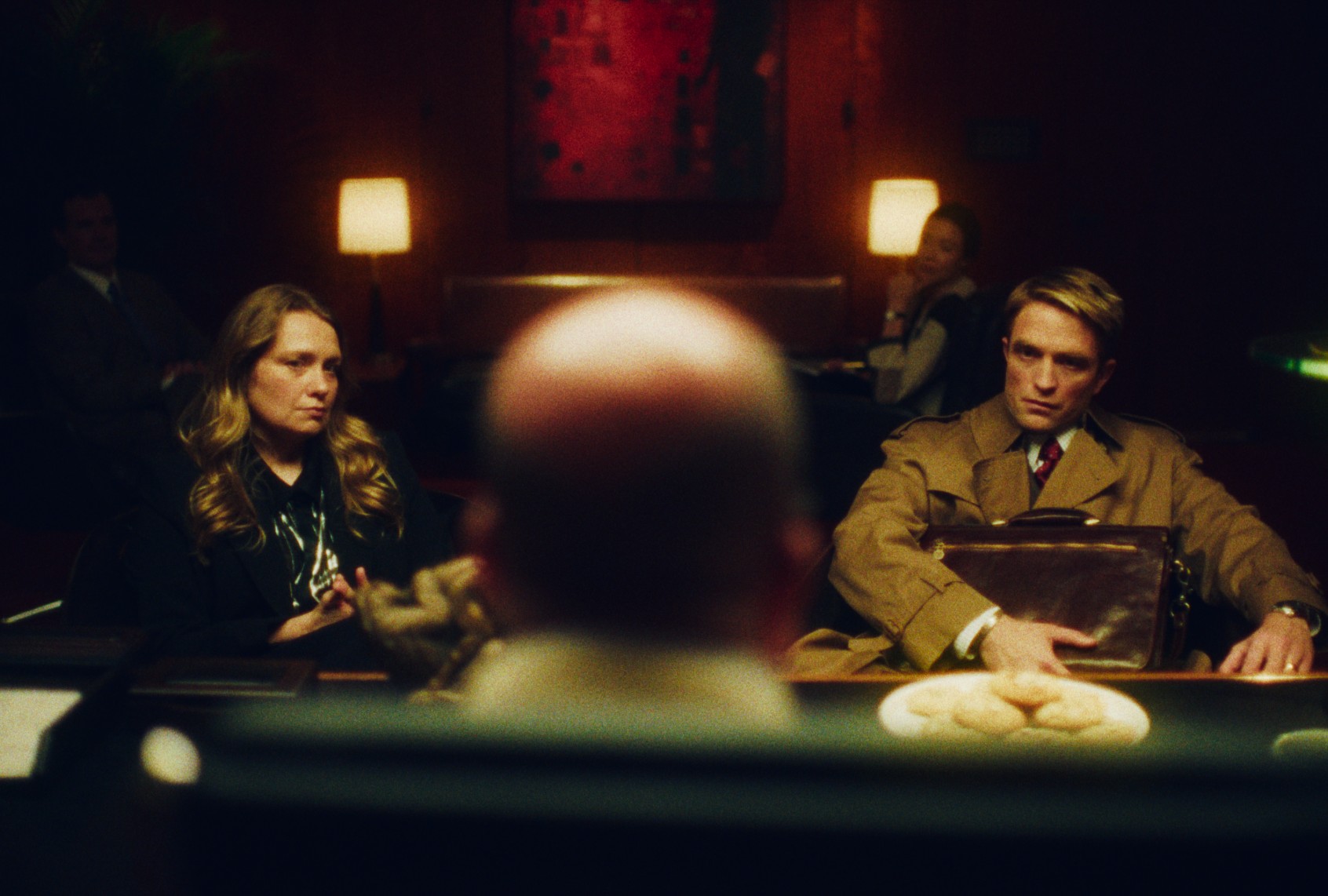
Lance Oppenheim’s new film “Primetime,” in which Robert Pattinson assumes Hansen’s enigmatic role, reveals the answer — sort of. Pattinson portrays Hansen as a caricature of himself, accentuating the journalist’s unmistakable vocal cadence to remove any distance between “To Catch a Predator” and the man behind the show. The effect is something like uncanny sketch comedy, dredging laughs from Hansen’s stilted expressions and intense demeanor, regardless of a scene’s emotional gravity.

(A24) Robert Pattinson in “Primetime”
“Primetime” poses no questions about Hansen’s ethics that haven’t already been asked, making the entire affair feel guilty of the same sensationalism as Hansen’s original show.
When the film’s second trailer dropped, Pattinson’s delivery of the notable Hansen-ism, “You see how this looks, right?” instantly became a reaction video itself; a meme of a meme of a meme. Soon after, the film’s distributor, A24, posted a production photo of Pattinson styled to look like Hansen’s headshot, the source of innumerable jokes during the aughts when memes were just two blocks of text in Impact font. At a pop-up event, A24 sold “Primetime” merch featuring another Hansen quote: “What would’ve happened if I wasn’t here?” For a film ostensibly about how “To Catch a Predator” self-destructed by catering to people tuning in for laughs and entertainment, it’s disconcerting that the movie’s marketing would play into the exact culture it’s commenting on.
Want more from culture than just the latest trend? The Swell highlights art made to last.
Sign up here
But perhaps that’s the point. “Primetime” presents itself as a story about Hansen’s callous quest for ratings and notoriety at the expense of his tact, but the portrait is unfinished. Not even “Predators” — the 2025 documentary on this very subject that not only beat “Primetime” to the punch but has far more to say about Hansen’s effect on culture — can complete the image. We, the audience, are the final piece of the puzzle, the culpable players who not only ate up the original “To Catch a Predator,” but all the media and memes that spun off it.
Now, “Primetime” (and its marketing) exposes itself as a continuation of that culpability, turning “To Catch a Predator” back into a spectacle for the viewer to gawk at, spoon-feeding them shallow bromides between handfuls of popcorn. The film poses no questions about Hansen’s ethics that haven’t already been asked, making the entire affair feel guilty of the same sensationalism as Hansen’s original show. “Primetime” isn’t a film so much as it is a final exam testing what we’ve learned over the last 20 years. The answer? Not much.
Set in late 2006, “Primetime” takes place in the shadow of Saddam Hussein’s collapsing regime, a context the film repeatedly emphasizes by reminding the audience that Hansen — though darting between Florida condos and Jersey Shore houses — is first and foremost a telejournalist. He senses the world changing in real time and doesn’t want to get left behind, lest his reporting and notoriety succumb to oblivion. With “To Catch a Predator” already a hit, NBC execs decide to move the show to a primetime slot to capitalize on its success. All Hansen has to do is deliver the high-impact predators: prominent pedophiles who can prove the show has a reach beyond the creeps who linger too long outside schoolyards. To do it, Hansen forges forward with all the ardent conviction of an American soldier, clinging to the belief that his definition of good is the greater good, too.
This is where “To Catch a Predator” divides. Some view the show as a public service; others see it as an illegitimate operation that lures creeps into a sting, allowing audiences to see the moment subjects realize their lives as they knew them are essentially over. On “To Catch a Predator,” there is no differentiation between the levels of danger the men pose; no mercy for those who understand they’re sick and desperately plead for rehabilitation. The show makes the final judgment call, with Hansen serving as executioner.

(A24) Robert Pattinson in “Primetime”
This total lack of regulation begets unchecked power. And it’s this scarcity of restrictions that contributed to the suicide of Bill Conradt, a former Texas district attorney who shot himself in November 2006 when police and NBC cameras forcibly entered his home. Eager to catch his biggest fish yet and keep the show highly rated, Hansen made the fatal mistake of pursuing the predator, rather than trapping him. Hence the film’s clunky equivalence of Hansen’s dogged chase to that of the American army.
The film seems to suggest that we — the audience to this specious display of white-knighting nobility — are monsters who can act just as heinous as the criminals. After all, the public drove up the “To Catch a Predator” ratings; they turned Hansen into both a hero and a joke. Perhaps we’re just as responsible for trivializing the show’s subject matter as the show itself.
These cultural comparisons would and should be interesting, if not for screenwriter Ajon Singh’s frustratingly shallow screenplay and Oppenheim’s stylish yet one-note direction. Whenever “Primetime” comes close to a deeper truth, the film backs off entirely, deferring to Pattinson to deliver the intended magnitude. And though his impersonation is spot-on, even a stellar character actor like Pattinson can’t voice his way out of platitudinous dialogue. “There used to be a pillory in every civilized town,” Pattinson’s Hansen remarks about the state of justice. “Now there’s a television with me on it.” Oh, brother.
But though “Primetime” fails to be a deservedly introspective analysis of its subject matter, it does tee up fair questions about its own existence. At one point, Hansen tells a “Predator” decoy, Dan (Skyler Gisondo), about a reporting trip to India, where he observed villages searching for a string of missing children. With no leads, the residents turned on each other to enact justice by their own hands. Hansen uses this as a metaphor for the “To Catch a Predator” conceit. But it’s a far better analogy for how viewers rallied behind the show, making Hansen and his questionable methods a sensation that could be replicated after their mutual cancellation.
Discussing his India trip, the “Primetime” version of Hansen remembers an alleged witness to the kidnappings, who describes the perpetrator as a monstrous ancient evil lurking in the dark. Hansen believes that by targeting predators, he is helping rid the world of such an entity. Later in the film, Oppenheim depicts a brief glimpse of said figure, lurking in the bushes outside of Conradt’s home in the wake of his suicide. The image is at once hokey and compelling, suggesting in unwieldy terms that the monster Hansen has been chasing is like a Hydra: cut off its head, and it’ll regenerate with two more.
Peering back at Hansen from the shrubbery, the film seems to suggest that we — the audience to this specious display of white-knighting nobility — are monsters who can act just as heinous as the criminals. After all, the public drove up the “To Catch a Predator” ratings; they turned Hansen into both a hero and a joke. Perhaps we’re just as responsible for trivializing the show’s subject matter as the show itself, and the fact that anyone is eager to see this movie points to the unfortunate truth that we haven’t learned from our actions in the last two decades.
And while that is true to some degree, the curious viewer can’t shoulder the blame for the film’s shortcomings. All the memes and merch exist on the movie’s fringes. If the movie had more to offer than frivolous musings about the fame machine and its sickly products — complex ideas that warrant real digging instead of ironically superficial investigation akin to Hansen’s — it might successfully catch us in its trap. But unlike the show it’s scrutinizing, “Primetime” lets its prey walk free.
Read more
about hotly anticipated fall films