
Trump didn’t break the press. They did that to themselves
Last week, Fox News seemed to be trying to give Donald Trump what he wanted. Network personalities went on air and recited, with all the enthusiasm of a sixth grader reading a book report he skimmed on the bus, the rosiest possible version of Trump’s economy. Will Cain stood in front of a big board and tried to force-feed viewers praise for an economy that much of the public sees as failing them and their families. Greg Gutfeld, in the familiar performance of a man discovering empathy only when the numbers flatter his side, acted surprised to care about falling poverty statistics. It all had the feel of a network reading from the same set of talking points, dispatched from somewhere on the C-suite level, hurrying to convince viewers that Trump’s economy is thriving.
But that synchronized propaganda blitz flopped.
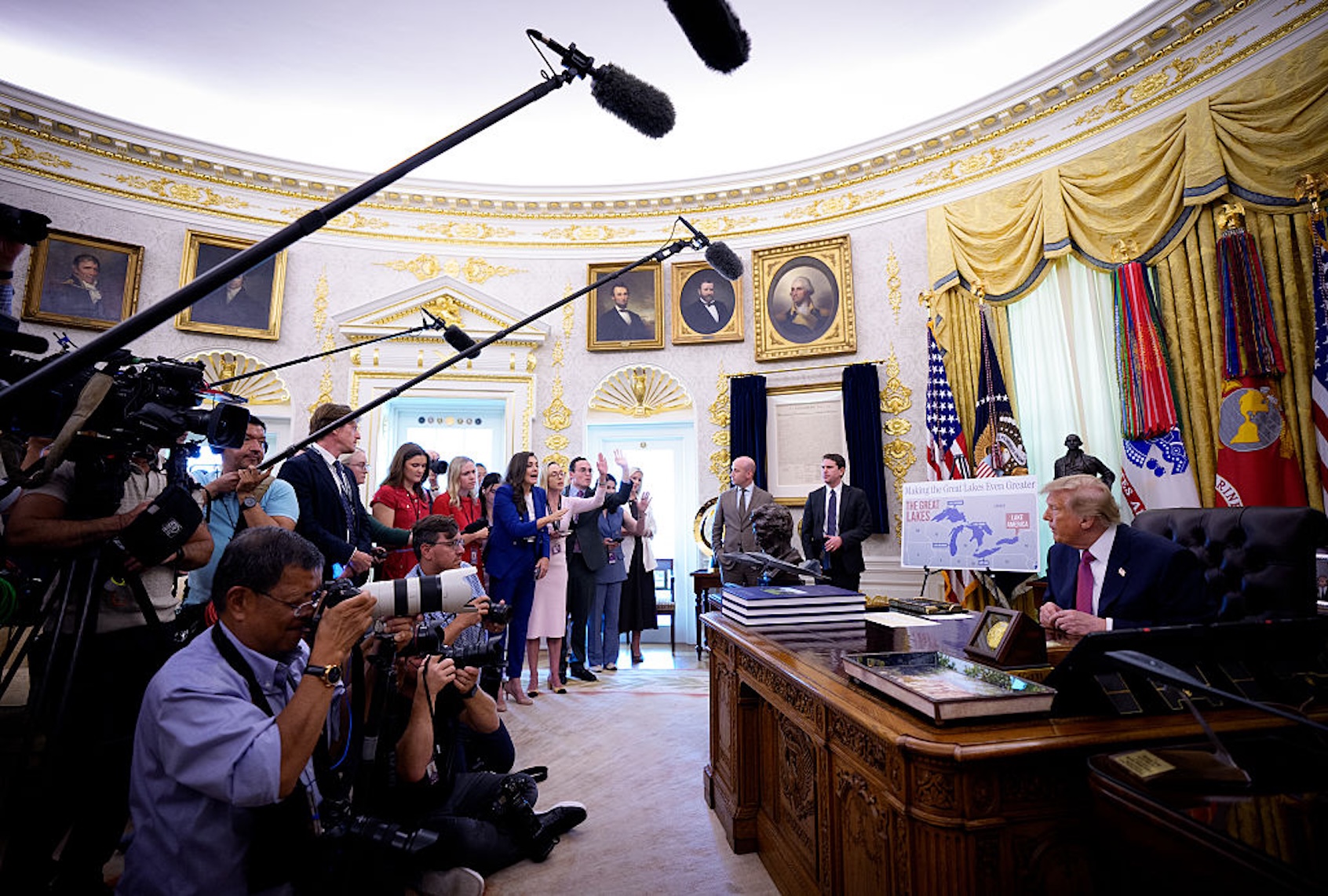
Whatever the assignment was supposed to accomplish, it did not appease the man it was designed to flatter. By the end of the week, the president who had just been handed hours of favorable spin by the most watched cable network in the nation let out a tantrum so large it swallowed three unrelated newsrooms. Facing a failing presidency, crashing poll numbers, the prospect of a Democratic wave in November’s midterms and zero sense of a second-term agenda, Trump just up and banned CNN, POLITICO and MS NOW from the White House for seemingly no reason.
Trump did not identify a specific false report or allege a security breach to justify his radical action. Instead, his stated offense was simply that these outlets had produced too many negative stories over too much time.
“On Friday the press shop was blindsided,” POLITICO reported, as the directive happened while chief of staff Susie Wiles was out of town. Still, the latest retaliatory purge was as pathetic as it was predictable. Trump did not identify a specific false report or allege a security breach to justify his radical action. Instead, his stated offense was simply that these outlets had produced too many negative stories over too much time. By Saturday morning, reporters from all three outlets were turned away at the White House gates.
Fox News barely let out a peep. And the rest of the White House press corps — the reporters who share vans and pool feeds and holiday parties with the people just banished — did what they have done for a decade now. Mostly nothing.
Late Sunday night, the administration escalated the situation by prohibiting CNN from serving on Monday as the scheduled television pool representative for the White House press corps.
Trump knows the press’ dirty little secret: It is far too late for symbolic outrage to substitute for collective action. The press has spent years teaching Trump that it is possible to divide journalists from one another. He knows that much of the Washington press corps will deplore his conduct in a statement, and then show up for the next photo-op, fight for the next pool slot and keep treating access to an increasingly authoritarian White House as a professional prize. He knows that outlets like Fox News will even frame the exclusion of their peers as a partisan squabble in an effort to appear balanced.
The irony is that Fox News has been here before.
In 2009, when Barack Obama’s White House tried to marginalize Fox News by excluding the network from an interview with Treasury official Kenneth Feinberg, the other television networks pushed back. The attempt was temporary — exclusion from one specific interview, not an announced and potentially expanding ban on multiple major outlets from White House grounds because their reporting offended the president. But the other four major television networks — ABC, CBS, NBC and CNN — refused to participate if Fox was excluded.
The Washington bureau chiefs delivered a clear ultimatum that either Fox News is allowed in the room, or nobody goes in. Jake Tapper, then at ABC, confronted White House press secretary Robert Gibbs in the briefing room and asked him directly why it was appropriate for the government to declare a news organization illegitimate. (Fox lawyers later argued in court that hosts like Tucker Carlson cannot reasonably be considered legitimate sources of news.) Facing a unified front from a press corps that put constitutional principles ahead of commercial rivalries, the Obama administration backed down immediately.
That moment demonstrated the power of absolute press solidarity. The networks did not defend Fox News because they agreed with its right-wing bias, but because they understood the precedent that would be set if a president were permitted to ban a critic from the room. Once the government establishes press facilities and admits credentialed journalists to gather news, it cannot hand access out according to ideological loyalty.
Want more sharp takes on politics? Sign up for our free newsletter, Standing Room Only, written by Amanda Marcotte, now also a weekly show on YouTube or wherever you get your podcasts.
Consider how far we’ve fallen since.
With Trump’s rise and his infamously leaky first term, White House reporters have seemingly surrendered to access journalism. When he descended his golden escalator at Trump Tower in 2015, major television networks traded journalistic rigor for spectacle. They broadcast his rallies uninterrupted, handing him billions of dollars in free airtime to normalize his attacks on democratic norms. In 2018, the administration pulled CNN White House correspondent Jim Acosta’s press credentials after he refused to hand back a microphone during a heated exchange. CNN sued, other outlets filed friend of the court briefs, and the administration eventually folded and restored his pass. Although imperfect, this response demonstrated that the old model still worked.
In 2025, Trump tried it again, this time against the Associated Press, after the wire service declined to rename the Gulf of Mexico on his say so. The AP sued. Fox News, NBC, the New York Times and the Washington Post all filed amicus briefs on the AP’s behalf, and a Trump appointed district court judge, Trevor McFadden, ordered the ban lifted from the broader White House grounds, even as an appeals court let Trump keep the AP out of the Oval Office, Air Force One and Mar-a-Lago while the case proceeds. All the while, the president held press avails in which he continued to attack the press.
Trump understands how to exploit every weakness the media has cultivated, like its addiction to spectacle. He insults a reporter, and the clip runs all day. He threatens a network, and the network gets a bump in attention.
Trump understands how to exploit every weakness the media has cultivated, like its addiction to spectacle. He insults a reporter, and the clip runs all day. He threatens a network, and the network gets a bump in attention. He calls the press “the enemy of the people,” then calls individual reporters when he wants to plant a story or manipulate a news cycle. He denounces the New York Times as “fake news,” then sits for lengthy interviews with its reporters when they are writing books he hopes will immortalize his preferred version of events. At this year’s White House Correspondents’ Dinner, Trump turned CNN’s Kaitlan Collins into a target of misogynistic ridicule while the assembled press corps remained seated.
This breakdown of solidarity among the press corps allows Republicans to build a false narrative around media access. After Trump announced his ban on CNN, POLITICO and MS NOW, the conservative political machine rallied to defend the blatantly unconstitutional act with a familiar bait and switch. Trump allies like Arkansas Gov. Sarah Huckabee Sanders, Centers for Medicare and Medicaid Services administrator Dr. Mehmet Oz and House Majority Leader Steve Scalise, R-La., absurdly claimed no president has been more open to the press than Trump and mocked the idea that press access requires actual access. Scalise repeatedly parroted the debunked claim that Joe Biden revoked the credentials of 400 reporters, a distortion fact-checked by ABC’s Jonathan Karl, who noted that only one reporter was ever denied a credential under Biden. The rest simply hadn’t reapplied and were let in anyway. United Nations Ambassador Mike Waltz told CNN’s own Dana Bash that he backs banning her network. Fox News contributor Joey Jones, whose colleague Jacqui Heinrich is the current White House Correspondents’ Association president, casually remarked that he would not “shed a tear” over the banned journalists. Heinrich, Fox’s White House correspondent, rightly condemned the ban as an unequivocal violation of the First Amendment.
Fox’s opinion side has spent a decade building an audience that treats CNN’s misfortune as content. In that time, Fox News paid $787.5 million to settle Dominion Voting Systems’ defamation lawsuit after internal communications revealed how Trump’s false election claims were knowingly aired and promoted.
None of this means the press deserves to lose this fight in the end. It will eventually win in court. But a legal victory that comes months from now, after CNN, POLITICO and MS NOW have been shut out of the most consequential midterm season in a generation, is not the same as winning.
Executive power cannot be checked by the courts alone; it must be checked by real-time resistance from reporters. Trump is correctly betting that while the lawyers argue in federal court, the rest of the White House press corps will quietly fill the empty chairs in the briefing room.
Read more
from Sophia Tesfaye on the media