
CUTS Raises Cartel Concerns Over Cement Manufacturers’ Uniform GH¢12 Surcharge
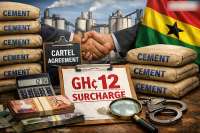
CUTS International, Accra, has cautioned that the Chamber of Cement Manufacturers, Ghana (COCMAG), may be edging into cartel‑like conduct following its decision to introduce a uniform GH¢12 per‑bag clinker demurrage surcharge across all member companies.
The public policy think tank says the collective agreement among competing cement producers to impose an identical surcharge raises serious competition and antitrust concerns.
COCMAG has attributed the surcharge to escalating demurrage costs caused by severe congestion at the Tema Port. According to the Chamber, vessel waiting times have jumped from an average of seven days in January to between 30 and more than 40 days in August 2026, resulting in estimated industry‑wide demurrage charges of US$45 million to US$50 million within the first eight months of the year.
CUTS acknowledges the cost pressures facing manufacturers but insists the method of passing those costs on to consumers must comply with competition principles.
“Cement manufacturers have every right to recover legitimate demurrage costs. What raises a red flag is when firms that are supposed to compete meet and collectively determine a common surcharge to be paid by consumers. When competitors agree on an element of price rather than determine it independently, such conduct bears the classic hallmarks of cartel behaviour,” said Appiah Kusi Adomako, Esq., Director of the West Africa Regional Centre of CUTS International.
Uniform Pricing Raises Red Flags
COCMAG says the GH¢12 surcharge—GH¢10 before tax and GH¢2 in taxes and levies—was agreed at an emergency meeting on 28 August 2026 and will remain in place until 31 December, subject to monthly monitoring and a review in January 2027.
CUTS argues that describing the charge as a “demurrage surcharge” rather than a price increase does not eliminate the competition concern, noting that surcharges form part of the final price consumers pay.
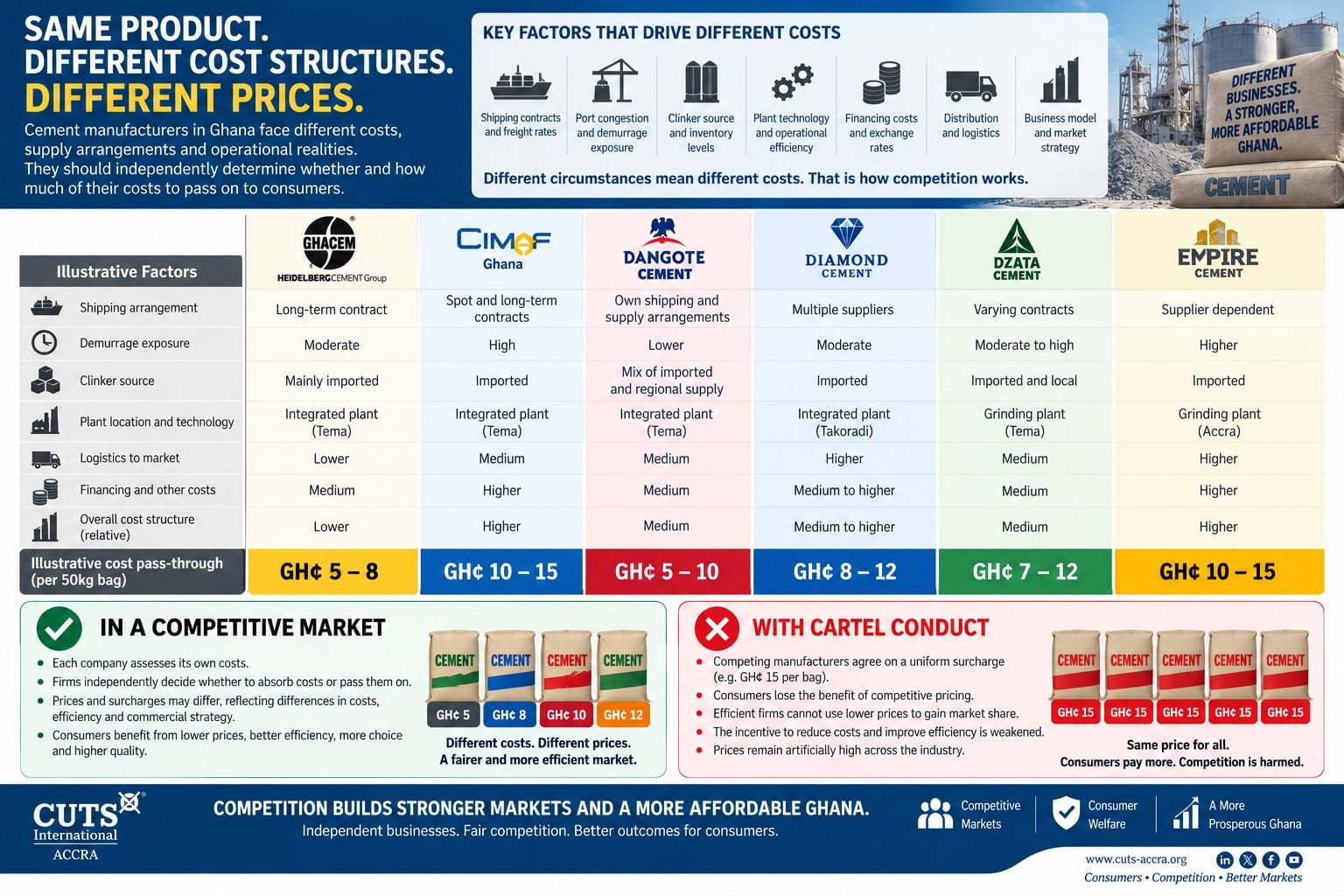
The think tank stresses that cement manufacturers operate with different shipping contracts, clinker volumes, vessel arrangements, inventory levels, financing costs and operational efficiencies. As a result, there is no economic basis for assuming that each company’s additional cost per bag is identical.
“One manufacturer might need GH¢12 to recover its costs. Another might require GH¢8. A more efficient manufacturer might absorb part of the additional cost to retain customers or gain market share. Different costs should ordinarily produce different commercial responses,” Mr. Adomako said.
Airline Fuel Surcharges Offer a Contrast
CUTS cited the airline industry as an example of how competition should function. Fare data reviewed for the Accra–Kumasi route on 15 September 2026 shows Africa World Airlines applying a fuel surcharge of GH¢220, while PassionAir applies GH¢75.
The difference, CUTS notes, reflects distinct aircraft types, fuel consumption patterns and commercial strategies. If airlines met and agreed on a uniform surcharge, it would raise cartel concerns—just as in the cement industry.
Trade Associations Must Avoid Coordinating Prices
CUTS emphasised that while COCMAG plays a legitimate role in advocating for industry concerns, it must avoid facilitating coordination on prices or other commercially sensitive matters.
The organisation has called on COCMAG to clarify whether the GH¢12 surcharge is a binding collective decision or merely a recommendation, and whether individual manufacturers remain free to charge a lower amount, a higher amount, or no surcharge at all.
CUTS also warned against using the proposed monthly monitoring and January review to exchange information on future prices, production volumes, individual costs or clinker stocks.
Fix Port Congestion Without Undermining Competition
CUTS urged Government and the Ghana Ports and Harbours Authority (GPHA) to urgently address the operational bottlenecks at Tema Port, noting that avoidable demurrage ultimately affects businesses, construction costs and consumers.
“COCMAG should collectively fight the demurrage problem. Individual manufacturers should independently decide what they charge consumers. Businesses must recover their costs and make profits, but competitors must compete, not coordinate prices,” Mr. Adomako said.
The think tank also reiterated its call for Parliament to expedite passage of Ghana’s Competition and Fair Trade Practices Bill and establish a national competition authority, warning that the absence of a comprehensive competition law makes the current development even more concerning.
CUTS noted that a formal determination of cartel conduct would require examining what was discussed at the COCMAG meeting and how the surcharge is implemented. However, it stressed that collective agreement on a uniform price component is a serious red flag that should not be ignored.
About CUTS
CUTS International, Accra, is an independent, non‑profit research, advocacy and capacity‑building think tank working in consumer protection, competition policy and law, trade and development, regional integration and economic regulation across Ghana and the wider West African region.