‘TMA is the highest political, administrative authority in Tema’ — Presidency rules on TMA, TDC impasse

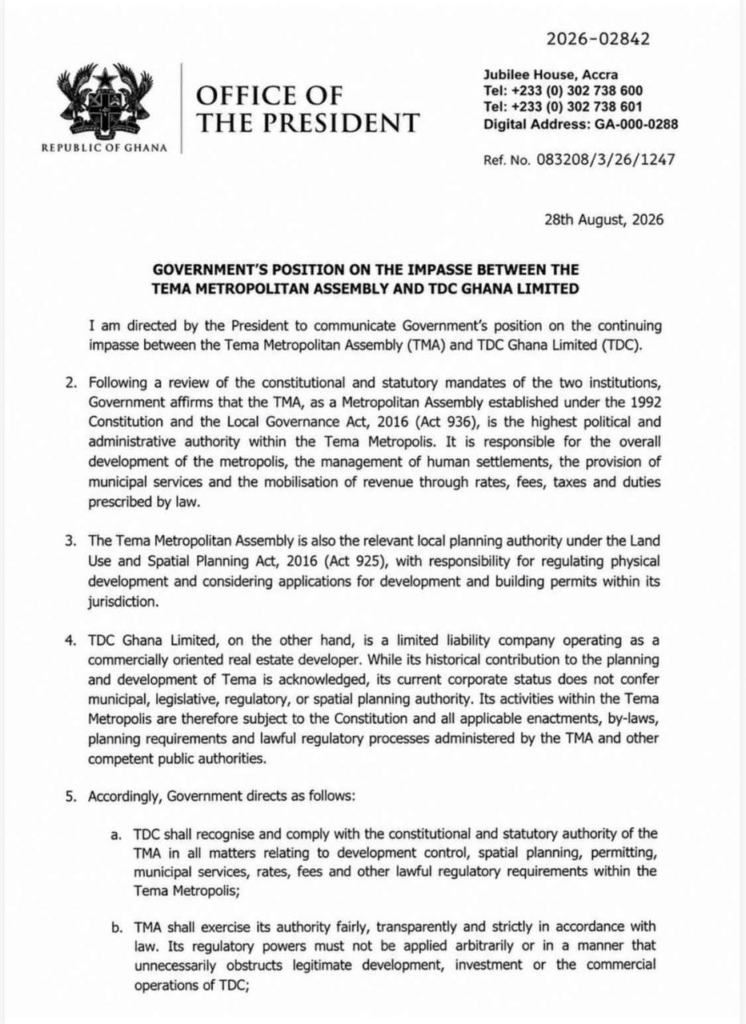
The Presidency has affirmed the Tema Metropolitan Assembly’s (TMA) authority over the overall development and administration of the Tema Metropolis, directing the Assembly and the Tema Development Corporation (TDC) Ghana Limited to resolve their longstanding institutional differences.
In a letter dated August 28, 2026, the Office of the President described the TMA as the highest political and administrative authority in the Tema Metropolis, with responsibility for local development, human settlements, municipal services, revenue mobilisation and planning.
The Presidency also reaffirmed the Assembly’s role as the local planning authority responsible for regulating physical development and issuing development and building permits within its jurisdiction.
TDC, meanwhile, was characterised as a commercially oriented real estate development institution rather than a municipal authority.
The intervention follows a dispute between the two state institutions over construction activities at Community One, Sites 3 and 8, where the TMA issued a stop-work order before portions of structures at the site were demolished.
The Assembly had maintained that the development was being undertaken without the required permits.
The dispute subsequently prompted TDC to petition the then Minister for Works, Housing and Water Resources, Kenneth Gilbert Adjei, and the Minister for Local Government, Chieftaincy and Religious Affairs, Ahmed Ibrahim, to intervene.
The disagreement was also fuelled by complaints from residents over the alleged cutting down of trees, demolition of existing structures, takeover of playgrounds and green belts, and obstruction of access to residential and commercial properties.
The TMA maintained that TDC’s ownership or management of land did not exempt the corporation from complying with physical planning and development regulations.
TDC, however, argued that it has a distinct statutory mandate to plan, lay out and develop Tema and should not be treated simply as a private developer operating under the authority of the Assembly.
The corporation traced its mandate to 1952, when the then Tema Development Corporation was established to develop the new Tema township and port.
According to TDC, approximately 63 square miles of land, known as the Tema Acquisition Area, were compulsorily acquired from the traditional authorities of Tema, Nungua and Kpone and placed under its management through a 125-year lease.
The corporation further argued that although some municipal responsibilities were transferred to the then Tema District Assembly in 1989, it retained its mandate to plan, lay out and develop the Tema area, including residential, industrial and commercial projects.
TDC acknowledged the TMA’s responsibility for physical planning, development control and municipal administration but maintained that those powers must be exercised alongside the corporation’s own statutory and proprietary interests.
“TDC does not dispute that TMA is a statutory local government authority with responsibilities for physical planning, development control and municipal administration. The issue is whether that mandate can be exercised as though TDC’s separate statutory mandate does not exist,” the company said in an earlier statement.
The corporation also pointed to a Joint Technical Evaluation Committee previously established between TDC and assemblies within the Tema Acquisition Area as an existing mechanism for coordinating their respective responsibilities.
The disagreement intensified following the TMA’s demolition exercise, prompting TDC Managing Director Courage Makafui Nunekpeku to call for dialogue to resolve the matter.
“We have petitioned the local government minister, and we have also petitioned our sector minister. They will take it up at their level, and I am sure this issue will be resolved amicably,” he said.
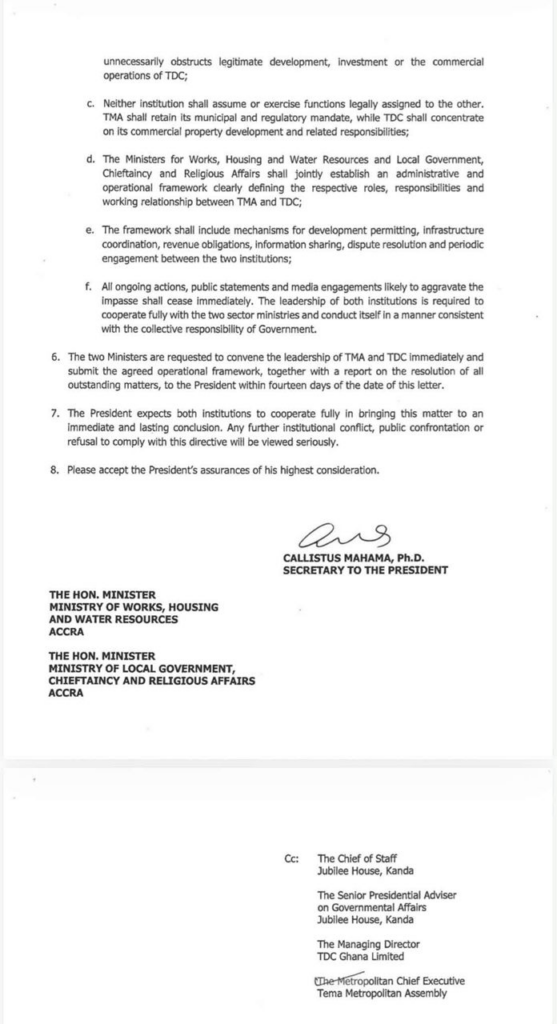
Under the latest directive, the President has tasked the two ministers with establishing a clear administrative and operational framework defining the respective roles and working relationship between the TMA and TDC.
The framework is expected to address development permitting, infrastructure coordination, revenue obligations, information sharing, dispute resolution and regular engagement between the two institutions.
The ministers have been directed to convene the TMA and TDC and submit the agreed framework, together with a report on outstanding issues, to the President within 14 days of the letter.
The two institutions have also been ordered to immediately refrain from actions, public statements and media engagements capable of escalating the dispute.
The Presidency expects both institutions to cooperate fully towards achieving an immediate and lasting resolution.
It further warned that any renewed institutional confrontation, public dispute or refusal to comply with the directive would be treated seriously.