
The humiliation of Tom Homan
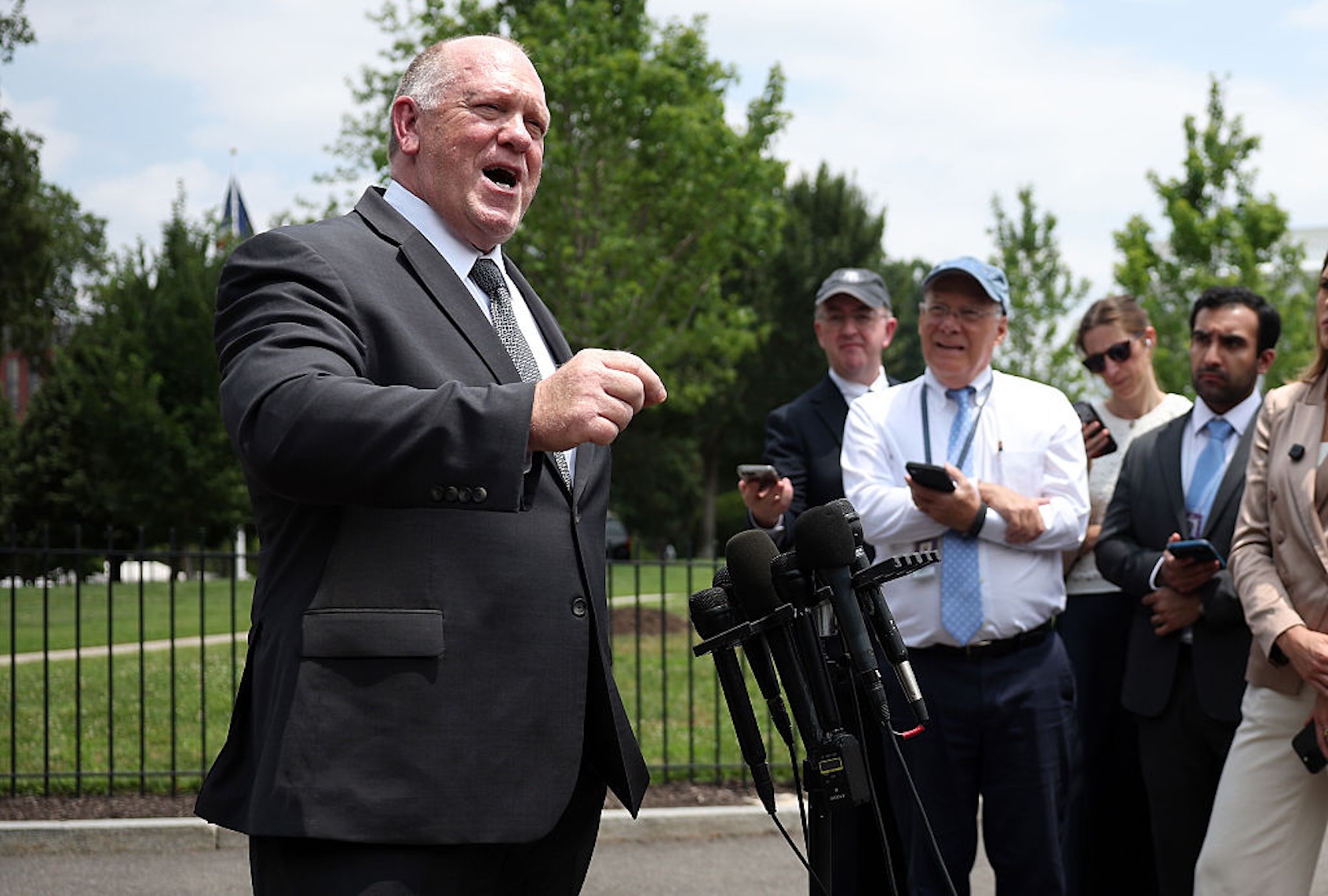
Tom Homan has spent years constructing the persona of a man who never backs down.
Donald Trump’s border czar is the hard man of immigration enforcement: scowling, blunt, perpetually indignant and seemingly unburdened by doubt. While other officials offer qualifications, Homan offers threats. He does not merely support mass deportation. He appears to relish being its public face.
Then Trump made him twist himself into a pretzel on national television.
After Immigration and Customs Enforcement officers fatally shot two men during vehicle encounters in Houston and Maine within six days, the Department of Homeland Security temporarily suspended most ICE vehicle stops. Homan defended the decision on July 14 as a limited tactical pause. Agents could follow people and arrest them after they left their cars, he explained, while stopping people inside moving vehicles could place officers in greater danger.
The decision and his reasoning sounded almost responsible. Two people were dead. Serious questions had been raised about ICE tactics. The administration would take a moment to review its training and protocols before another encounter ended the same way.
By the following day, Trump had learned about the suspension and publicly rejected it. In a Truth Social post, he described vehicle stops as an “important and effective” enforcement tool and instructed ICE officers to return to the job. The White House then confirmed that the suspension had been reversed. And like a good lackey, Homan returned to Fox News and defended the opposite position. Vehicle stops, he now declared, were “our main tool,” and ICE had to continue using them.
The problem was not merely that Homan had changed his message. It was that everyone watching knew he had not been permitted to have a position of his own.
A border czar who cannot reliably tell the public whether one of ICE’s most consequential tactics is suspended is not directing immigration enforcement. He is instead narrating Trump’s impulses after the fact.
To be fair, Homan was not the only administration official diminished by the episode. According to reporting by The Wall Street Journal, Homeland Security Secretary Markwayne Mullin and acting ICE Director Dave Venturella approved the pause without first informing Trump. The president was caught off guard when the decision became public and overruled his own officials through social media, leaving the department scrambling to reconcile its guidance with his post. Mullin soon announced that he and Trump were “in lockstep.”
Of course they were. Everyone in the Trump administration is always in lockstep, especially immediately after the president steps on them.
This is the ritual humiliation at the center of Trump’s management style. He does not simply reverse subordinates. He requires them to appear before the public and deny that any meaningful turnabout occurred.
This is the ritual humiliation at the center of Trump’s management style. He does not simply reverse subordinates. He requires them to appear before the public and deny that any meaningful turnabout occurred. Yesterday’s policy must be reconciled with today’s opposite policy, and officials must perform that reconciliation with enthusiasm.
The humiliation is not incidental. It is how Trump maintains control.
No cabinet secretary or agency director can develop independent authority when every decision remains subject to the president’s next social media reaction. Expertise becomes dangerous when it produces conclusions Trump dislikes. Institutional judgment becomes meaningless when operational directives can be rewritten on a whim overnight.
For Homan, the spectacle is especially revealing because toughness is his entire brand. He presents himself not as a political press secretary but as the experienced operator who understands what federal agents need and how immigration enforcement must work.
But commanders establish protocols. They do not discover operational policy by reading the president’s Truth Social feed.
The consequences extend beyond Homan’s bruised ego. ICE agents are being asked to conduct dangerous operations under a chain of command that cannot reliably communicate whether a major enforcement tactic is authorized from one day — or hour — to the next.
Vehicle stops are inherently volatile. Officers approach people seated inside machines capable of rapid movement. Visibility is limited, fear escalates quickly and decisions are made in split seconds. The recent shootings by ICE agents have also renewed questions about training, body cameras and whether the people killed posed the threats DHS initially alleged. In both cases, the answer to the latter appears to be an unequivocal no.
Reuters reported that the men killed in Texas and Maine were not the original targets of the immigration operations. Yet the administration abandoned its review of the shootings before explaining what had gone wrong — or assuring the public that anything would change.
Start your day with essential news from Salon.
Sign up for our free morning newsletter, Crash Course.
Pausing such operations long enough to reassess protocols was not surrender. It was what a competent law enforcement organization should do after repeated fatal encounters.
Trump offered no public analysis of the shootings, the relevant training or the safety concerns Homan himself had acknowledged one day earlier. He simply declared the stops effective and ordered that they continue.
That was apparently enough to resolve a life-or-death operational question for armed federal officers across the country.
The episode also destroys accountability. Suppose another vehicle stop ends with an unarmed person dead. Who will own the decision?
Homan can say he initially supported a pause. Mullin can say he follows the president. ICE leadership can say the White House reversed its directive. Trump can blame the driver, protesters, Democrats or the media. In this likely scenario, everyone will exercise power, but no one will accept responsibility.
This is what governing by humiliation produces. Officials retain their titles but lose their authority. Agencies issue orders that remain valid only until the president encounters an unfavorable headline. Public statements become disposable because the person making them may be required to defend the opposite position tomorrow.
Tom Homan will survive this episode. He will continue appearing on television on behalf of the White House, scowling at critics and assuring the public that the administration has never been more unified. His willingness to absorb humiliation may even strengthen his position. Trump prizes subordinates who demonstrate that their pride, judgment and credibility are expendable.
But we should stop calling such people powerful. A czar who can be overruled overnight on the central tactics of his own operation is not a czar. He is a spokesman wearing a costume. And a government in which armed federal agents receive operational direction through the president’s late-night social media posts is not projecting strength.
It is advertising that no one is truly in command.
Read more
about ICE