
Canadian wildfire smoke pushes Toronto air quality to world’s worst, reaches US
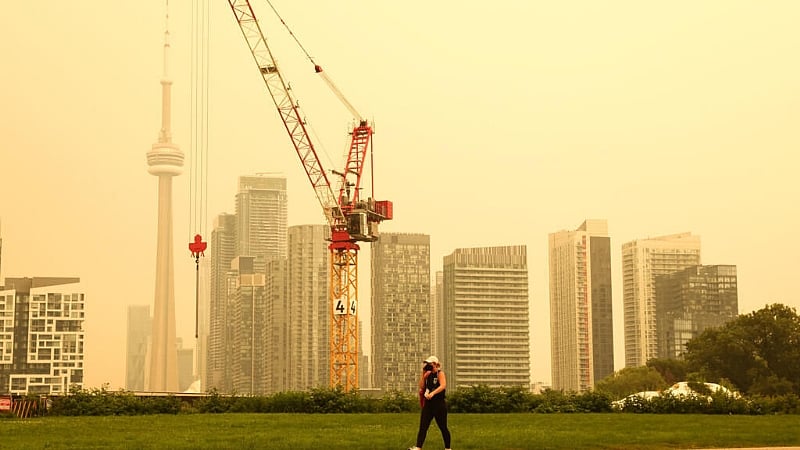
Toronto‘s air quality ranked the worst among major cities globally on Wednesday as wildfire smoke from northwestern Ontario blackened skies and spread into the northeastern United States, prompting health warnings and calls for residents to limit outdoor activities.
Wildfires are raging through sparsely populated areas hundreds of miles from Toronto and sending smoke over a wide area, although they are not directly threatening cities.
Environment Canada reported an Air Quality Health Index reading of 10+, classified as “very high risk”, for Toronto, while forecasts suggested hazardous conditions could persist through Thursday night.
New York City began feeling the effects days before neighbouring New Jersey is scheduled to host the World Cup final on Sunday. Local authorities issued an alert as air quality reached an unhealthy level and urged residents to reduce strenuous outdoor activity and take extra breaks if they are outside on Wednesday and Thursday.
The National Weather Service said smoke could linger into the end of the week.
Read more ‘My heart is on fire’: Fontainebleau forest blaze leaves community reeling
“We probably haven’t seen the worst of it yet for New York City. We probably haven’t seen the worst of it yet for the Great Lakes and upstate and New England yet either,” said Dan Westervelt, Lamont associate research professor at Columbia University.
IQAir, a Swiss air quality technology company, ranked Toronto as having the worst air quality across the globe, surpassing Kinshasa and Delhi. New York ranked No. 5.
Fires trapped two small groups of children from Minnesota who were in the Canadian wilderness on a camping trip organized by the YMCA, a worldwide Christian youth association, the Minnesota Star Tribune reported on Wednesday, citing a YMCA official. One of the groups was evacuated by helicopter in coordination with the Canadian military, the newspaper said.
“Both groups have been rescued and are on their way back home to safety,” Minnesota Governor Tim Walz said on X.
Read more Roughly 9,000 evacuated in northeast Canada due to raging wildfires
Wildfire smoke from northern Canada has been a common summer occurrence across wide swaths of the United States in recent years.
A video that went viral on social media showed a Canadian National train surrounded by fire near Armstrong, Ontario.
Canadian National employees in the area and residents of Armstrong were evacuated on Monday night, the railroad operator said in a statement. It suspended rail operations near Armstrong, more than 500 kilometres (310 miles) north of Toronto, as a precaution due to the wildfires.
The City of Toronto canceled the FIFA Fan Festival and the England-Argentina World Cup watch party at Nathan Phillips Square because of poor air quality.
In the New York City area, more than 80,000 people are expected to attend the World Cup final at an open-air stadium in New Jersey on Sunday. Another 50,000 plan to watch the game from Central Park in Manhattan, where skies appeared hazy.
New York Governor Kathy Hochul said on social media that smoke and haze from Canadian wildfires were creating unhealthy air conditions across the state and encouraged people, especially those with health conditions, to exercise caution.
The Government of Canada has said wildfire season began more slowly in 2026 than in 2023 or 2025 – the two worst seasons for wildfires – but warned that fires were likely, due to warmer-than-usual temperatures across the country.
Some 835 active fires were burning in the country on Wednesday and 112 were considered out of control, according to the government. So far, 1.9 million hectares (4.7 million acres) have burned. Most of the fires were in the central provinces of Manitoba, Saskatchewan and Ontario.
Greg Evans, professor of chemical engineering and applied chemistry at the University of Toronto, said Toronto had been simultaneously hit with severe heat and wildfire smoke.
“I expect that this will occur more frequently over the coming decades so cities and residents need to prepare for this in the future,” he said.
Paula Oreskovich, a Toronto resident, said she noticed the haze and smell of smoke when she stepped outside in the morning. She said the poor air quality was concerning, particularly as wildfire smoke has become a recurring feature of recent summers.
“I think you have to be silly if you’re not going to be concerned about climate change. It’s definitely here, it’s definitely happening, and it’s happening globally,” Oreskovich said.
(FRANCE 24 with Reuters)