
Nigeria, Portugal, Spain, seal Iberian-Africa trade pact, as experts warn AI must be ethical in migration governance
By Vera Anyagafu
Nigeria moved to deepen economic and migration ties with Europe, even as experts at a major conference in Porto warned that artificial intelligence must be governed ethically to protect migrants and the Nigerian diaspora.
The two developments dominated the second Centre for African Studies, University of Porto (CEAUP) Conference on ‘Migration, Artificial Intelligence and the Creative Economy’, with a strong emphasis on African and Nigerian perspectives, ethical AI, digital identity, and migration policy.
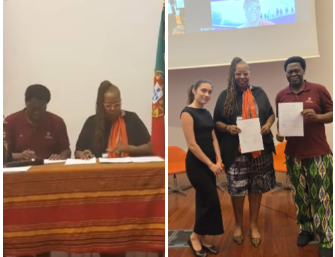
An official signing ceremony in Porto formalised a Memorandum of Intent between the Nigeria Migration Observatory Lab at the Centre for African Studies, University of Porto and the Nigerian Association of Chambers of Commerce, Industry, Mines, and Agriculture (NACCIMA).
The MoI was signed by the Vice Chair of the Creative Economy Trade Group at NACCIMA Nigeria,
Dr. Ngozi Omambala, and Lead Researcher at the Migration Observatory Lab, Centre of African Studies, University of Porto, Prof. Akinwale Roy Ojomo.
The agreement establishes a formal framework for cooperation between Nigeria and the Iberian Peninsula, specifically Portugal and Spain.
According to the document, the partnership lays the foundation for cooperation in areas directly linked to migration. The proposed areas include, Migration-related research and policy collaboration, Academic, business, and professional exchange programmes, and Skills development and education, as well as the Trade missions and advancement of the creative economy.
The agreement also outlines plans for joint workshops, seminars, conferences, annual events, and collaborative research projects to keep stakeholders engaged.
A key proposal is the exploration of a NACCIMA representative desk or collaboration hub at the Migration Observatory Lab within the Centre of African Studies, University of Porto.
Both institutions are also exploring physical offices in each other’s locations to support project delivery.
Describing the moment as pivotal for Africa-Europe relations, Dr. Omambala said the initiative opens essential pathways for trade and economic development.
“The memorandum moves us from general dialogue to tangible, actionable collaboration,” she stated, noting an immediate need for structured trade access and pathways for the Nigerian creative sector and others in Europe.
Organisers added that the MoI will deepen Nigeria-Portugal ties by facilitating knowledge sharing, trade, innovation, and fresh engagement channels across academia, business, and public institutions.
The next phase of talks is expected to define how the partnership will work in practice, paving the way for a full Memorandum of Understanding to codify the collaboration.
Alongside the signing, expert presentations and panels examined AI’s transformative impact on migration governance and migrant experiences.
Speakers focused on ethical AI use, including explainable hybrid deep learning for migration early-warning systems, AI for sustainable development, AI-powered language translators in Portuguese schools, and how migrant narratives are represented in AI systems.
In a discussion on Border Technologies, Surveillance and Digital Control, chaired by Jorge Sebastião, Co-Founder of BBurgh & EcoX AI, led a conversation on how biometric and digital surveillance are shaping migration governance, the use of AI to combat migrant smuggling, the role of MIDAS technology in border management, and concerns over the growing digital divide between Africa and Europe in AI-powered border security.
Two panels at the forum tackled the intersection of technology and migration.
Chaired by Remi Alapo of CUNY York College, the session on Gender, Race and Social Inequality in Migration, chaired by examined how AI is reshaping mobility while amplifying gender and racial biases. Panelists paid particular attention to AI-related gender-based violence against Nigerian women abroad and education gaps for immigrant learners in South Africa.
On Diaspora, Digital Identity and Transnational Futures, Prof. Akinwale Roy Ojomo of MOP, CEAUP, focused on digital remittances, AI and social networks driving Nigerian transnational economies.
Presenters also examined migration pathways from Lagos to Europe, how digital platforms are redefining diaspora identity, and the challenge of ‘brain waste’ as qualified Nigerian professionals face barriers to credential recognition in Europe.
HUMAN-CENTRED MIGRATION POLICY
The conference concluded with a call for ethical, inclusive, and human-centred AI policies, emphasising that technology must address migration challenges while promoting sustainable development, social equity, and human rights.
MIGRATION FOCUS
With the new MoI, the Migration Observatory Lab and NACCIMA aim to strengthen institutional partnerships on migration governance, diaspora engagement, and economic opportunities connecting Nigeria with Portugal and the wider Iberian Peninsula.
Planned conferences, workshops, and the proposed collaboration hub are expected to support research and policy dialogue on mobility and sustainable development.
Stakeholders also said momentum from Porto will now be used to turn dialogue into concrete programs.
However, Consular Hub learned that the pact is being positioned as the start of what organisers expect will be ‘great things to come’ for Nigeria, West Africa, and Iberian partners.