
Digital deception: How AI is creating a new crime wave in Nigeria
By Juliet Umeh
Days when pictures and videos were considered unquestionable proof are over. Artificial Intelligence, AI, has shattered that long-held belief.
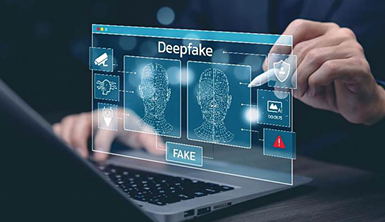
While the technology is revolutionising businesses, public services and everyday life, it is also creating a dangerous new wave of digital deception. Deepfake videos, cloned voices, manipulated images and AI-generated misinformation are becoming so realistic that distinguishing fact from fiction is increasingly difficult for investigators, journalists, businesses and even the courts.
Unlike traditional cybercrime, which relied on stolen passwords, malware or phishing links, generative AI now enables criminals to produce convincing fake identities, forged documents and fabricated audio and video within minutes, making sophisticated fraud easier and more accessible than ever before.
The threat is no longer theoretical. According to the World Economic Forum’s Global Cybersecurity Outlook 2025, 66 percent of organisations believe AI will have the greatest impact on cybersecurity this year, while 47 percent identify AI-powered attacks as their biggest concern. The FBI’s Internet Crime Complaint Center, IC3, reported more than $16 billion in internet crime losses in 2025, as criminals increasingly deployed AI-powered phishing, voice cloning and identity fraud. Nigeria is equally exposed.
As digital banking and online services expand, reports by the Nigeria Inter-Bank Settlement System, NIBSS, and Nigeria Cybersecurity Outlook 2025 show that identity theft, account takeover, AI-generated phishing and deepfake scams are becoming more sophisticated. With research by Sumsub indicating that deepfake fraud worldwide surged by more than 200 per cent between 2023 and 2024, experts warn that digital evidence can no longer be accepted at face value, underscoring why forensic experts, legal practitioners and policymakers gathered at the 2026 Global Forensics Summit in Lagos to explore how Nigeria can strengthen its capacity to combat AI-driven crime.
Recognising this growing threat, the Lagos State Government has pledged to deepen the deployment of advanced forensic technologies to tackle cybercrime, digital fraud, identity theft and other technology-enabled crimes.
Speaking at the 2026 Global Forensics Summit organised by the International Academy of Forensics, Governor Babajide Sanwo-Olu said science and technology have become indispensable in modern criminal investigations because traditional investigative methods alone are no longer sufficient.
Represented by the pioneer Permanent Secretary of the Citizens’ Mediation Bureau, CMB, Mrs. Aderinsola Olanrewaju, the governor noted that many criminal cases in Nigeria collapse not because investigators lack suspects or witnesses, but because prosecutors are unable to present scientific evidence capable of surviving judicial scrutiny.
“Every year, thousands of criminal cases in Nigeria are stalled, not for want of witnesses, not for want of suspects, but for want of evidence that can withstand scrutiny in the court of law. The gap between investigations and what prosecutors can successfully prove is a forensic gap. Closing that gap is precisely why this summit matters.”
The rise of digital deception
At the same summit, legal practitioner and forensic expert, Oluwatomi Ajayi warned that misinformation has evolved beyond fake news into an era dominated by AI-generated deception.
According to her, AI now enables criminals to manipulate photographs, generate realistic videos, clone voices and fabricate digital conversations with remarkable accuracy.
“The days when people believed pictures and videos could never lie are over,” she said, noting that AI-generated content can damage reputations, manipulate public opinion, derail investigations and even influence judicial proceedings.
The implication, she explained, is that investigators, judges and journalists can no longer rely solely on what appears on a screen.
Lagos responds with forensic technology
For Lagos, the challenge is particularly significant.
Sanwo-Olu described the state, home to more than 22 million residents and Nigeria’s commercial capital, as a city increasingly targeted by cybercriminals exploiting digital technologies.
“As Nigeria’s commercial capital and home to the largest concentration of financial institutions, technology companies and international businesses on the continent, Lagos sits at the intersection of innovation and global connectivity.
“The crimes threatening our city are increasingly sophisticated. Digital fraud, financial manipulation, identity theft and organised crime exploit the anonymity of cyberspace. Our response must be equally sophisticated,” he said.
The governor highlighted the state’s investment in forensic infrastructure, recalling that Lagos established West Africa’s first DNA and forensic centre in 2017.
The ISO/IEC 17025-accredited laboratory has since supported investigations into homicide, sexual offences and the identification of human remains using scientific evidence.
He also disclosed that the second phase of the project, focusing on toxicology and forensic chemistry, is underway to strengthen the state’s capacity to analyse substances recovered from crime scenes.
When fact-checking is no longer enough
Ajayi argued that conventional fact-checking is no longer sufficient to combat AI-generated misinformation.
Instead, investigators now depend on digital forensic technologies capable of examining metadata, tracing the origin of online content, identifying manipulated media and detecting deepfakes.
These tools include AI-assisted forensic software, open-source intelligence, OSINT, geolocation systems, metadata analysis and advanced deepfake detection platforms.
Rather than asking whether a video appears genuine, investigators now analyse where it originated, how it was produced and whether it has been altered.
Every digital action leaves a footprint
Cybercriminals increasingly exploit digital platforms for phishing, identity theft, cyberbullying, financial fraud, online blackmail and coordinated disinformation campaigns.
Ajayi noted that despite attempts by criminals to erase evidence, digital footprints rarely disappear completely.
Even deleted chats, call logs, emails and social media posts can often be recovered through specialised forensic tools.
“People often believe deleting chats or files permanently removes them. That is not always the case. Digital forensic technologies can recover information that becomes vital evidence during investigations,” she explained.
This capability allows investigators to reconstruct criminal activities, establish timelines and identify suspects through digital traces left across communication networks and electronic devices.
Deepfakes threaten justice
Perhaps the greatest concern is the possibility that AI-generated evidence could find its way into courtrooms.
A fabricated video could falsely implicate an innocent person. A cloned voice recording could influence investigations before experts establish whether it is authentic.
Ajayi stressed that courts must increasingly rely on scientifically validated forensic analysis rather than visual impressions alone.
She noted that specialised forensic software can now determine whether digital images, audio recordings and videos have been manipulated before they are admitted as evidence.
Fighting AI with AI
Ironically, artificial intelligence is also becoming one of law enforcement’s most effective we apons.
Machine-learning systems are now capable of identifying abnormalities in digital files that human investigators might overlook.
These technologies analyse lighting inconsistencies, facial movements, audio frequencies, editing patterns and metadata to determine whether digital content has been altered.
Combined with modern cybersecurity systems, AI is also helping investigators detect hacking attempts, phishing attacks and digital fraud before significant damage occurs.
Nigeria’s evolving response
Nigeria has introduced several legal and policy frameworks to strengthen cybersecurity, including the Cybercrimes Act and the National Cybersecurity Policy and Strategy.
Ajayi also pointed to ongoing efforts to strengthen national cybersecurity coordination and improve the use of forensic technologies in criminal investigations.
For Lagos, legislative reforms have complemented technological investments.
Sanwo-Olu noted that amendments to the Administration of Criminal Justice Law have modernised the state’s criminal justice architecture, encouraging greater reliance on scientific evidence in criminal proceedings.
He also reaffirmed Lagos’ readiness to deepen collaboration with forensic experts, security agencies and professional institutions.
“The infrastructure we have built is a foundation, not a ceiling. Our ambition is a justice system where evidence speaks clearly, courts decide swiftly, and citizens, whether victims seeking justice or suspects entitled to fair hearing, can trust the integrity of the process.”
As artificial intelligence becomes more powerful, experts believe forensic science will become one of the justice system’s most valuable assets.
For journalists, investigators, prosecutors and judges, seeing will no longer believe.
Instead, every image, voice recording and digital document may require scientific verification before it can be trusted.
In the age of AI, the future of justice may depend less on eyewitness testimony and more on forensic technologies capable of separating authentic evidence from convincing digital deception.