
Right-wing Christians want to exclude people like me — I’d rather reach out
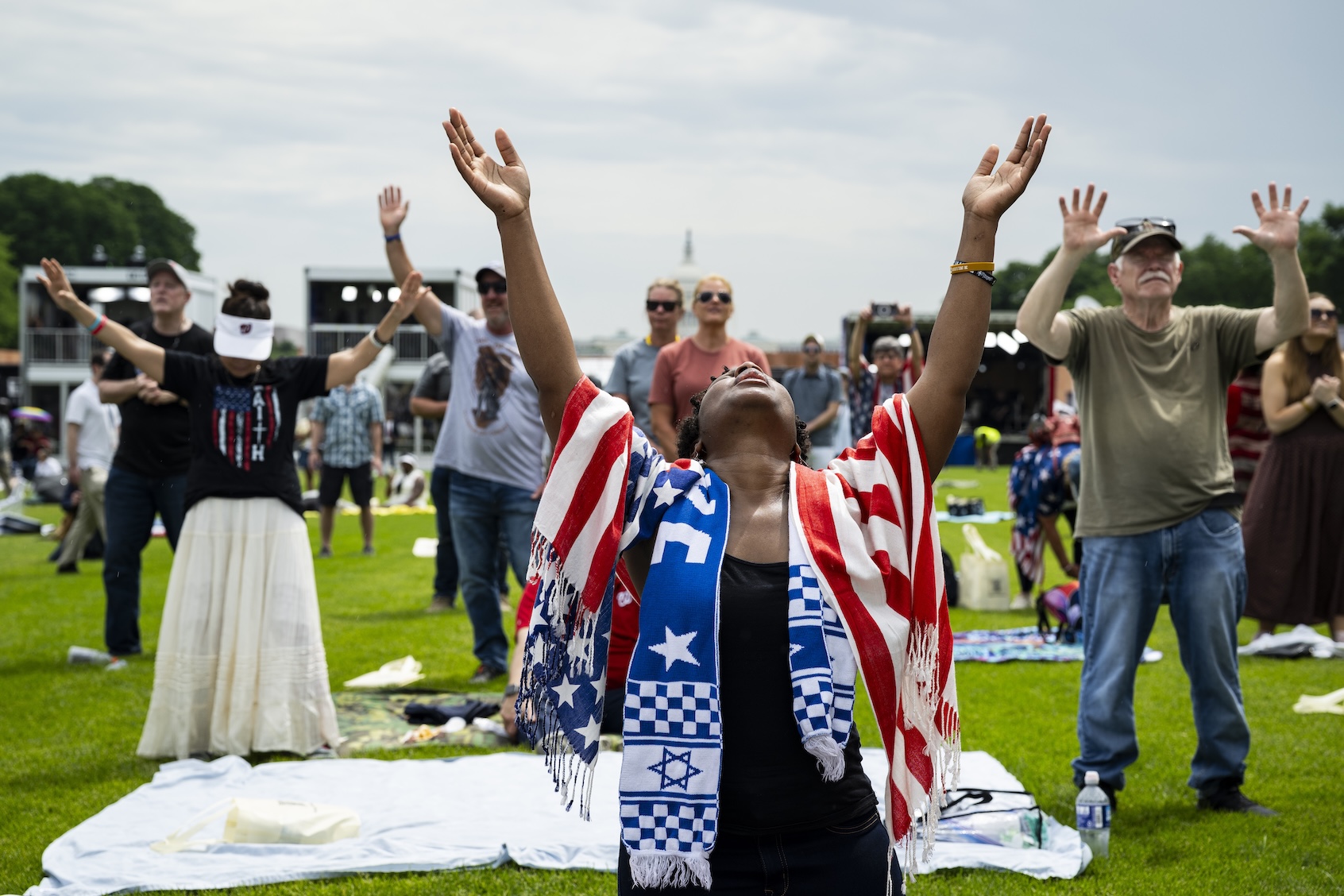
During the 10 days between the Muslim celebration of Eid al-Adha (which coincides with the Haj gathering in Mecca), and the May 17 National Jubilee of Prayer, Praise and Thanksgiving on Washington’s National Mall — a conservative Christian gathering that featured one Orthodox Jewish rabbi but completely excluded Muslims — I offered my own version of a conciliatory message.
It is one that will endure after my death.
I am an 84-year-old Sudanese-American journalist who has lived in Washington for 46 years. I recently purchased my gravesite at National Memorial Park in Falls Church, Virginia. Under the terms of my contract, two things will happen:
First, my body will be returned to that spot from anywhere in the world, unless it cannot be found or recognized.
Second, a granite headstone, measuring six feet by three feet, will be erected. It will be engraved with my name and the dates of my birth and death, and also with the symbols of six religions, carved in a single line: In this order, Judaism, Christianity, Islam, Buddhism, Hinduism and Unitarian Universalism. Below that, an inscription will read: “Symbols of local worship places I took my young children to. Thanking America’s freedom of religion. And hoping for a conciliation between Islam, Christianity and other religions.”
I am not alone in criticizing the so-called jubilee on the National Mall. The Council on American-Islamic Relations also noted the absence of any Muslim faith leaders. Muslims have been an integral part of the American fabric since the colonial era, CAIR said in a statement, and have been “present in significant numbers in the country since the colonial era.” An official event meant to mark the nation’s 250th anniversary, the statement added, should reflect the actual religious diversity of America, rather than a narrow theological viewpoint.
Speakers at the National Mall gathering focused heavily on promoting Christian nationalist views, pushing the historically discredited narrative that America was founded exclusively as a Christian nation. Although they avoided any specific mention of Muslims, some are well-known for their history of attacking them.
We can start, for instance, with Donald Trump. This past Easter, in a series of controversial Truth Social posts, the president criticized those he believed did not share “Western values.” He wrote: “Happy Easter to all, except those who want to destroy our Country with their radical religions and ideologies. We are a Christian nation, and we will not let Islam or any other force replace our heritage. It’s a Crusade for survival!”
Trump then went further, threatening Iran’s closure of the Strait of Hormuz with profane language, ending his warning this way: “Open the F**kin’ Strait, you crazy bastards, or you’ll be living in Hell — JUST WATCH! Praise be to Allah.”
Muslim leaders in the U.S. condemned this as an overt mockery of Islam. CAIR said in a statement that “the casual use of Alhamdulillah (‘Praise be to God’) in the context of violent threats reflects a disturbing willingness to weaponize religious language while simultaneously denigrating Islam and its followers. … These statements are not made in a vacuum. They follow a long pattern of anti-Muslim rhetoric and policies that have dehumanized Muslims at home and abroad.”
Above my grave, a granite headstone, measuring six feet by three feet, will be erected. It will be engraved with my name and the dates of my birth and death, and also with the symbols of six religions, carved in a single line.
Defense Secretary Pete Hegseth did not explicitly mention Muslims during his National Mall appearance, but his recent Pentagon briefings and public addresses on the conflict with Iran have been loaded with overt religious language. He ended a recent press briefing by urging the American people to pray U.S. service members “every day on bended knee with your family, in your schools, in your churches, in the name of Jesus Christ.”
Days later, during the monthly Christian worship service inside the Pentagon, Hegseth prayed: “Let every round find its mark against the enemies of righteousness and our great nation,” concluding with an explicit invocation for “overwhelming violence of action against those who deserve no mercy.”
Also addressing the May 17 gathering was the Rev. Franklin Graham, a leading evangelical preacher and the president of Samaritan’s Purse. Just a month earlier, Graham had specifically implicated Islam in the broader geopolitical conflict. “I pray for victory so Iranians can be set free from these Islamic lunatics,” he wrote. “It is time to pray for a free Iran to emerge … the church in Iran is growing rapidly. … Wouldn’t it be great to one day see millions of Christians worshipping freely across Tehran?”
On the day I signed the contract for my final resting place, I also wrote a will that includes a specific request for my children: “Take my body to a few of the worship places that I had taken you to.”
Start your day with essential news from Salon.
Sign up for our free morning newsletter, Crash Course.
I understand the logistical challenges of such a request, so I suggested four specific sanctuaries out of the dozen or so we used to visit: the Islamic center, the Methodist church, the Jewish synagogue and the Unitarian Universalist church.
This whole thing started around 30 years ago around our family dinner table. At different times, my three children began to ask me daunting questions about God. I wanted to help them find their own answers, and I initially took them to two nearby houses of worship, one Muslim and one Christian. I soon realized, however, that each of them represented an extreme within its own faith.
The Muslim house of worship was a Pakistani Sunday school operating out of a warehouse in Lorton, Virginia. At first, the immigrant teachers provided my children with useful lessons about the core beliefs and practices of Islam, and my children enjoyed exploring the cultural diversity of the families there.
But rigid cultural obstacles soon emerged. The teachers told the children not to celebrate Halloween, describing it as satanic. They advised them not to eat Thanksgiving turkey unless it had been slaughtered according to halal strictures, and discouraged celebrations of Christmas by organizing mandatory Dec. 25 trips to Islamic conferences. Most devastatingly for my kids, they were told not to eat McDonald’s French fries because they were supposedly cooked in pork fat. (According to McDonald’s, a blend of vegetable oils is used.)
Once, during a Passover Seder, Rabbi Bruce Aft introduced me to his congregation as the Prophet Elijah, reminding his community that Elijah wanders the earth disguised as a stranger, testing humanity’s capacity for hospitality, compassion and kindness.
On the other hand, at the local Roman Catholic church down the street from our house, the priest took a long look at my son and me, and immediately separated us. He welcomed my son, but allowed me in the church only in my capacity as his father. He told me I could not partake in the bread and wine of the Eucharist. I told him I absolutely no intention of doing so.
Right around that time, a Unitarian Universalist church was built near our home. For several years, my wife, my children and I found a sanctuary that was genuinely welcoming, open-minded and pluralistic.
I remained eager to expose my children to the full spectrum of human faith, and over the next few years I took them to many different houses of worship, including the Jewish Congregation Adat Reyim, the nondenominational Burke Community Church, Nativity Catholic Church, Burke United Methodist Church, Burke Presbyterian Church, Ekoji Buddhist Temple, the Hindu Sri Venkateswara Lotus Temple, the Korean Bo Rim Sa Buddhist Temple and a local Arabic Coptic Church.
After our visit to Adat Reyim, an inclusive, independent synagogue in Springfield, Virginia, I befriended its spiritual leader, Rabbi Bruce Aft. I visited him many times over the decades until his retirement a few years ago. Throughout his career, he was a fierce, joyful advocate for interfaith coexistence.
Once, during a Passover Seder, Aft introduced me to his congregation as the Prophet Elijah. He spoke beautifully about how Elijah is meant to serves as a universal bridge-builder. As he poured the traditional cup of wine for the prophet, Rabbi Aft reminded his community that Elijah wanders the earth disguised as a stranger, testing humanity’s capacity for hospitality, compassion and kindness.
Remembering Aft’s warmth, I am wondering what he would have to say about the troubling quality of the recent gathering on the National Mall the recent Washington National Mall’s gathering—where minority faiths were entirely left out of a national celebration in favor of a single, exclusionary theological viewpoint.
Read more
from Mohammad Ali Salih