
“Battlestar Galactica” had Cylons — We have AI
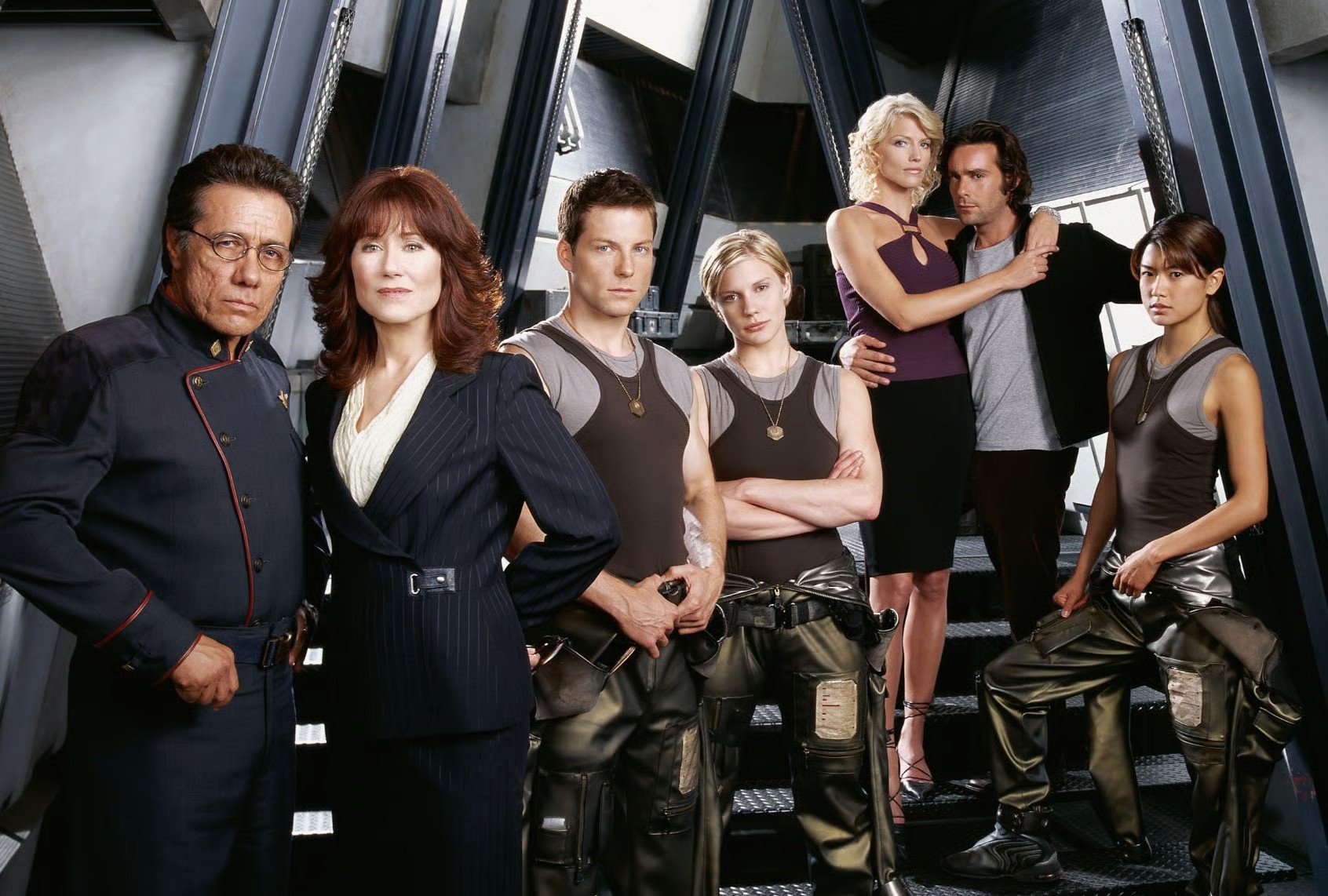
As I recall, the main problems nonbelievers had with “Battlestar Galactica” were tech-related: The cable network revival, which began as a miniseries, demoted its monocular Cylon Centurions to favor new Cylons that looked and behaved like us.
When “Battlestar Galactica” was introduced as a miniseries in 2003, America was still reeling from 9/11. Meanwhile, here was a drama about humans living in a galaxy far, far away, broadsided by an enemy they didn’t take seriously enough.
The first Cylon introduced, Number Six, was played by a fashion model named Tricia Helfer. You would think fanboys would have loved that switch-up, but nooooo. These geeks – a term I use lovingly, for the most part – protected the notion of canon as fiercely as their lunchbox collections. The original’s Cylons were the show’s answer to George Lucas’ stormtroopers in “Star Wars,” only shinier, with sinister red lights roving back and forth where their eyes should be.
In the minds of some retrograde dweebs, representing these baddies with a woman who could play Barbie was sacrilege. But even they came around faster than the burgeoning class of prestige TV era viewers who couldn’t fathom that the new “Battlestar” could be as culturally resonant as, say, “The Sopranos” or “The Wire.”
Having said all that, many of us were instantly floored by Ronald Moore’s reinterpretation of ABC’s 1978 prime-time space saga, and still point to it as one of TV’s strongest political and social parables.
On Friday, May 1, “Battlestar Galactica” landed on Paramount+. It’s available on Pluto TV’s lineup as well, along with its feature-length prequel “The Plan.” Its spinoff prequel “Caprica” is also available on Paramount+. You might say the franchise’s return to streaming is overdue. I think it’s right on time.
Think about it: When “Battlestar Galactica” was introduced as a miniseries in 2003, America was still reeling from 9/11. Meanwhile, here was a drama about humans living in a galaxy far, far away, broadsided by an enemy they didn’t take seriously enough.
The Cylons are fundamentalist, monotheistic zealots who wipe out nearly all of humankind, making them apt representations of all kinds of real-world threats. When the series was on, the easiest parallel for audiences to make was al-Qaeda, the nominal justification for launching the Iraq War and a broader, unwinnable war on terror.
Want more from culture than just the latest trend? The Swell highlights art made to last.
Sign up here
Once again, America is embroiled in a war that is upending the world’s political order, this time with Iran – and now, the United States is the aggressor. Even if that hadn’t come to pass, other threats are already present in our lives. Much like the Cylons moved undetected among the 50 trillion citizens of the Twelve Colonies before annihilating all but around 48,000 survivors, artificial intelligence has evolved so quickly that it’s tough to discern what’s real on our screens and what isn’t. If you watched “Battlestar Galactica,” you’d know that was an actual paranoia human survivors had to contend with.
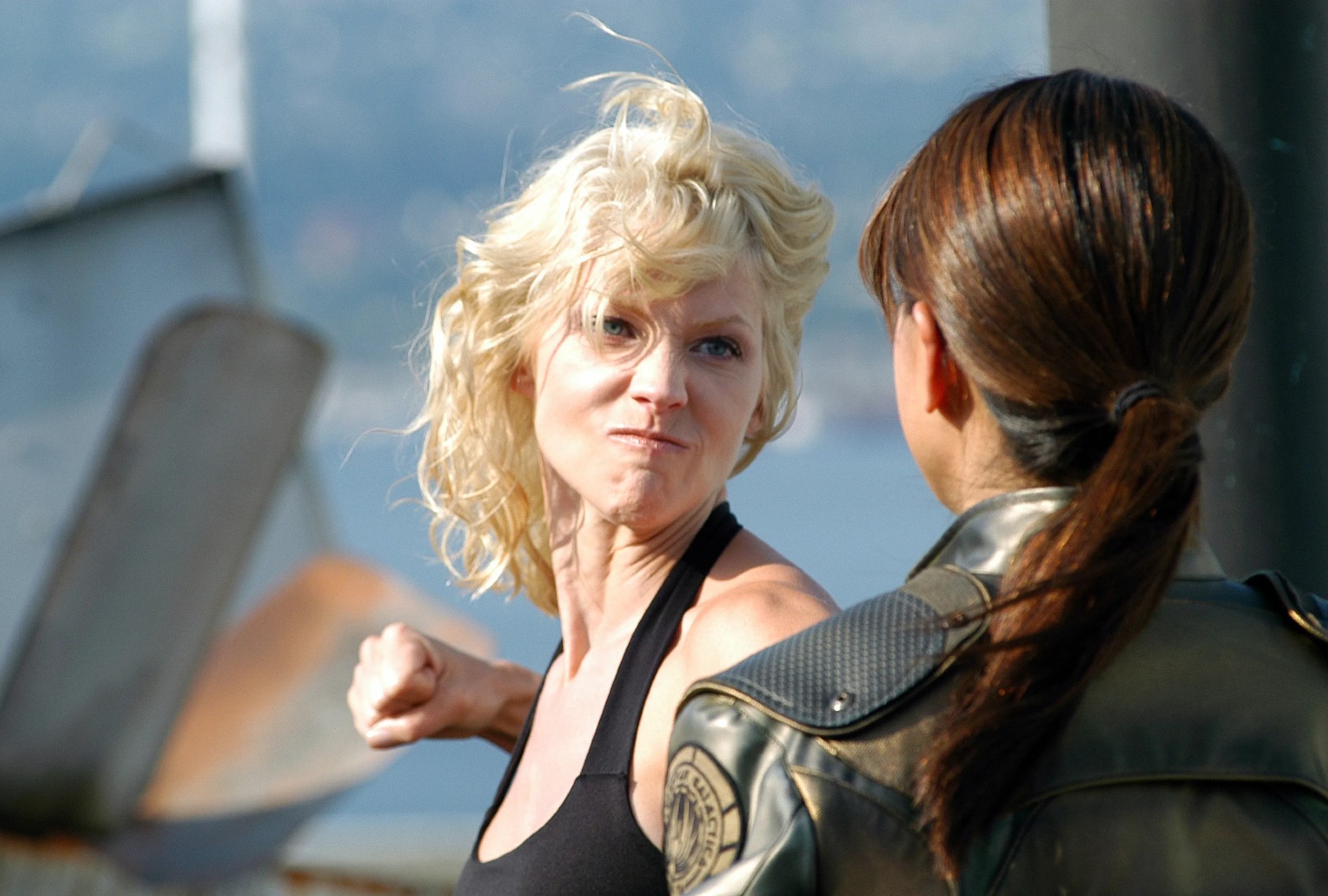
(Syfy) Tricia Helfer as Number Six in “Battlestar Galactica”
Models like Helfer’s Six always knew what they were; moreover, we were reminded at the top of each episode that they had a plan. Part of that plan involved awakening sleeper agents inserted amid the human population . . . including a trusted pilot fighting with the human resistance, Boomer (Grace Park).
As Earth’s societies rearrange around the AI race, and many of us use it without fully measuring its environmental and social cost, “Battlestar Galactica” gives us a lot to think about. The Twelve Colonies fall because the machines hacked all their systems. The only reason Galactica survives is that its commanding officer, William Adama (Edward James Olmos), refused to subject the ship to the fleet-wide networking upgrades that made every other ship vulnerable.
While the robots are certainly exciting – and, yes, sexy – it’s the human grit demonstrated by the likes of Adama and President Laura Roslin (Mary McDonnell) that keeps us emotionally invested. That, and the cocksure charisma of Katee Sackhoff’s Kara “Starbuck” Thrace.
Even the Cylons changed their tune as they interfaced with the survivors more frequently, shifting their aim from destruction to occupation. Twenty years ago, the grim and creatively valorous third season thrust the story’s human heroes into the role of insurgents. Some even sacrificed themselves in suicide bombings to hammer home that in war, one side’s villain might be the other’s version of a freedom fighter.
My dear friend Maureen Ryan is currently working on a book about the series’ legacy and points out on her blog that “scenes that could be ripped from BSG are playing out in America right now. Every day.” She’s absolutely right. Many series followed in the wake of “Battlestar Galactica” that aspired to capitalize on its legacy; in my mind, “The Expanse” came closest to meeting its level of fearless political and social pertinence.
But even that show was more reflective of current cultural problems than prescient, not to mention disconcertingly accurate, about the dreadful directions we were heading. Consider that in a 2006 episode, Roslin took an unconventional (and at the time, some would say unthinkable) position on abortion: She outlaws it out of what she views as necessity, reasoning that an endangered species doesn’t have the luxury of procreative choice.
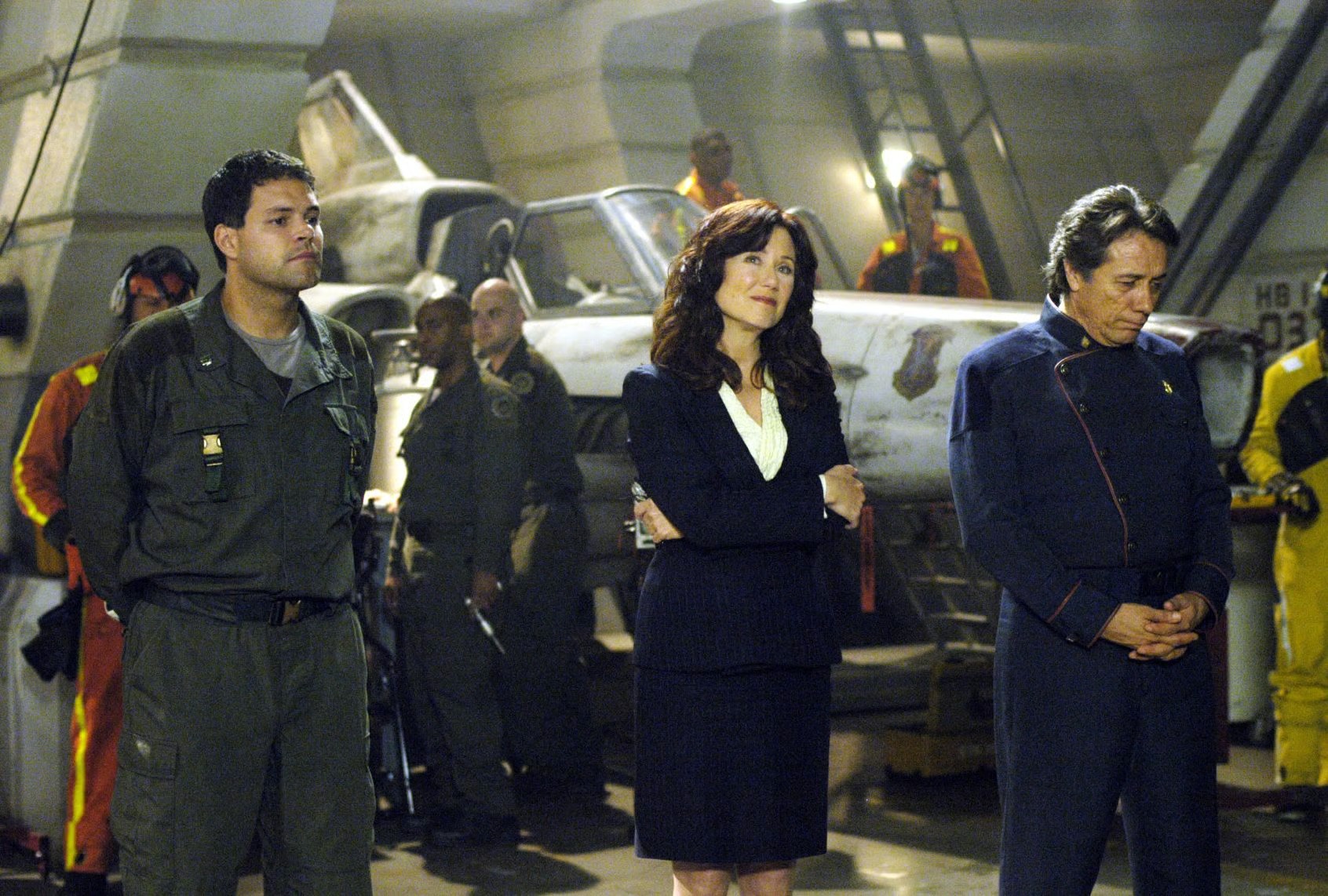
(Syfy) Aaron Douglas, Mary McDonnell and Edward James Olmos in “Battlestar Galactica”
While there are plenty of far-right politicians and influencers making the same argument in our world, Earth’s population currently stands at 8.3 billion – more than our planet can sustain in the long term, warn scientists whose findings were published in Environmental Research Letters.
As Earth’s societies rearrange around the AI race, and many of us use it without fully measuring its environmental and social cost, “Battlestar Galactica” gives us a lot to think about.
Now is not the time for tough TV viewing, I realize. But believe me when I say that “Battlestar Galactica” was never a difficult watch. Actually, you may find that revisiting the series, or strapping in for your first journey with it, is a great way to siphon some of the endless fuel source that kept Adama, Roslin and their ragtag fleet hurtling onward.
I’m talking about hope.
In many ways, “Battlestar” is an idealized version of what a multicultural, egalitarian society can look like – if not here, then perhaps on some distant planet. Never are Starbuck’s capabilities (or Boomer’s, or other female fighter pilots’) questioned because of their gender.
Plus, the fleet trusts a woman to be its president – hey, look at that! Of course, she only got the job because the Cylons killed everybody else; before the attack, she was the Secretary of Education. Regardless, if Adama is humanity’s fist, Roslin is the glue that holds the fleet together. And sometimes that stickiness isn’t pleasant.
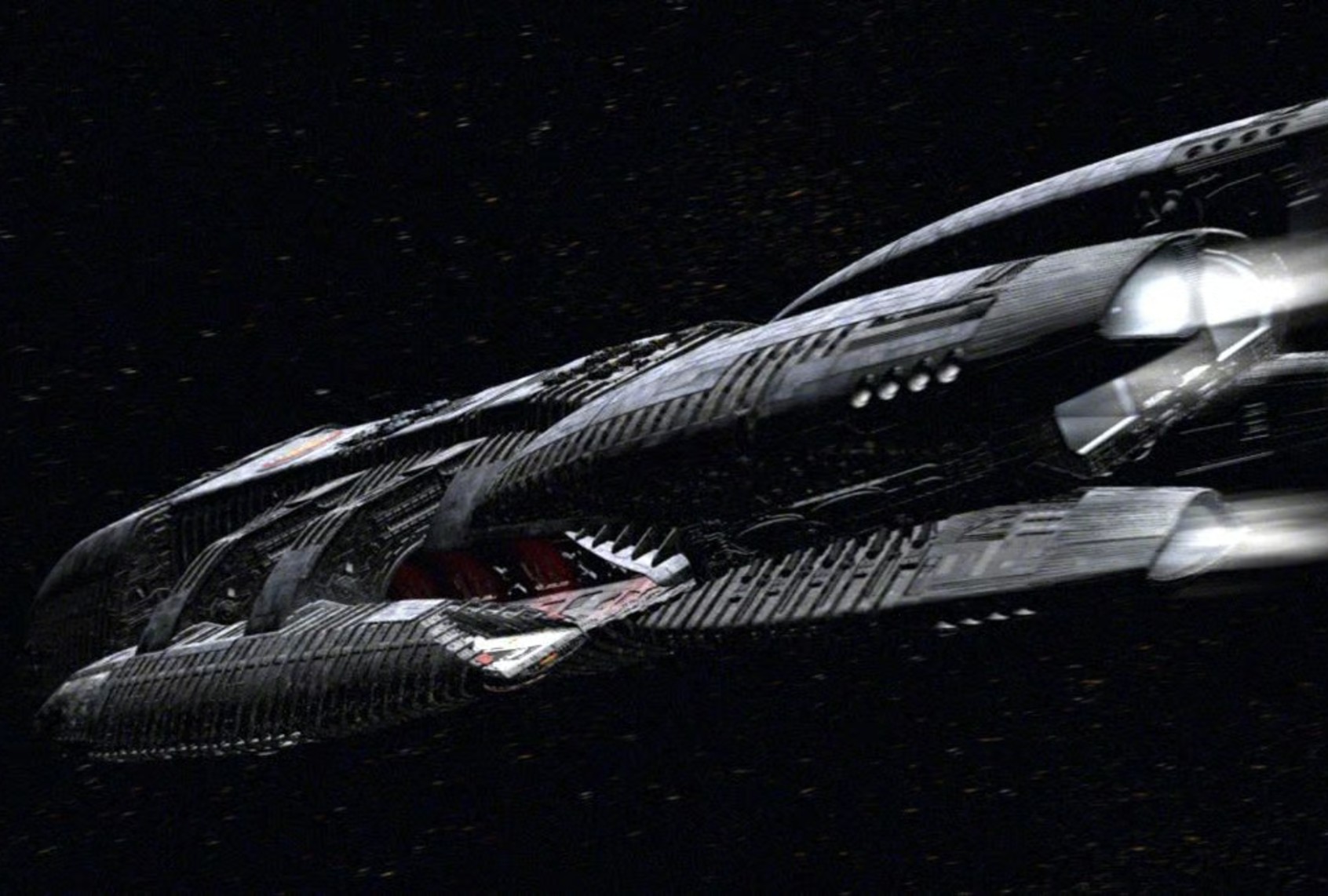
(Syfy) “Battlestar Galactica”
That grim political conclusion pales next to the disconcertingly precise speculation that launches the story’s action, which relates our overreliance on technology. Humanity’s salvation, then, rests in reverting to analog and relying on people more than circuitry.
On “Battlestar Galactica,” the survivors desperately searched for a mythical place called, yes, Earth. Without spoiling whether they find it by the time the show concluded in 2009, let’s say that our too-prevalent denial of climate change’s existence lends a grim accuracy to a late series twist. But that setback never stopped the remaining humans from pursuing the dream of something we colloquially refer to as touching grass.
Finding solid ground, not necessarily common ground, is the motivating mission of most space missions. The good guys are in the business of defending planets or seeking out new worlds, whether to connect or to find new homes. Moore’s version of “Battlestar” follows that pattern too. But what it’s also preaching is a message that feels more relevant now than it did 20 years ago: When all the stars go dark, machines may fail, but that’s when the human spirit can burn brightest. To quote the survivors’ prayerful mantra, “So say we all.”
Read more
from Salon’s culture newsletter, The Swell