
Trump’s cable-news Cabinet tries to sell a war
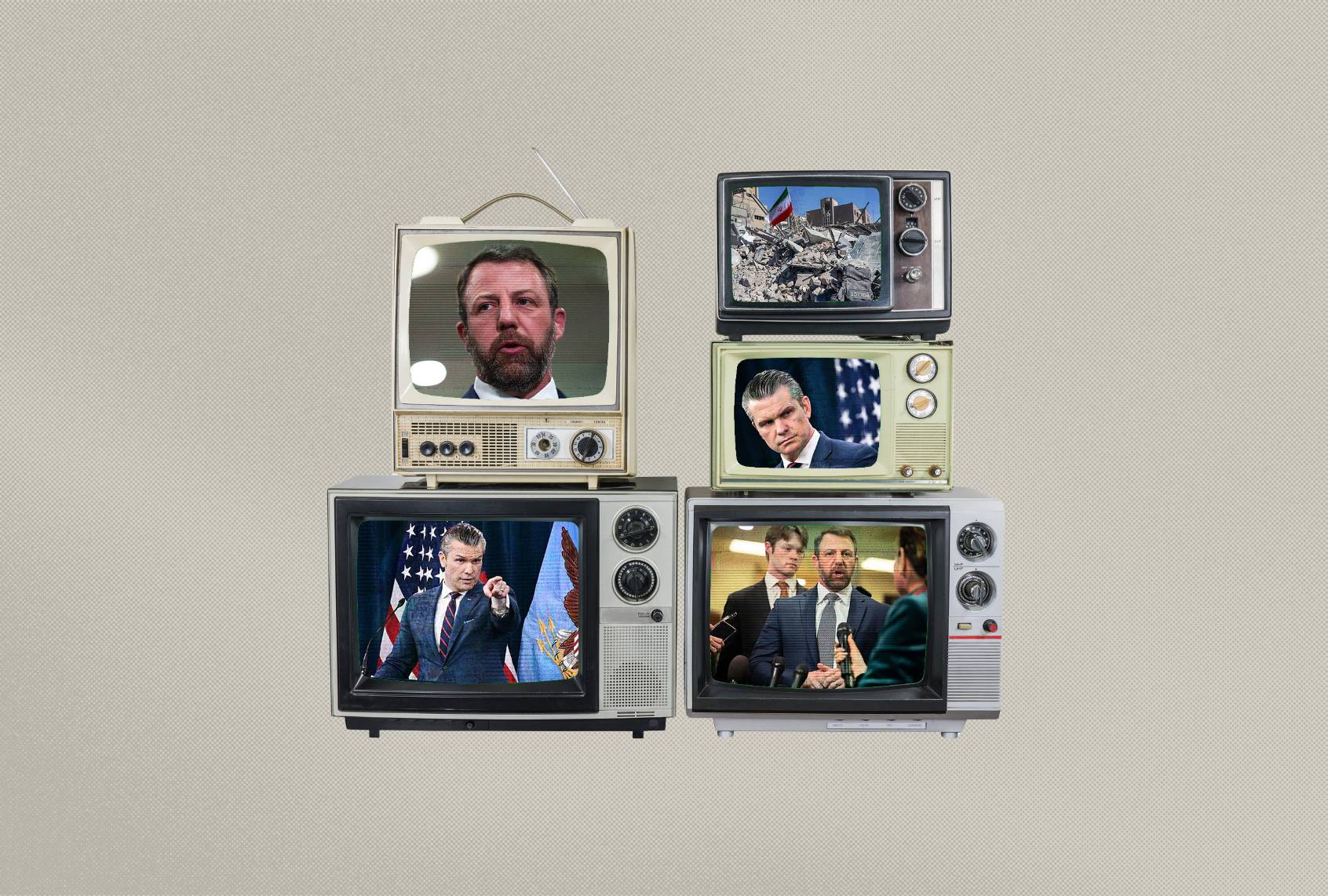
Donald Trump has always treated politics like reality television, from counter-programming debates with his own rallies to assigning degrading nicknames to his opponents. Now he is treating war the same way.
In the first week of the U.S.-Israeli bombing campaign against Iran, the Trump administration has revealed something extraordinary about how it intends to wage war: not just with missiles and drones, but with narrative control so aggressive it borders on parody. Defense Secretary Pete Hegseth‘s turn at running the most powerful military in human history increasingly resembles one of his “Fox & Friends Weekend” segments. He held only the second Pentagon press briefing since October on Monday, two days into the war. That is not a communications strategy — it is the beginning of a cover-up.
The obfuscation got even worse on Saturday when a reporter quizzed Hegseth aboard Air Force One. “Did the United States bomb a girls’ elementary school in southern Iran in the first day of the war and kill 175 people?”
“No, in my opinion, based on what I’ve seen, that was done by Iran,” Trump interjected.
“Is that true, Mr. Hegseth, that it was Iran who did that?” the reporter followed up.
“We’re investigating,” Hegseth demurred, before backing Trump’s assumption. “But the only side that targets civilians is Iran.”
Even some conservative commentators were unsettled by this exchange. Fox News’ Laura Ingraham called the strike “horrific news” and warned that the military would have to do a better job at addressing it publicly.
As Trump’s war with Iran grows more deadly and continues to widen, the Pentagon’s communications strategy is not even pretending to care about transparency, persuasion or even basic credibility.
As Trump’s war with Iran grows more deadly and continues to widen, the Pentagon’s communications strategy is not even pretending to care about transparency, persuasion or even basic credibility. Since he took office in January 2025, Hegseth has done his best to turn independent journalism into a branch of the Defense Department’s communications office. Meanwhile, the people responsible for explaining military action have behaved less like public officials and more like pundits auditioning for the next viral clip.
The daily Pentagon briefings of the Gulf War era and the CentCom pressers during the Afghanistan and Iraq wars were undoubtedly inadequate and often sanitized. And yet it represented a floor which I naively believed democratic accountability could not fall beneath without consequence. That floor has been demolished.
In October, Hegseth introduced a 21-page set of reporting rules that essentially required journalists to submit their reporting for Pentagon approval before publication. Most major outlets refused. Rather than agree to censorship disguised as “credentialing,” companies including the New York Times, Washington Post, Wall Street Journal and even Fox News surrendered their Pentagon press passes.
Their replacements are exactly who you would expect.
Pro-Trump outlets like One America News Network, conspiracy impresarios like Mike Lindell of LindellTV and a rotating cast of MAGA influencers were welcomed into the briefing room and declared journalists. Another granted access was Laura Loomer, who proudly calls herself “President Trump’s chief loyalty enforcer.”
The consequences of this coup are already visible in the public discourse. Americans are being asked to support — or oppose — a military campaign against Iran with almost none of the information required to make that judgment. What is the legal basis for these strikes? Has the War Powers Resolution been triggered, including the requirement that the president officially notify Congress within 48 hours of committing armed forces to a military action? What does success look like, and who defines it? What is the escalation threshold — at what point does Iranian retaliation become a pretext for a ground campaign?
Instead, we are getting messaging in the style of machismo. Rather than make the case on the merits, the administration and its operatives have saturated social media with images and rhetoric meant to trigger patriotic reflexes among the American people.
On Wednesday, the White House released a video on social media combining real footage of combat operations in Iran with computer-generated clips lifted from a popular combat video game. A day later, another video appeared online splicing together scenes from Hollywood action movies with actual war footage under the caption “JUSTICE THE AMERICAN WAY.” War — particularly one involving nuclear-capable states in the Middle East — is not supposed to look like a highlight reel assembled by a 16-year-old editing gaming clips.
The spectacle reflects a broader transformation underway across the national security apparatus, as Trump’s cabinet increasingly resembles a cable-news panel.
Before being tapped on Thursday to replace Homeland Security Secretary Kristi Noem, Oklahoma Sen. Markwayne Mullin spent the week across all of cable news trying to sell the president’s war of choice. Speaking to Fox News, Mullin argued Trump was right not to brief Congress ahead of attacking Iran because “you just simply can’t trust” all of the elected representatives, specifically naming Reps. Rashida Tlaib of Michigan and Ilhan Omar of Minnesota. Both are Muslim. In another appearance, Mullin pivoted seamlessly from discussing military action abroad to denouncing immigration policies at home, treating the two issues as part of the same broader struggle for national survival.
Mullin speaks like a culture-war combatant and has cultivated the kind of blunt, confrontational style that plays well on television debate panels. He has embarrassingly conflated Iraq and Iran, and backpedaled on whether the U.S. is at war, but he has never shied away from a cable news hit.
Mullin’s cable news appearances offer a revealing preview of what the Department of Homeland Security might look like under his leadership. A former mixed martial arts fighter and plumbing company owner, Mullin speaks like a culture-war combatant and has cultivated the kind of blunt, confrontational style that plays well on television debate panels. He has embarrassingly conflated Iraq and Iran, and backpedaled on whether the U.S. is at war, but he has never shied away from a cable news hit.
Mullin’s constant presence on television as a defender of Trump clearly endeared him to the president and is at least partially responsible for his nomination to succeed Noem, who was not fired because her policies failed. They are still the policies of the Trump administration. Noem was fired because she became a liability on television, unable to defend the indefensible without embarrassing the president in front of his real audience. She had grown unpopular with Trump’s base, overseeing the decline in support for his signature domestic policy, with Fox News host Tomi Lahren summing up the sentiment by saying in reaction to Noem’s ouster, “Good riddance and hide your dogs.”
After the crisis in Minneapolis, Republican senators trained their criticism on Noem, saying change was needed at the top, and many see Mullin as a steadier hand — meaning he performs better on camera. The department’s actual function is secondary to whether the person in charge can hold their own in a split-screen. Nevermind that Mullin, who, like Noem, also appeared on cable news the day a second U.S. citizen was gunned down on video by a DHS employee, told Fox News that Alex “Pretti was a deranged individual who came in to cause massive damage with a loaded pistol.”
Meanwhile, the administration’s hostility toward independent journalism continues to escalate. The Justice Department has subpoenaed journalist Seth Harp for reporting on the identity of a military official involved in the military incursion into Venezuela, which saw President Nicolás Maduro toppled and, along with his wife, seized and brought to New York to face criminal charges. Officials have also begun invoking the concept of “doxxing” — once used to describe online harassment — to criminalize reporting on immigration enforcement operations carried out by Immigration and Customs Enforcement.
Want more sharp takes on politics? Sign up for our free newsletter, Standing Room Only, written by Amanda Marcotte, now also a weekly show on YouTube or wherever you get your podcasts.
The Pentagon’s press restrictions are now the subject of a major lawsuit brought by the New York Times, which argues that the new media policy violates both the First and Fifth Amendments by granting the department “unbridled discretion” over who is allowed to report from inside the building.
When the traditional press corps was finally allowed back into the briefing room this week, what they found looked less like a government briefing than a political rally. Hegseth opened Monday’s conference with a line that perfectly captured the administration’s posture toward the war now unfolding in Iran. “This war,” he said, “will have no stupid rules of engagement, no nation-building quagmire, no democracy-building exercise, no politically correct wars.” Where previous administrations at least gestured toward international humanitarian law and democratic ideals, Hegseth openly mocked them. But most shockingly, that contempt extended even to the subject of American casualties.
At the same briefing, the defense secretary referred to weapons that had killed U.S. service members abroad as “every once in a while you might have a squirter that makes its way through.” At a briefing two days later, he lashed out at journalists for reporting on the deaths of American troops. “When a few drones get through or tragic things happen, it’s front page news” Hegseth complained. “The press only wants to make the president look bad.”
According to The Atlantic’s Nancy Youssef, Hegseth’s comments “sent a stunned silence through the briefing room.” Someone in the room, she recalled, said, “That was one of the most insulting things I have ever heard.”
Pentagon reporters are saying that military representatives now refuse to discuss operational details, referring nearly every inquiry to the White House. As CNN’s Brian Stelter recently reported, “virtually everything gets referred to the White House.”
After begrudgingly acknowledging last fall that Congress had gotten more information from the Pentagon during the Biden administration, Republicans are now reportedly growing frustrated about Hegseth’s inability to message on Iran.
But Republicans well understand that the people Trump promotes are rarely those with the deepest policy expertise. They are the ones who can most effectively defend the president on television. Hegseth’s path from Fox News host to defense secretary was the clearest example. Mullin’s trajectory now appears to follow a similar arc. This is the logic of the cable news Cabinet applied at scale: governance as content and television performance as the only qualification that actually counts.
The danger is that governance conducted as media spectacle inevitably prioritizes short-term political impact over long-term stability. Crises become opportunities for viral moments. That is the logic currently shaping how the Pentagon communicates about war. And if Mullin’s media tour is any indication, it is the same logic that may soon guide the nation’s domestic security apparatus as well. Trump’s wars — at home and abroad — are being narrated like a reality television show.
Read more
about Trump’s cable-news administration