
Is parity in the Premier League a sign of quality — or do these teams just stink?
-

Ryan O’Hanlon
What were you doing last Thursday, right around 1:30 p.m. ET? Actually, I think I know.
It was New Year’s Day. So, chances are you were tired — maybe a little hungover. But you probably had the day off. And since you’re reading this column, chances are you’re interested in the Premier League. And since you were sluggish, didn’t have work, and you do like soccer, my guess is that, at 1:30 p.m. ET last Thursday, you were sleeping in front of your television.
How do I know this? Because there were four Premier League games being played at the same time, and they were all terrible.
Crystal Palace and Fulham tied 1-1, and then Liverpool, Leeds United, Sunderland, Manchester City, Tottenham and Brentford combined to score … just kidding. They didn’t score a single goal. Across the 360 minutes played in the Premier League on New Year’s Day by eight different teams, just two balls ended up in the back of the net. The teams that have combined to win the past eight Premier League titles couldn’t score against a pair of promoted teams, the team with the league’s fanciest new stadium couldn’t score against the team they’d just stolen their manager from, and the team that’s supposed to be the league’s new overachieving upstart got outshot by Fulham at home.
With the quality of open-play attacking in the Premier League as low as it’s been in over a decade, you may have woken up from your nap and eventually come to the following conclusion: This league stinks.
It seems like almost every team in the league still has a chance to qualify for the Champions League. And outside of Arsenal, are there really any good teams? The Gunners are on a six-game winning streak, and only one other team is even on a winning streak at all: Newcastle United, with their two straight victories.
But, perhaps, once you had some coffee or eventually went to bed before midnight, you might have eventually had another realization: Those same data points could also be used for … the exact opposite argument, couldn’t they? Maybe it only seems like there are no good teams because, well, everyone is actually pretty good? Sure, it put me to sleep, but don’t matches between teams of similar quality frequently result in tactical stalemates?
Now that we’ve had about a half a week to recover, it’s time to ask: Which one is it? Is the Premier League’s quality this season throughout the table just really good — or is it really bad?
– 12 top candidates to be Man United’s next manager
– Keep, Dump or Extend: January moves Liverpool should make
– Chelsea using Strasbourg as a feeder team: Will more teams copy it?
The case for the Premier League being bad
We’ll start here:
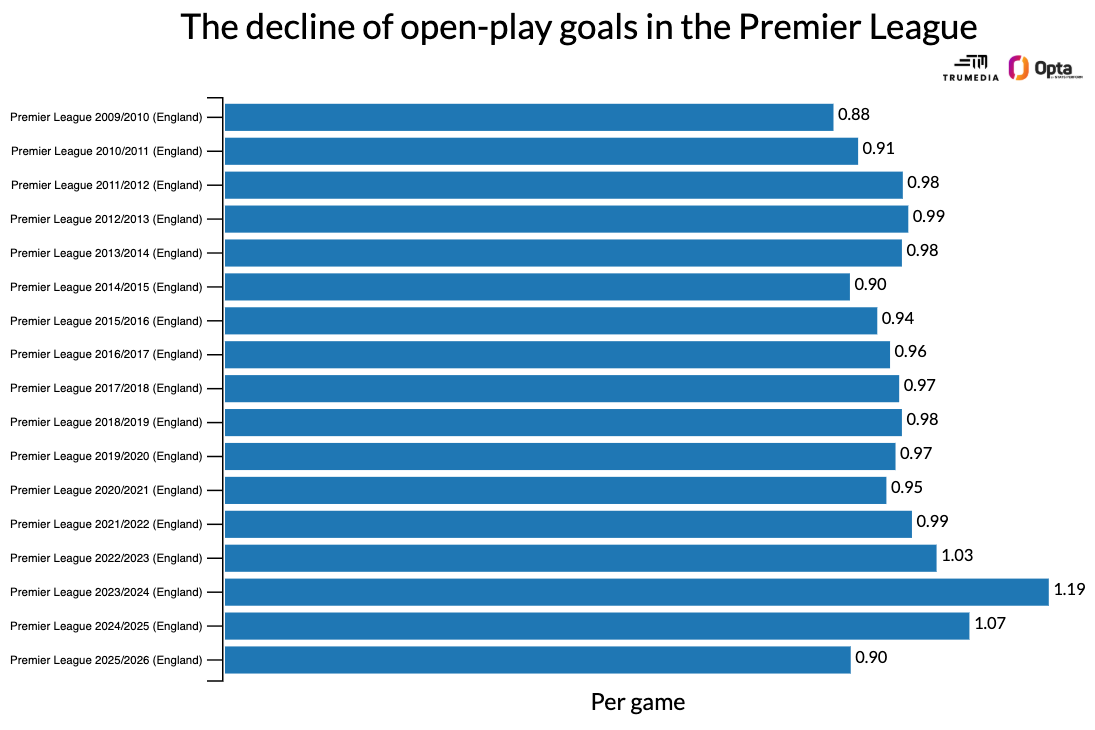
And lest you worry this is just random fluctuation, here’s the same chart, just with open-play shots instead of open-play goals:
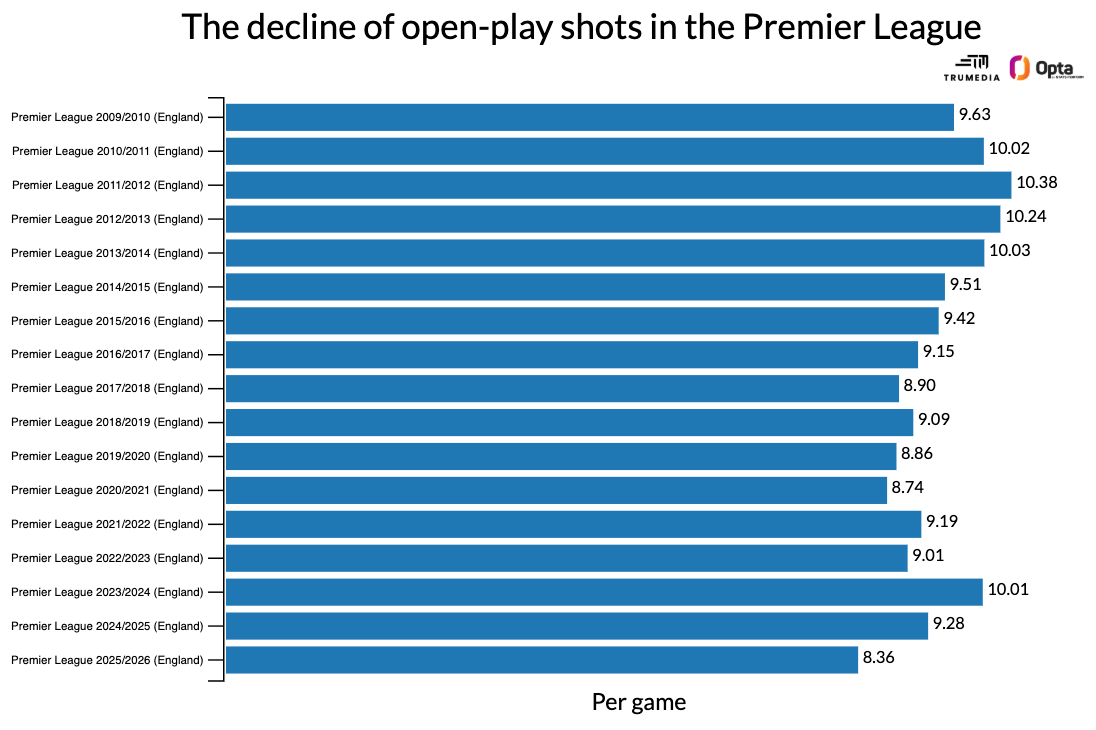
In order to avoid Arsenal fans threatening my life again or badgering my loved ones on the internet, though, I don’t want to spend too much time on this particular part of the argument — but if teams can’t score goals from open play anymore, then that says something about the quality of the teams in this league. Mainly, that they’re not good enough to consistently do the hardest thing in the sport: Score goals without the benefit of a dead ball and preplanned movements.
That decline in overall quality, particularly, shows up at the high end of the league.
We can use expected goal differential to show the general caliber of the chances a team is creating and conceding. And from 2009-10 through last season, per Stats Perform, there were 64 Premier League teams who posted an xG differential of plus-0.5 or better per game. By combining the computing power of multiple large language models, I am able to reveal that those numbers average out to four teams per season.
Well, this season, it’s only two — and no other season in the dataset has featured fewer than three. Just last year, when Liverpool ran away with the league despite finishing with only 84 points, we still had five such sides: the five top teams in the table.
If we flip to the bottom of the league this season, then there’s Wolves, with six points through 20 games — the second fewest in Premier League history. Of course, they also just beat 18th-place West Ham, 3-0, while generating nine shots on target and conceding zero. But the team sandwiched between both of them might be even worse. Since 2009, only two teams have finished a Premier League season with a worse per-game expected goal differential than Burnley‘s current mark of minus-1.08.
No one is scoring from open play, there are barely any traditionally good teams, and there are lots of really bad teams.
The case for the Premier League being better than ever
Let’s say there was a league with a table that looked like this:
That looks like the best league in the world — by far. You have two teams that have won the Bundesliga within the past 20 years in the relegation zone, plus another one that’s currently in the Champions League. Just above it, there’s the team that’s currently in first in Ligue 1, the one that’s currently leading in the Netherlands for the third-straight year, and the defending title-holders in Serie A.
These names aren’t chosen at random — this is just how good the people who take your money every weekend think the Premier League is.
At the site PitchRank, Tyson Ni compiles betting market implied power ratings by looking at the lines for each game across all of the major European leagues and continental competitions. It’s more complicated than this to calculate, but it’s based on the premise that you can, say, look at how much Liverpool was favored by against Eintracht Frankfurt on the road, and how much they were favored by against West Ham on the road, to get a sense of how good those teams are in comparison to each other.
And yes, these ratings see Eintracht and West Ham as very close to each other. That’s how I made the table: by replacing each Premier League team’s position in the table with the closest ranked non-Premier League team from the most recently updated ratings at PitchRank.
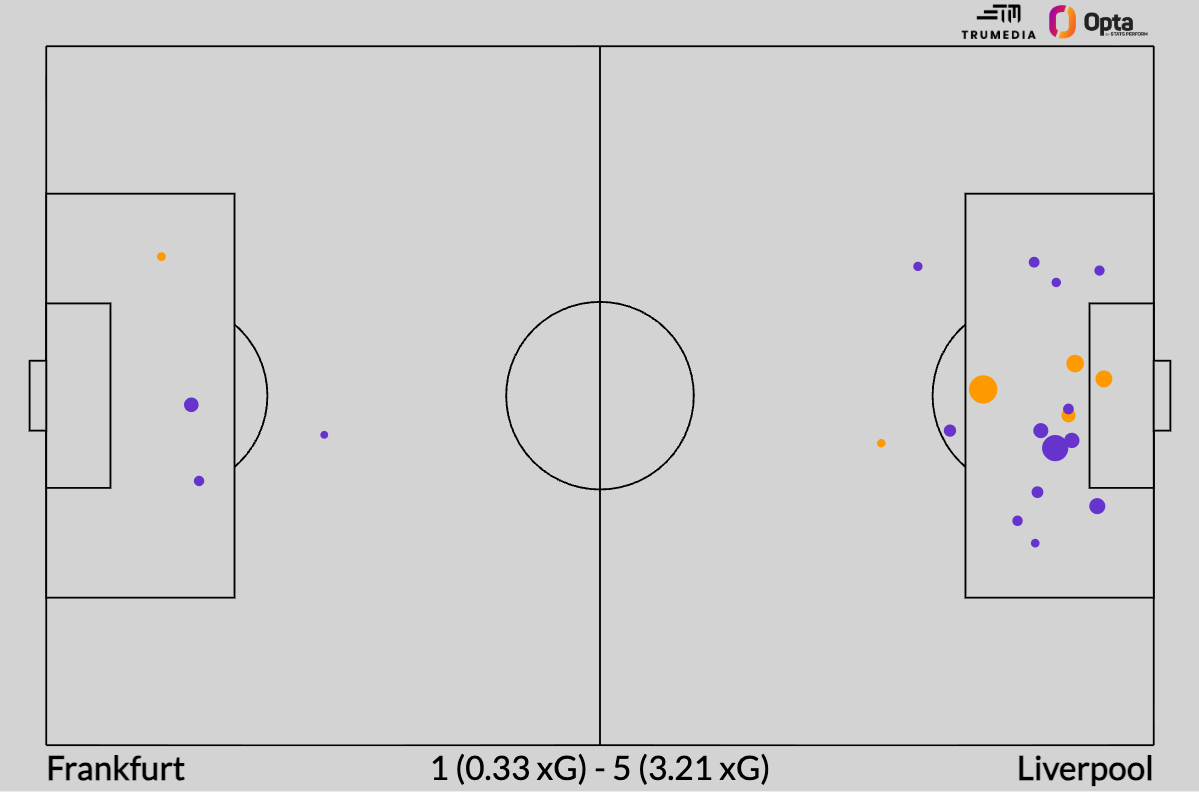
While it might seem absurd to say that Eintracht and West Ham are equivalent to each other, reality suggests otherwise. Here’s what happened when Liverpool actually played Eintracht Frankfurt on the road:
And here’s what happened when they actually played West Ham United on the road:
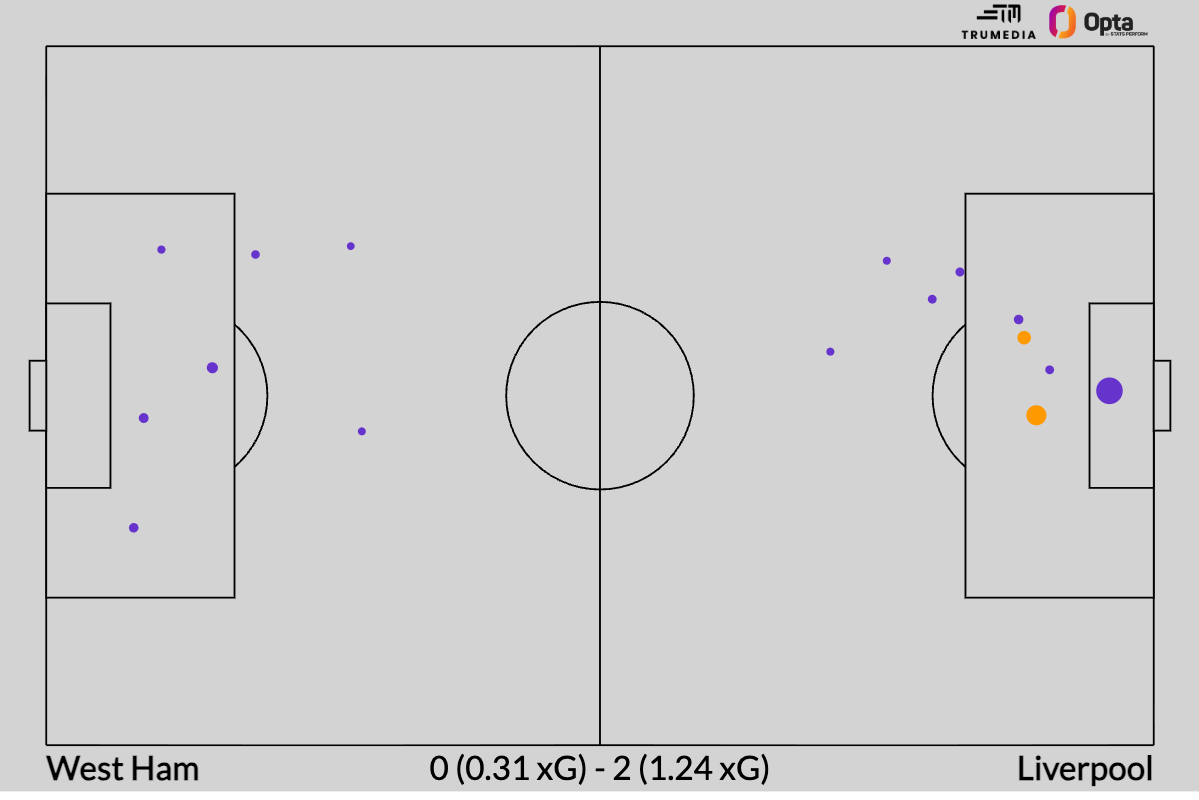
The results and performances this season mostly speak for themselves.
Arsenal smothered Bayern Munich and Atletico Madrid in London. Manchester City beat Napoli at home and Real Madrid on the road. Although Liverpool collapsed against PSV at Anfield, they’ve also beaten both Madrid sides at home and Inter Milan on the road. They might be the worst set piece team in England … and the best in the Champions League. Chelsea beat Barcelona 3-0. And both Newcastle and Tottenham have better goal differentials in the Champions League than they do in the Premier League.
As it stands, all six Premier League sides would finish in the top 15 of the league phase.
In the Europa League, Nottingham Forest have the second-best expected goal differential among all teams, while Aston Villa have won five and lost one. And in the Conference League, Crystal Palace are the only team with an xG differential north of plus-nine.
If almost all of the Premier League teams are improving when they leave the Premier League to go play in leagues that are theoretically collecting all of the best teams in Europe, then it becomes pretty hard to argue that the Premier League is having a down year. The soccer hasn’t been good to watch, but the league might actually be more competitive than ever before.
And, well, why wouldn’t it be? The Premier League has the most lucrative television deals of any league in Europe, and it has historically divvied that money up way more equitably than any of the other major European leagues. Among the 30 richest clubs in the world, per the most recent accounting, 16 of them come from the Premier League.
But on a financial level, the rest of the league hasn’t caught up to the traditional Big Six: Arsenal, Chelsea, Liverpool, Manchester City, Manchester United and Tottenham Hotspur. The ratio for the wage bills of the Big Six and the rest of the league has sat around 2.5-to-1 for over a decade. And this past summer, we saw Liverpool and Arsenal spend on player acquisitions in a way that very few other clubs in the world ever could — or ever have.
Except, since the television deal has been distributed more equitably, it means that the Big Six remains competitive with Bayern Munich, Barcelona, Real Madrid and Paris Saint-Germain for the best players in the world, rather than surpassing them. Plus, as I wrote about a couple weeks ago, the players at the highest-end of the market come with a massive mark-up.
So, not only do the, say, top 100 or so players mostly get split among the Big Six plus these other four, but your dollar doesn’t go as far once you start acquiring these players. And so the rest of the Premier League has more money than ever before, and it’s easier for them to improve than it is for the best teams in the league to improve.
Per analysis by Futi’s John Muller, the Big Six employed 29% of Transfermarkt’s estimated 300 most valuable players in the world back during the 2014-15 season, while just 7% were employed by other teams in England and 64% played elsewhere in Europe. Fast forward 10 years, and the Big Six’s share of the world’s best players has remained stable at 29%, but the rest of the Premier League’s hold on top talent has nearly tripled: up to 18%.
It’s not that these teams are holding onto their players more often than they have in the past, either. Every Big Six club made at least one major signing from a smaller Premier League club this past summer. But rather, it’s that the players who used to play for AC Milan and Borussia Dortmund are now playing for Crystal Palace and Fulham.
When that happens, you don’t get a surprise title challenger in the Premier League, but you do get a team like Aston Villa crashing the top four. And well, you get a Premier League table where, 20 games into the season, the gap between 5th place and 14th place is still only four points.