A wave paralysed me but AI could help me walk again
Meleri WilliamsBBC Wales
When Dan Richards went for a New Year’s Eve swim in 2023, he never could have imagined how drastically his life would change.
In a freak accident, he injured his neck when a wave caused him to flip and hit the sand in Langland Bay, Swansea.
“I knew instantly that I was paralysed,” the 37-year-old said.
“I couldn’t move anything.”
Doctors told him he would be bed-bound but, two years later, he uses a wheelchair and can move his arms and fingers.
He has even walked with the help of Artificial Intelligence (AI) technology in Wales and Germany.
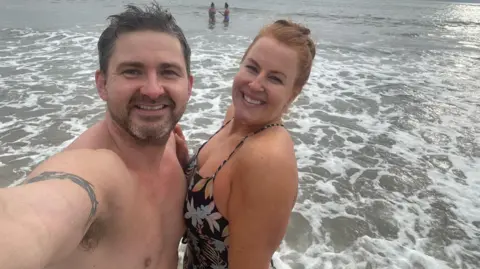
Dan and his partner Anna, 40, were celebrating the new year with a cold water dip when the accident happened.
“I remember all of it, unfortunately. Being pulled out. And then everything changing,” Dan said.
“I got hit by a wave, it flipped me over and folded me backwards, and snapped my neck. I knew it was bad.”

 Anna Thomas
Anna recalled hearing Dan shouting for help as she got ready to get into the water.
“I just remember looking over and just seeing Dan’s head coming up and then going back under,” she said.
“We dragged him out. But he was just dead weight and the sea was coming in really fast.
“We waited for emergency services, and then [I remember] begging them to let me go in the helicopter. It was horrendous.”
After being taken to hospital in Bristol, the couple from Swansea were given life-changing news.
 Anna Thomas
Dan said he was told he was paralysed form the neck down, would not be able to move and it was “highly likely” he would be bed-bound for the rest of his life.
Anna – who had only started dating Dan a few months before the accident – had to make dreaded phone calls to family members.
“It was New Year’s Eve, I was put in a room on my own but you could hear people laughing and joking, and I had to tell Dan’s parents.
“How do you phone someone’s mum and say that their son is paralysed?”
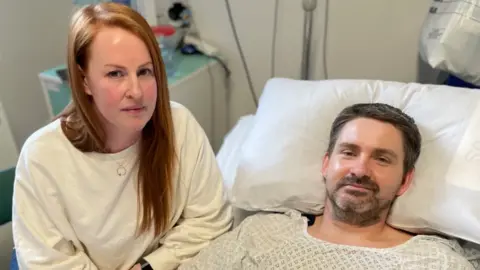
Anna said every day since the accident has brought a new challenge.
“It’s our reality. Until you’re in this situation… you don’t realise just how much you have lost.”
But in the months that followed the accident, when Dan was in hospital, even the slightest movement in his toes gave the couple hope things would change.
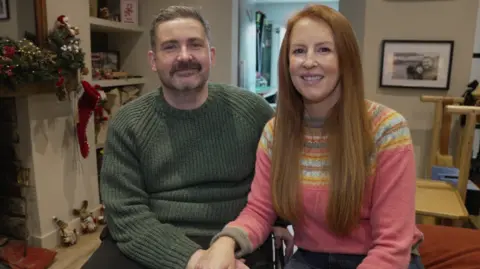
“Luckily I’m quite stubborn,” Dan said.
“I just wanted to see the physios as soon as possible. I wanted to work. I didn’t accept what they were saying.
“I’m proud of the progress I’ve made. It’s a long time since laying in bed in Bristol, that’s for sure.”
He continued: “The feeling in my toes then translated into full feeling through my legs and feet, some movement in my right leg [and] core strength – which I was told was gone – started to come back. Movement in my arms, my fingers, being able to hold things.
“I’m still hopeful, I’m still positive. With modern technologies, I’m not giving up.”
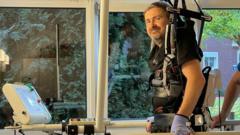
Dan had private physiotherapy at a specialist clinic in south Wales which used a world-first combined treatment to help him walk with a machine.
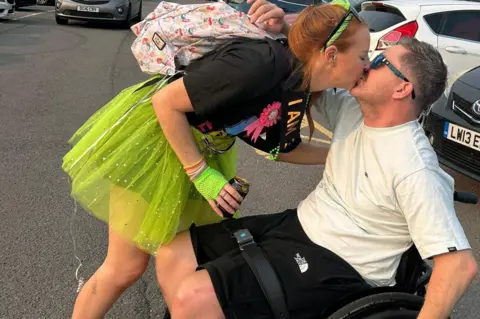 Anna Thomas
Jakko Brouwers, a neurophysiotherapist from Morello clinic in Newport, said Dan was “an immensely motivated guy” when he visited them after being discharged from hospital.
“The technology is two-fold,” he explained.
“The first part we tried with Dan is a robot. The robot will mimic normal human gait as much as possible.
“The other part of the system that we developed is a stimulation suit that has got sensors. The trousers are also fitted with electrodes and we can stimulate muscle activity at the right time.
“Through a little bit of algorithm – and dare I say AI – it will start developing a walking pattern.
“It’s super exciting. It’s not often that you see that in Wales.”
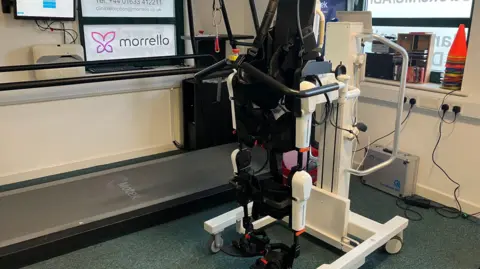
Dan said the experience was “surreal” but “the best feeling”.
“It just made me want to push harder. That’s on our doorstep here in Wales, so it spurred us on to do some research, and do other things.”
But private physiotherapy and innovative treatment does not come without cost.
From raffles to ultramarathons and charity nights, family and friends have fundraised meaning Dan and Anna could set off for a trial abroad in October.
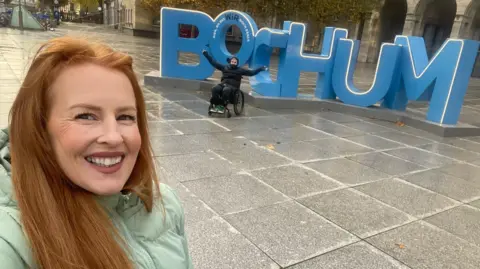 Anna Thomas
Dan explained he was trying two different treatments simultaneously in Germany – a stem cell treatment straight into his spinal cord, alongside using a Hybrid Assistive Limb (HAL) suit, which is a machine that works on brain waves.
“It’s one of the first times it’s ever been done,” he said.
“Sensors translate signals into movement, which then get my legs working, get me walking.
“The more you do it, the stronger the signals get, the faster it gets and eventually you’re able to walk without the suit.”
With six weeks of treatment left in Germany in the new year, Dan will have to apply for an EU Medical Visa, which is another challenge he said he is determined to overcome.
He does not know what the future holds, but is determined not to give up.
“Technology is advancing so fast, things aren’t where they were 10 years ago.
“New research is incredible. There is no limit. I don’t want there to be a limit.
“The more progress I can make now, the better our future will be.”