
Manchester City’s cheating scandal isn’t really about soccer
The biggest scandal in the modern history of professional sports broke wide open across the Atlantic this past week. How much that reflects larger social, cultural and economic pathologies and whether it affects regular people’s lives in any meaningful way is a complicated question. At the very least, I would suggest that the Manchester City scandal, which has driven the already-overheated British media to new heights of hysteria, isn’t really about soccer or sports.
Man City (often simply called “City”) is by far the most successful team in the English Premier League over the last 15 years and one of the four or five biggest soccer franchises in the world. Last week an independent legal panel delivered a long-anticipated verdict, finding the club guilty on 114 counts of systematic financial fraud, amounting to more than a billion dollars in fake revenues and sham commercial sponsorships. This scathing judgment only covers the years from 2009 to 2018, but no one thinks the actual or alleged fraud suddenly stopped after that.
Effectively, the verdict amounts to a finding that City cheated their way to the top of world football through a dizzying but blatant series of scams and shell games, allowing the team’s petro-state owners to illegally outspend competitors and pump hundreds of millions into inflated salaries for star players like Norwegian thirst-trap Erling Haaland (he of the formerly golden locks), Kevin De Bruyne and Sergio Agüero, and illustrious coaches, first and foremost among them the Catalan genius Pep Guardiola.
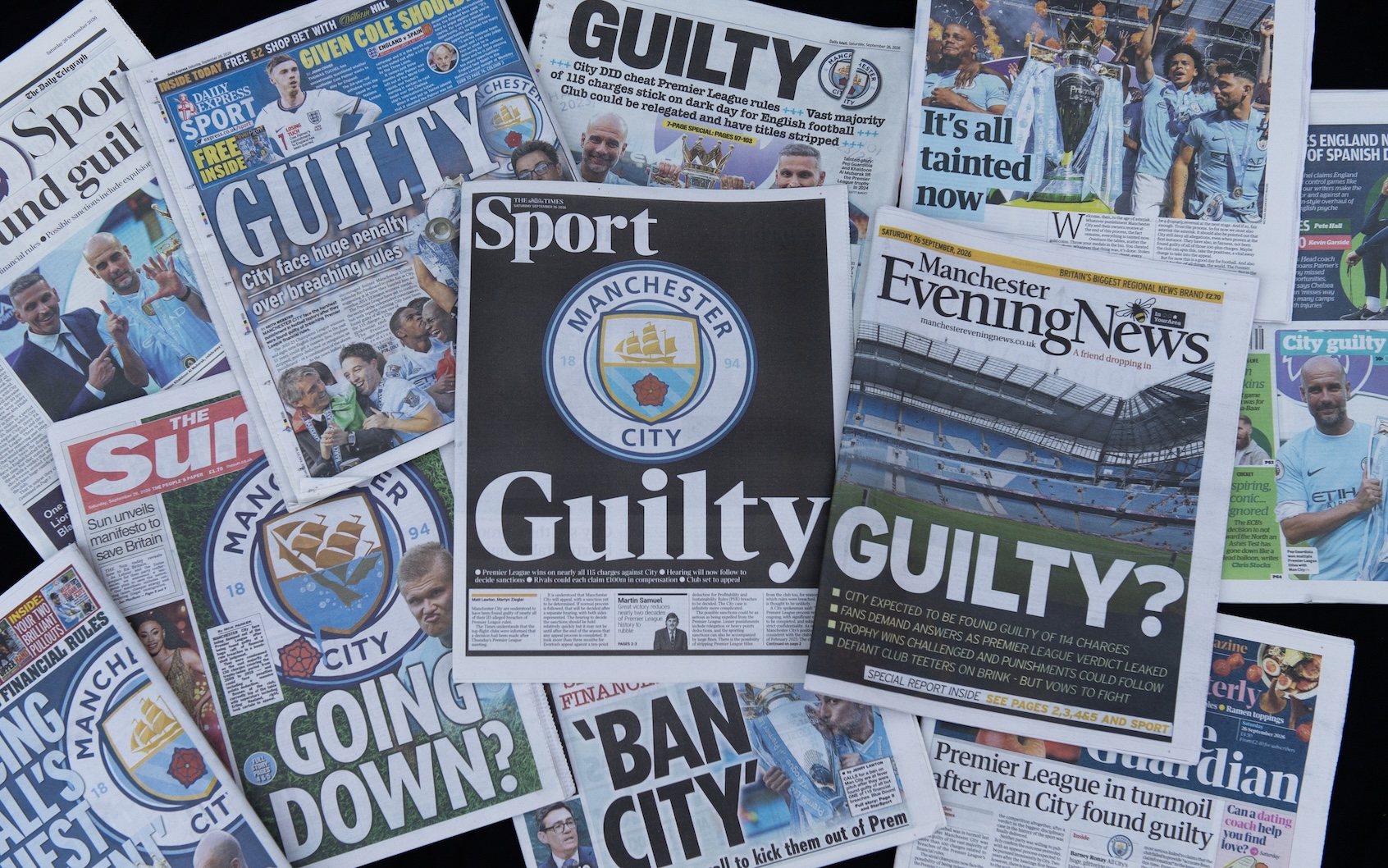
(Visionhaus/Getty Images) British newspaper headlines after Manchester City found guilty of breaches of Premier League financial rules, Sept. 26, 2026.
Along with winning numerous championships and tournaments, Man City changed the nature of the world’s favorite sport and transformed the EPL from a medium-size U.K.-based enterprise plagued by hooliganism, erratic attendance and crumbling stadiums into a global merchandising and marketing empire whose broadcasts, “kits” and online fan clubs extend from Indonesia to Arkansas.
If you belong to the large proportion of humanity inclined to a shrug-emoji reaction — billionaire oligarchs, overpaid athletes, incalculable sums of dirty money; who cares? — the first thing to say is that you’re absolutely right and that’s the only healthy response. But the salient fact that pushes the Man City narrative beyond a sports-business scandal and toward more cultural, political and even philosophical terrain is that virtually everyone who followed soccer and the EPL understood what was happening all along. That sort of willful blindness or collective cynicism is by no means limited to sports or celebrity culture — and it has become a widespread corrosive force in our society.
At any rate, everyone who was paying attention rapidly perceived the pattern after 2008, when Manchester City — a historically mediocre team with a modest fan base, sad-sack local rivals to Manchester United, who dominated the sport in the 1990s — was acquired by the Abu Dhabi United Group, a private equity firm closely aligned, shall we say, with the royal family of a Persian Gulf autocratic state. (Exactly how closely, and whether ADUG can be considered a separate entity from the Abu Dhabi government, is one of the issues at stake in the byzantine Man City case, now heading into an appeal process that could take years.)
It’s worth noting here that City Football Group, the ADUG subsidiary that has poured all that money into Man City, also owns or operates football/soccer clubs and related real estate projects around the world, including New York City FC in Major League Soccer, which at this moment is constructing an expensive new stadium in Queens, to be named — like everything else in the CFG universe — for Etihad Airways, Abu Dhabi’s state-owned carrier.
Here we find the central conundrum of the Man City scandal: Abu Dhabi’s petrodollars are deeply embedded in the economies of many Western nations, and any effort to punish or exile the emirate’s big sporting property could have far-reaching ripple effects.
Here lies the central conundrum of the Man City scandal, which is, like so much else about this story, a dirty secret that is no secret at all. Abu Dhabi’s petrodollars are deeply embedded in the economies of many Western nations, and any serious effort to punish or exile ADUG’s prize sporting property could have far-reaching ripple effects. That goes a long way toward explaining why U.K. Prime Minister Andy Burnham, who has struck such a forceful posture toward Donald Trump and Benjamin Netanyahu, has issued only vague blandishments about this explosive case on his own home turf, and clearly hopes the whole thing will simply go away.
In his excellent summary of the City scandal, Alex Shepherd of the New Republic observes that the “massive accounting sham” behind the team’s spectacular rise under the Abu Dhabi ownership was concealed only in threadbare fashion, and was widely tolerated for a range of interlocking reasons:
Manchester City committed fraud on a massive scale primarily as a soft power project for an authoritarian nation because it was allowed to do so. The Premier League chose to look away. The team was good and the money was flowing. Questions about its finances — let alone about its ownership — were swept under the rug. As Manchester City became the best team in the Premier League, the Premier League became the most powerful league in Europe and, by extension, the world.
It isn’t easy to translate this tangled affair into American terms, and in any case I’m here to argue that the real significance of the Man City story is not about big-money skulduggery in professional sports. But let’s imagine that the Los Angeles Dodgers or the New York Knicks were found to have broken the rules of their respective leagues to such an extraordinary degree that observers seriously suggested that their recent championships should be stricken from the record books and that the teams themselves should be banished from Major League Baseball and the NBA for years to come, if not forever. (Such outcomes are on the table in the City case; so is a slap on the wrist and a large payoff, or a negotiated compromise somewhere in between.)
Let’s further imagine that we had collectively decided that the Dodgers or Knicks were so entertaining to watch that we’d pretend not to notice that they were owned by Kim Jong-un’s first cousin or Vladimir Putin’s niece. (Which if anything is understating the case: ADUG’s proprietor, Sheikh Mansour bin Zayed, is the brother of Abu Dhabi’s absolute ruler and his regime’s vice president.) Then we’d pretend we were surprised to learn that their entire operation was shamelessly corrupt, when the only genuinely surprising part was that the leagues involved had decided to risk their own survival by exposing the financial misdeeds after all those years of looking the other way.
My point here is that while I’m surprised to find myself writing yet another article in 2026 about soccer — if you presume that betrays some personal interest, you would be correct — this one isn’t really about soccer at all. Whatever ultimate judgment befalls Manchester City after years of legal wrangling is beside the point, although there’s some grim amusement to be found in comments sections on The Athletic, as fans try to “well, actually” or DYOR a verdict that will certainly tarnish the team’s reputation in perpetuity.
This is partly a story, as Shepherd says, about sportswashing and the immense soft-power reach of authoritarian regimes like the UAE, Qatar and Saudi Arabia, all of which are heavily invested in professional soccer and other global sporting ventures. (Paris Saint-Germain, the biggest team in France and current European champions, was once owned by its fans but is now a property of the Qatari state.) Beyond that, it’s a story about questions almost too large to describe clearly.
It’s a story about a world that pretends to value democracy but is increasingly defined by massive inequality, oligarchy and, for that matter, monarchy. It’s about a world where the billionaire ex-president of the United States had to run for re-election in order to stay out of prison — and it worked. A world where the two most respected organizations in American broadcast journalism, CNN and CBS News, could come under the control of one man, who transparently aims to turn them into propaganda outlets supporting one faction of one political party.
This is partly a story about sportswashing and the immense soft-power reach of authoritarian regimes like the UAE, Qatar and Saudi Arabia. And also a story about a world that pretends to value democracy but is increasingly defined by massive inequality, oligarchy and, for that matter, monarchy.
It’s a story, in other words, about how much we will put up with. Or rather about how much we have convinced ourselves we must accept, given the unimaginable imbalance between the tech billionaires and fossil-fuel despots on one side and the other 99.9% of us on the other, whose only feasible role is to be their servants, their worker drones or their captive audience, or else to be deemed expendable.
It would be ridiculous to cast the English Premier League as a hero in that larger narrative, as if its current stance had anything to do with standing up against autocratic sportswashing or defending democracy and the rule of law. Man City may even have a point, on the level of libertarian economic theory, that the EPL’s financial rules were unfairly structured to prevent upstart teams from competing with long-established franchises like Liverpool, Arsenal and Manchester United, and that owners should be allowed to spend as much as they want to put a competitive team on the field. (That is, in fact, exactly how Major League Baseball operates, although its moment of reckoning is right around the corner.)
But there may also be a crude lesson under this dunderheaded clash of the titans that pertains to democracy, and can be seen reflected in the verdict on the Trump regime that we all see coming in this year’s American midterm elections, or in the surge of popular opposition to data centers and to the unrestricted development of AI. To paraphrase the maxim falsely attributed to Lincoln, you can fool a whole bunch of the people for a hell of a long time, but you can’t fool all of them forever.
Want more sharp takes on politics?
Sign up for our free newsletter, Standing Room Only by Amanda Marcotte, also a weekly show on YouTube or wherever you get your podcasts.
Ultimately, the Premier League must have concluded that the reputational and economic damage of prosecuting its most successful team for their obvious financial crimes — which is likely to be considerable — was preferable to the damage of not doing so. EPL leadership stuck a finger in the wind of public opinion, so to speak, and decided their best chance of not killing the golden goose lay in manning up for the principles they had visibly abandoned, or at least pretending to.
You definitely shouldn’t care what becomes of the EPL or Manchester City; I’d be better off if I didn’t either. Erling Haaland and his teammates will be fine, as will the Abu Dhabi royals, although whatever remains of the club’s pre-2008 Mancunian fanbase is likely to suffer bitterly. But you might care about finding the outer limits of the corrosive social and cultural corruption and cynicism to which we have all been subjected — and in which we have all been complicit — and then finding the courage and resolution to resist.
Will I watch Manchester City’s first post-verdict match on Oct. 11, against their archrivals Liverpool? Um, yeah. It’s a news event! I’m doing my job, or that’s what I’ll tell myself. But I won’t pretend my hands are clean.
Read more
from Andrew O’Hehir on our WTAF world