Consumers are the final product inspectors—CDA Consult

“Regulation is critical to a safe marketplace, but regulators cannot be present at every market, every stall, every lorry station, and every online trading point—the consumer is always present and must become the final inspector,” the Communication for Development and Advocacy Consult (CDA Consult) has stated.
Mr. Francis Ameyibor, CDA Consult Executive Director, revealed that Ghana is at a tipping point in its trust economy, where the proliferation of counterfeit goods, expired products, misleading advertisements, and online scams is eroding public confidence and costing families millions of cedis annually.
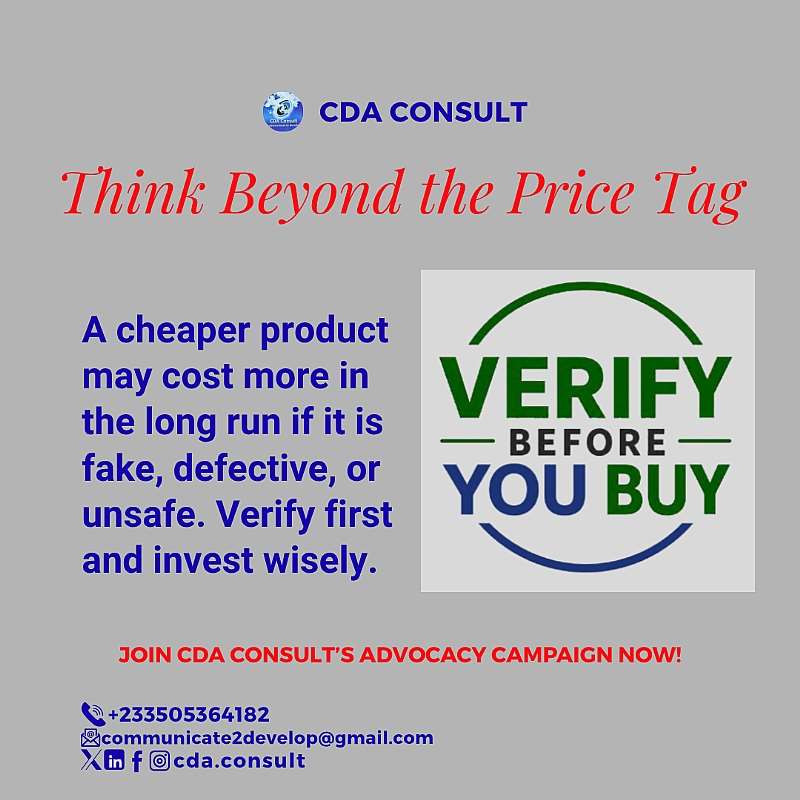
Speaking under its flagship advocacy dubbed “The Trust Economy: Verify Before You Buy,” Mr. Ameyibor said the campaign is shifting Ghana’s consumer protection conversation from enforcement alone to shared responsibility.
The CDA CONSULT the Trust Economy-Verify Before You Buy advocacy is a nationwide campaign, being implemented in collaboration with regulators, manufacturers, dealers, and law enforcement agencies, that seeks to complement existing efforts to curb counterfeit and substandard products.
The first phase, which will run over two years, will cover engagements in all 16 regional capitals and 60 district capitals nationwide, with Koforidua selected to host the maiden regional engagement.
The initiative is built around four pillars—education, awareness, action, and protection—with the goal to make pre-purchase verification a social norm while ensuring violations trigger fast, credible consequences.
Mr. Ameyibor stressed a hard truth that underpins the advocacy: the Ghana Standards Authority (GSA) and the Food and Drugs Authority (FDA) have done commendable work, but they cannot police all shops, markets, containers, and online vendors at the same time, especially during peak seasons.
“But you are there. You are present at the market, in the shop, and at the moment of purchase. Be an extension of the GSA and FDA for your own protection. You are the final inspector,” he stated.
He explained that counterfeit goods are flooding Ghanaian markets not because enforcement is absent, but because too many shoppers still “buy first and verify later at home.” This habit, he said, sustains the market for fakes.
“When verification is skipped, demand for fakes stays high and the cycle repeats. Verification is the first line of defense,” Mr. Ameyibor noted and stressed that consumers must police the market.
Mr. Ameyibor appealed “to consumers to change their attitude and change their focus when taking a decision to buy a product. GSA and FDA have a responsibility, but you play a critical role towards the sanitation of our markets.”
CDA Consult Executive Director reiterated the categorization of consumers into two—responsible and irresponsible—with the distinction lying not in income or education, but in attitude to safety.
“The responsible consumers take personal responsibility for their actions in the shop. They verify the information on the products to be sure of the quality and are not persuaded by price tags only,” Mr. Ameyibor said.
Irresponsible consumers, he said, transfer their responsibility to third parties, regulators, law enforcers, and others, assuming that if it is on the shelf, it must be safe.
Dr. Chris Kpodar, member of the Board of Directors of CDA Consult, said regulatory institutions cannot address the challenge alone, stressing, “Regulatory institutions cannot address this challenge alone.
“Businesses that operate with integrity cannot remain silent, and consumers need practical tools, not just warnings, to make informed purchasing decisions.
“Counterfeit products will not win if we stop giving them space to thrive. The moment a consumer chooses to check, scan, or ask, the market for fakes begins to shrink. Every verified purchase is a vote against counterfeiters.”
Dr. Kpodar, who is the Executive Chairman and Chief Executive Officer of Solomon Investment Ghana Limited, appealed to Ghanaian consumers to undertake the basic but critical task of asking, checking, and confirming the authenticity of products and services before making final payment.
He said, “An informed consumer is an empowered consumer, and verification remains the most effective first line of defense against counterfeit, substandard, and unapproved goods flooding the market.”
Dr. Kpodar noted that consumers must cultivate the habit of verifying products and services to ensure they receive quality and value for their money, stressing that the culture of impulse buying without authentication exposes households to financial loss, health risks, and erosion of trust.
He has therefore called on manufacturers, product dealers, distributors, and regulatory agencies to visibly support the initiative and become active partners in building a trust economy across the value chain.
Dr. Kpodar said Koforidua has been selected to host the maiden regional engagement in the third week of November this year, which will combine consumer education, market activations, media engagements, stakeholder collaboration, and institutional partnerships.
He said the Koforidua rollout will be implemented in collaboration with state and non-state actors, including regulators, manufacturers, dealers, and law enforcement agencies.