Lake America is Trump’s “freedom fries”
For a few years around the turn of the millennium, Ronald McDonald had an unusually sophisticated side hustle.
Between 1998 and 2003, McDonald’s released six installments of “The Wacky Adventures of Ronald McDonald,” a direct-to-video series sending Ronald, Grimace, Hamburglar and company on quests involving haunted houses, pirates, aliens and, eventually, the Loch Ness Monster. These were not bargain-bin cartoons. They were produced by Klasky Csupo, the studio behind “Rugrats” and “The Wild Thornberrys,” with music by Mark and Bob Mothersbaugh. For much of the series, $3.49 got you a tape at participating McDonald’s, alongside a small vanilla cone or Diet Coke.
In retrospect, it is a vivid artifact of fast food learning it could be much more than food. McDonald’s offered characters, stories, collectibles and peculiar geography. A child could eat the fries and then go home and watch the clown who sold them solve a mystery.
The menu had escaped the menu.
The sixth and final adventure arrived on Jan. 30, 2003. In “The Monster O’ McDonaldland Loch,” Ronald and company travel to Scotland in search of the Loch Ness Monster.
Less than three weeks later, Americans began experimenting with another way fast food might carry meaning.
At Cubbie’s, a restaurant in Beaufort, North Carolina, owner Neal Rowland removed “French fries” from the menu. France was resisting the Bush administration’s push toward war in Iraq, and Rowland wanted to register his displeasure. The potatoes remained. Their nationality did not.
They were now Freedom Fries.
The idea traveled quickly. By March, cafeterias in all three House office buildings had replaced French fries with “Freedom Fries” and French toast with the even more magnificent “Freedom Toast.”
I was 10, and I don’t remember this registering primarily as a joke. The patriotism of those years seemed earnest, even when it occasionally had the bearing of Sam Eagle: chest out, chin up, deeply concerned with the dignity of the republic. Over time, though, Freedom Fries began to feel less like political language than period ephemera, filed away with yellow-ribbon magnets, Toby Keith CDs and those “Wacky Adventures” tapes — artifacts from an era when virtually anything could acquire a patriotic gloss, including potatoes. By 2006, House cafeterias had quietly restored the French names.
Want more great food writing and recipes? Sign up for Salon’s free food newsletter, The Bite.
Which is why, when Rep. Lauren Boebert — no stranger to political (or musical) theater — proposed an encore for Freedom Fries last year, the suggestion sounded spectacularly dated.
“We rightfully have the Gulf of America,” Boebert wrote on X. “I’m also for changing French fries to Freedom fries!”
Yet more interesting was that Boebert had unintentionally placed the old joke beside a current one, drawing a straight line from the House cafeteria of 2003 to Trump’s campaign to rename American geography.
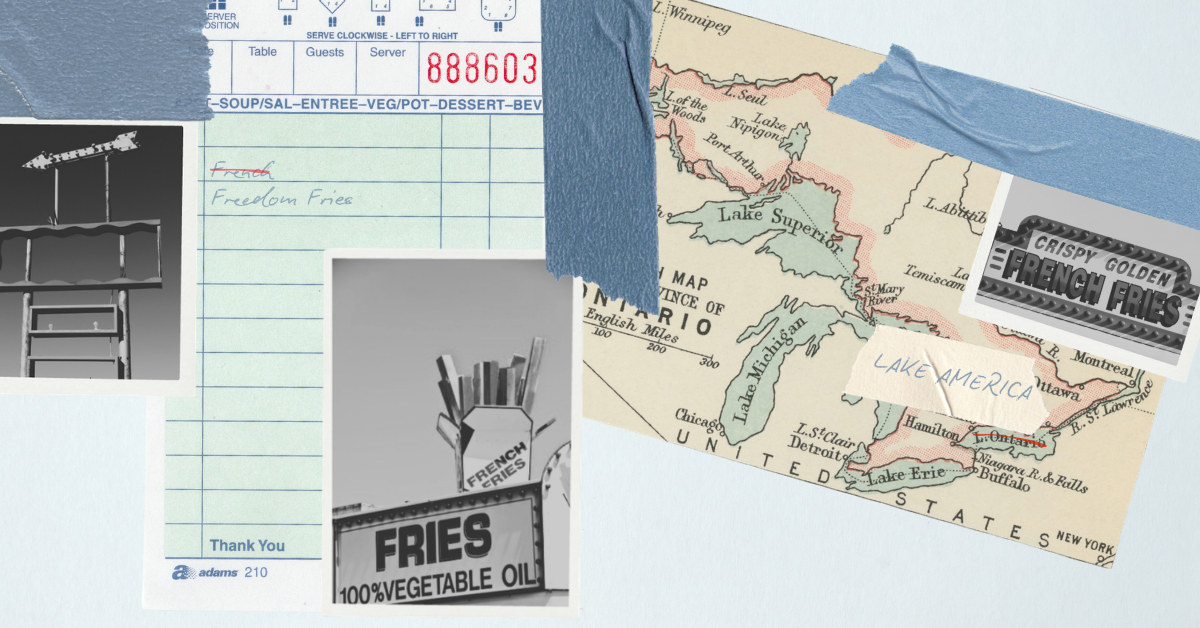
That campaign acquired its latest specimen last week, when Trump signed an executive order directing the federal government to call Lake Ontario “Lake America” amid his escalating trade fight with Canada. The order could govern federal usage; it could not compel Canada or the rest of the world to play along. Almost immediately, though, the dispute landed somewhere more intimate: the map in everyone’s pocket.
Google Maps changed it for U.S. users; Canadians kept Lake Ontario, while users elsewhere saw both names. Apple reportedly followed. A body of water that had managed for centuries without an identity crisis had become an A/B test: which lake you saw depended on where you stood and which corporation’s map you opened.
And then there was MapQuest — another artifact safely filed away in the same early-2000s drawer as Freedom Fries — which announced, simply, “We’re not changing it.” Hundreds of thousands responded by downloading the app; by Monday, MapQuest had climbed to No. 1 among navigation apps in Apple’s U.S. App Store, with usage reportedly surging to 50 times normal.
This is where Freedom Fries start to look less like a historical embarrassment than a prototype. The point was never really the potato. Once somebody changed the menu, everyone else had to decide what to call it.
Comedian John Mulaney has a bit about the kid at a sleepover who waits until after midnight to announce, “It’s tomorrow now,” then spends the rest of the night correcting everyone. The kid has discovered a maddening form of power: forcing an entire room to participate in a distinction nobody else needed.
Patriotic renaming operates on much the same principle. Rename a lake and the water does not change. But suddenly newsrooms need a style rule. Weather forecasters need a noun. Ordinary people acquire one more linguistic choice through which to signal agreement, resistance or exhausted indifference.
Freedom Fries asked the same question: What are you going to call it?
Fast food has only become more culturally expansive since 2003. Taco Bell can collaborate with Hollister on hoodies and KFC can produce a Colonel Sanders dating simulator; Donald Trump can stage a campaign stop at a McDonald’s drive-thru, and the HHS secretary can celebrate Steak ’n Shake’s switch to fries the chain boasts it has “RFK’d.” Fast food has increasingly become fashion, entertainment, identity and political shorthand.
Freedom Fries were ridiculous. They were also potent for exactly the same reason: they took a distant argument about nationhood and shrank it down to lunch. Patriotism became a word printed beside a hamburger, waiting for you to decide whether to say it.
Twenty-three years later, the fries are French again. The menu escaped the menu a long time ago.
The map, apparently, is now on it.
Read more
from Ashlie D. Stevens about food and politics