
“The Invite” debunks heteronormativity
Over dinner recently, I got to talking with one of my dearest friends — let’s call him Paul — about relationships. The subject appears frequently in our conversations, not just because Paul and I have known each other for over a decade, but because the first time we met was also our first date. Needless to say, things didn’t work out. Such is the way these things go at 19 years old, when you don’t realize there’s still so much life ahead of you, yet so much you haven’t learned. But falling in love at such a formative age allowed us to develop a mutual transparency and radical candor that I’ve learned few people possess, especially with their exes. Such emotional familiarity ensures that even a quick dinner over sandwiches in the park can provide us with conversational carte blanche, a space to decompress and demystify without judgment. Even so, when Paul told me that he and his partner were separating, my jaw hit the ground, taking a stray piece of grilled chicken with it.
My surprise was warranted. After all, Paul and his partner were the ideal couple. They’re both creative-minded people with big hearts and a wealth of opinions. If their views diverged, they listened to each other instead of silently preparing a counterargument. And in life, they let each other take turns at the wheel, planning events and dates with a notable regard for the other person. To me, it seemed Paul found love at the center of a Venn diagram, with someone who didn’t mind when Paul wanted to spend time at the other end of his individual circle.
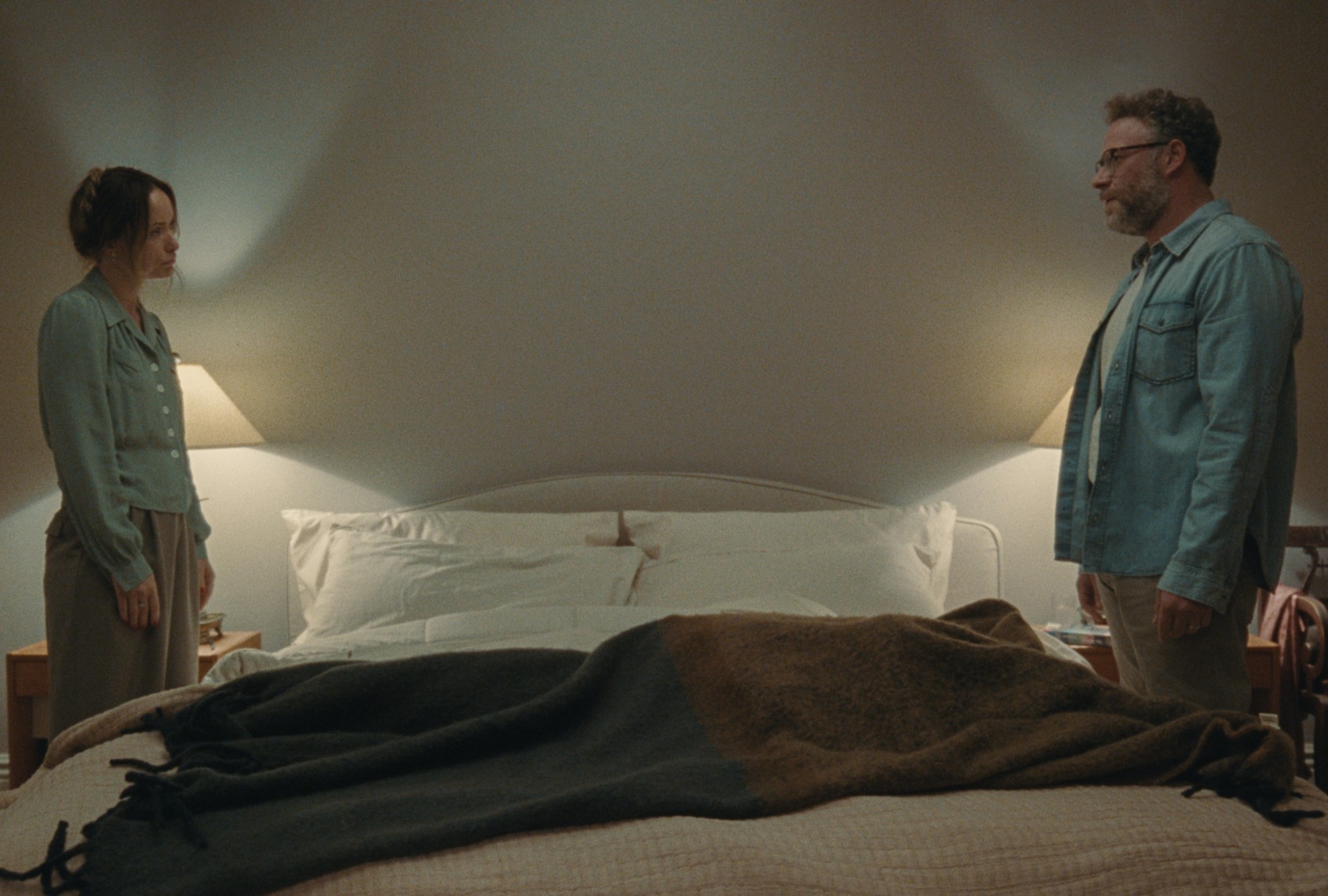
(A24) Olivia Wilde and Seth Rogen in “The Invite”
Wilde’s gaze elegantly cuts through all the noise and laughter, moving past the movie’s surface-level investigation of heteronormative culture and toward a shared experience defined not by sexual preference or relationship structure, but by our desire to love and be loved.
For a long time, I’d watched Paul tinker with the recipe for his perfect relationship. He never wanted to confine himself to the romantic guidelines that so often affected his straight friends. Paul was determined to write his own rules, and anyone he dated seriously would have to understand that. After years of both slight miscalculations and substantial errors, it looked to me like he finally nailed the formula. And yet, time revealed aspects Paul couldn’t make work. Things that, in all his years of grueling romantic data analysis in pursuit of the perfect relationship, he still couldn’t see coming. You can have open communication, clear rules, and an endless fount of love for one another, and life can still present you with options and obstacles you never thought to budget for.
Want more from culture than just the latest trend? The Swell highlights art made to last.
Sign up here
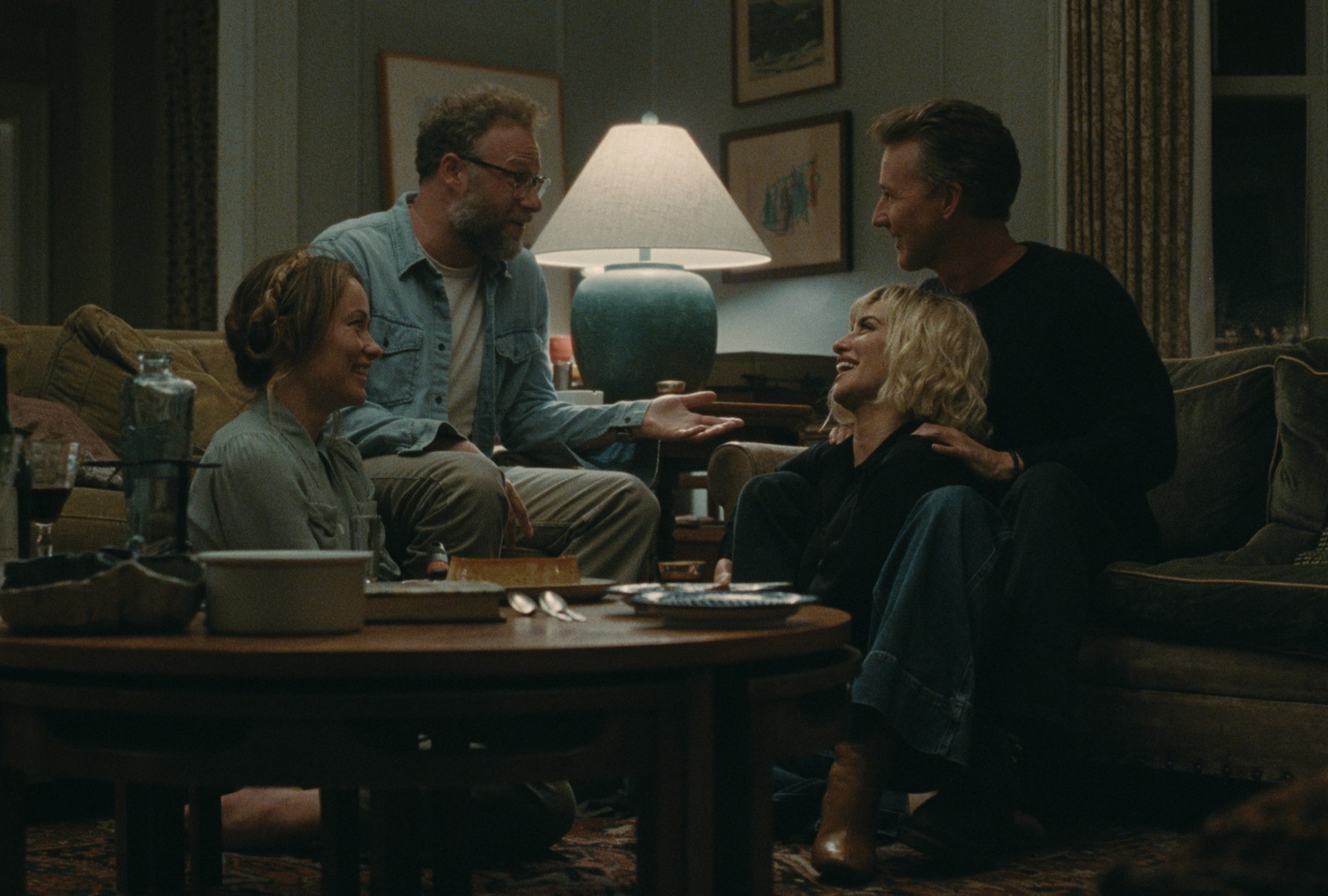
These sorts of surprises bloom from the center of Olivia Wilde’s latest directorial effort, “The Invite,” a chamber comedy that’s equal parts droll and disarming. Alongside her costars Seth Rogen, Penélope Cruz and Edward Norton, Wilde mines romantic relationships (and their foolish, heart-eyed architects) for all they’re worth — which is to say: a whole damn lot. Set entirely during an impromptu dinner party hosted by Angela (Wilde) and her reluctant husband, Joe (Rogen), for their loud, horny upstairs neighbors, Hawk (Norton) and Pína (Cruz), the film creates an atmosphere where the clock is king. Viewers submit themselves to the rising interpersonal temperatures, unconsciously counting the minutes, waiting for the moment someone inevitably mentions the proverbial heat.
Given that “The Invite” riffs on the strange sexual tension between these four characters, it would be easy to refute the film as your average romantic comedy for the straight, white upper-Millennial crowd. Those are the kinds of people whose sexual hang-ups dictate their relationship dynamics — or so most romantic comedies have convinced us. But when the pressure heightens and matters boil over between the quartet, Wilde carefully examines the resulting eruption instead of recoiling. Her gaze elegantly cuts through all the noise and laughter, moving past the movie’s surface-level investigation of heteronormative culture and toward a shared experience defined not by sexual preference or relationship structure, but by our desire to love and be loved.
Best of all, Wilde wastes no time getting right down to it. The only bit of scene-setting her film requires is an introductory sequence where Joe finishes his workday teaching music to kids at a local, mid-tier San Francisco conservatory and bikes home to his wife, who’s waiting with a whole deli’s worth of meats and cheeses. The neighbors are coming for dinner in a matter of minutes, Angela says, and Joe needs to prepare for their arrival. The problem is that Pína and Hawk are the last people Joe wants to see, after already being kept awake the entire night before by their raucous lovemaking. When Joe complains and threatens to bring up the noise, Angela all but begs him to put on a smile and let it go, just for this one night.
Initially, Joe and Angela don’t look so different from the pictures of couples we’ve seen before: harried and married, dead when they wed. Neither Wilde nor Rogen would be out of place in a ’50s-era sitcom. But the film’s screenplay — a biting, laugh-a-minute wonder penned by Rashida Jones and Will McCormack — shrewdly plays with genre conventions and audience expectations, illuminating more depth with every other sentence. There is information tucked inside every punchline and dig. And these character details are legible but not conspicuous, letting the viewer keep their eyes on the story, rather than the trail of expositional breadcrumbs.
But when Pína and Hawk arrive, their presence throws a wrench in a union that’s already on the fritz. They are the diametrical opposites of Angela and Joe: calm and free, while their downstairs neighbors are neurotic and toxically codependent. Hawk and Pína present a noticeably different picture of a relationship than most rom-coms offer — a kinetic, unpredictable spark that fuels the movie’s uncertainty and intrigues the audience tenfold. Much of the film’s first act revolves around the party’s inherent awkwardness, giving all four players the chance to relay the texture of their personalities. Who are we if not how we act at a dinner party with three other people, where the lack of buffers presents the opportunity for total, intimate sincerity? One gets the sense that this will be the defining night in all four attendees’ lives. At one point, I wondered whether it would end in raunchy, animalistic sex or graphic murder.
The beauty of “The Invite” is that it holds onto that suspense for as long as possible; so long, in fact, that the audience can settle into it, as if Jones and McCormack wanted to conjure the exact sort of tension that so many couples dance around, too afraid to name or look at it for fear that they might have to address it. By the time the rug — which Angela bought the morning of in desperate hope of impressing her cool, sexy neighbors — is pulled, it’s more fun to lie down and enjoy the ride instead of acting like you didn’t know what was coming. Eventually, one too many social gaffes have stacked up into a rickety pile, and Joe can’t help but play the Big Bad Wolf. The cork is popped, the can of worms is opened, and Joe mentions that Pína and Hawk’s screaming, animalistic sex has kept them awake for months.
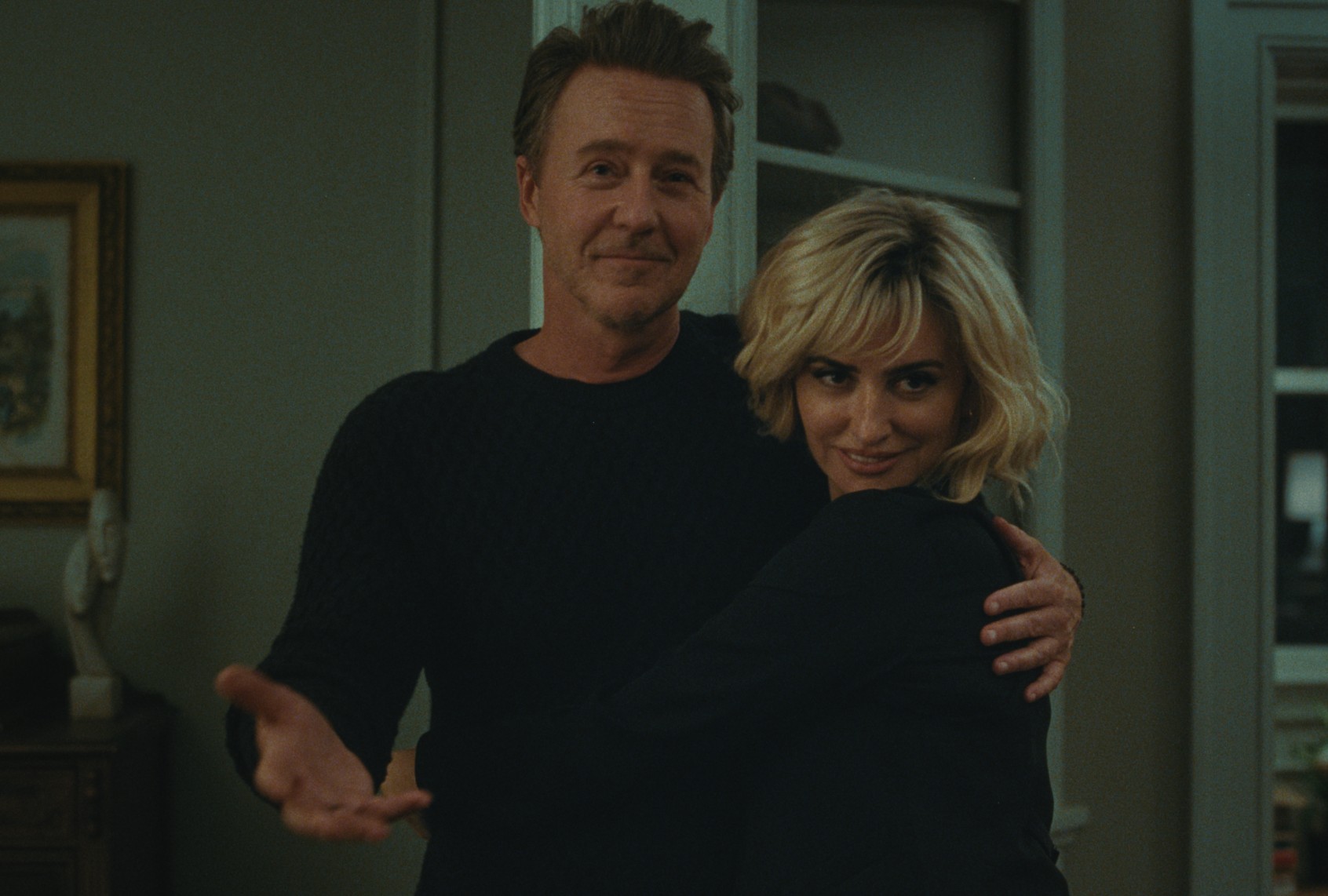
(A24) Edward Norton and Penélope Cruz in “The Invite”
Everything that follows is some of the most sophisticated, charming filmmaking I’ve seen all year long. “The Invite” shifts from situational comedy into full-on sexploration, taking each of its characters’ psychopathic tendencies with it. As a director, Wilde lands this jump with gleeful ease, making it clear what she meant when she recently described the dreadful reaction to her sophomore film, “Don’t Worry Darling,” as “liberating.” That experience didn’t just provide her the freedom to fail; it pushed her to take risks with abandon and follow her instincts. Even if that movie wasn’t well-received, it was an ambitious project that she had an obvious passion for. And while “The Invite” might not be operating on the same scope, its structure ultimately feels far less rigid than that of its by-the-numbers predecessor. Often, the best way to refine your tastes as an artist is to allow yourself space to play.
As Pína and Hawk assert, that’s also the best way to determine what you like in the bedroom. How can you understand exactly what excites you if your experience is limited to one person for most of your life? This question puts a crack in the dam, and in no time, a flood of emotional consequences follows. “The Invite” is technically a sex comedy, sure, but it’s not so explicitly about the act itself. Rather, the film is about all of the vulnerability, trust and communication that sex requires — three things Joe and Angela don’t have. And, as it turns out, Hawk and Pína might not have the whole roster, either; they’re just more adept at acting as though they do.
Who are we if not how we act at a dinner party with three other people, where the lack of buffers presents the opportunity for total, intimate sincerity? One gets the sense that this will be the defining night in all four attendees’ lives. At one point, I wondered whether it would end in raunchy, animalistic sex or graphic murder.
“The Invite” skilfully dissolves a complaint that has plagued the romantic comedy genre for years. As dating and marriage evolve and relationship styles progress, these films can sometimes look outdated. They depict meet-cutes and starry-eyed, idealistic love stories about people who fall in love and will never, ever have sex with anyone else. Other films in the genre assess broken marriages that are, somehow, still together — the type of people who want to divorce but are so bound by the chains of straight culture that they can’t say it. The resulting malignancy is hetero bullsh*t, some might say; something queer people or even straight people in non-monogamous relationships would never force themselves to endure. But that’s simply not true.
Classic romantic comedies might have convinced many viewers that these kinds of problems are relegated specifically to heterosexual culture. But one of the primary reasons that narrative exists is that, for so long, mainstream filmmaking catered to the majority. If you wanted to see a romantic comedy in the theater, your choices were likely limited to movies following straight, white couples whose biggest issue was that they were from different sides of the tracks. Or maybe he was a playboy, and she was a self-respecting career girl. How could they ever make it work?! By the power of love, of course! No wonder these stories have a reputation for being antiquated heterosexual fantasies.
But dismissing a film like “The Invite” as one of many would be a mistake. The film’s merit is not simply in how it illustrates the structures that bind and confine, but in how Wilde propulsively peels them apart to create a picture of romantic neuroses anyone can relate to. No one gets out of this life without their own complex around sex and romance, even those who seem like they’ve got it all figured out: your porn stars, your celebrity couples, your mom and dad who have been married 35 years, your Pínas and Hawks. These dynamics are not exclusive to monogamy or heterosexuality. But as viewers, it’s tempting to wave off our similarities to Joe and Angela, to think of ourselves as advanced beings who, by the nature of living in a relatively open-minded era, don’t have the same inhibitions.
“The Invite” beautifully conveys that, no matter how open we might be — or, crucially, believe we might be — there will be barriers that arise, ones that must be dealt with instead of hidden behind. These obstructions don’t pop up specifically because we’re straight or gay or queer or open or pansexual or asexual or ethically nonmonogamous, but because we’re human. Entering into a relationship with someone is not a one-and-done situation; it’s a constant conversation that evolves alongside social mores. Accepting that is what keeps the dialogue open. Only when we’re talking can we express exactly what we want.
Read more
about movies you shouldn’t miss