
VAR review: Cubarsi’s sending off changed Barça-Atléti, Pubill penalty claim?
Video assistant referee causes controversy every week whether it be the Premier League, Champions League or FA Cup, but how are decisions made and are they correct?
This season, we take a look at the major incidents to examine and explain the process both in terms of VAR protocol and the Laws of the Game.
 Andy Davies (@andydaviesref) is a former Select Group referee, with over 12 seasons on the elite list, working across the Premier League and Championship. With extensive experience at the elite level, he has operated within the VAR space in the Premier League and offers a unique insight into the processes, rationale and protocols that are delivered on a Premier League matchday.
Referee: István Kovács
VAR: Christian Dingert
Time: 44 minutes
Incident: VAR overturn. Red card to Barcelona’s Cubarsí.
In the 43rd minute, Barcelona and Atlético were scoreless, playing 11 vs. 11. In the 44th minute, the hosts went down to 10 men. In the 45th minute, the visitors took a 1-0 lead.
The game changed when Pau Cubarsí was sent off, with Julián Álvarez scoring a delightful goal from the ensuing free kick. Atléti would add a second through Alexander Sørloth to seal a 2-0 win and set up a raucous return leg of this Champions League quarterfinal at the Metropolitano Stadium on Tuesday.
What happened: Atlético midfielder Giuliano Simeone was seemingly through on goal when Cubasrí appeared to trip up his opponent. The on-field referee awarded the free kick as expected. However, he only produced a yellow card for the Barcelona defender.
VAR decision: VAR recommended an on-field review for a possible red card for denying an obvious goal-scoring opportunity.
VAR review: VAR took their time to review this situation and had to consider the referee’s rationale for issuing a yellow card in this situation as opposed to a red. The on-field referee felt that the ball was behind the attacker when the trip was committed, meaning the attacker was not in full control of the ball and therefore did not meet the threshold for a red card for denying an obvious goal-scoring opportunity.
Following several replays, the VAR felt the original decision was an error. The considerations were that, without the trip by the defender, the ball would have continued its path through into the penalty area and the Atlético attacker would have had the opportunity to score. The referee, following several looks at the incident, eventually agreed with the VAR and sent off Cubarsí.
Verdict: The correct outcome, in my opinion, and a positive VAR intervention. I was surprised that a yellow card was shown initially, as the situation had all the evidence of a red-card offense. However, the ball being airborne at the point the trip was committed would have made the decision more difficult and added a layer of doubt to the referee’s decision-making process, and he would have been more comfortable with a yellow card given these circumstances.
Incident: Possible penalty for handball.
Time: 54 minutes
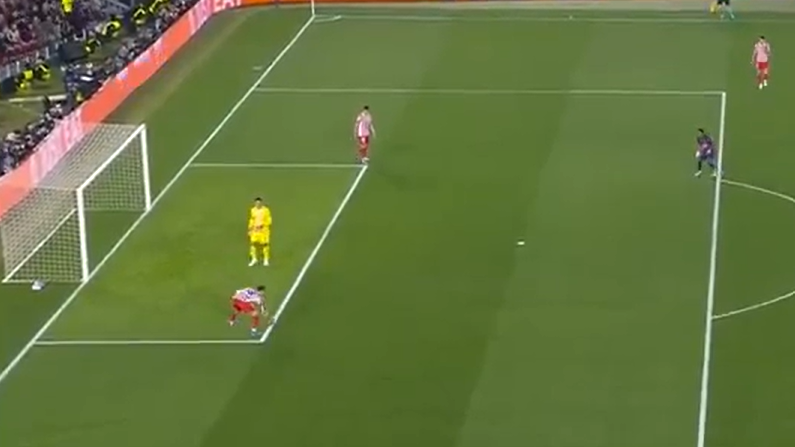
What happened: A bizarre situation that angered Hansi Flick as Barcelona felt they should have had a penalty when Atletico keeper Juan Musso seemingly tooka goal kick, only for teammate Marc Pubill to stop the ball with his hand and then retake the kick.
Verdict: This is an unusual moment, and I have sympathy with the referee. I’ve been met with that same dilemma, a choice between strictly applying the law and taking a sensible approach. Whatever happens, the referee is in a no-win position regardless of how they decide to manage the situation.
Let’s start with Law 16: The Goal Kick. It says that the ball is in play when it is kicked and clearly moves, so many considered from this that it was Musso who played the ball first and therefore the game was live when Pubill touched the ball with hand. The alternative reading of this incident is that Musso was merely giving the ball to Pubill for him to restart play.
Ultimately, it’s the referee’s judgement that counts and he decided to take the least contentious option based on the available facts. And I am comfortable he did.
Awarding a penalty where the action had no impact on the opposition’s ability to engage with the ball, or gave an advantage to Atletico for restarting in this manner, is not what we want to see. And while plenty were upset about the decision, the fallout would have been on another level if had gone the other way.
UEFA has been ambiguous with similar situations in recent seasons, allowing referees the autonomy to use their game management skills, judge the moment and trust their instincts.
Indeed, two similar incidents have happened in the Champions League in recent seasons and were treated differently. Last year, Aston Villa’s Tyrone Mings picked up the ball against Club Brugge after a short goal kick by goalkeeper Emiliano Martínez and conceded a penalty. A year before, Arsenal defender Gabriel went unpunished for picking up a short pass from goalkeeper David Raya in the quarterfinal first leg against Bayern Munich.
Kovács made his decision and, to be clear, this is not a situation for VAR intervention. The referee would have been clear with what he had seen and made the judgment in real time, so it would not be deemed an error and therefore is not something for VAR to get involved with.
Furthermore, it could not have been a second yellow card (meaning a sending off for Pubill.) A handball can only be punished with a yellow card if the defender has deliberately stopped a shot on goal or deliberately stopped an attacker from having a positive opportunity in the penalty area, and neither happened here.