David Bowie’s Goblin King still casts the longest spell
As an artist who played extensively in visual realms, David Bowie was equally defined by his distinct personas and his music.
Aladdin Sane, with his face strafed by a scarlet firebolt edged in blue, blue, electric blue, is quintessential Bowie iconography. But we also know him as Ziggy Stardust, the alien rock star, or the elegant, worldly Thin White Duke. His transformation into the rakish Soul Man earned him the rare cultural validation of a “Soul Train” appearance. And “Blackstar,” released two days before his death in 2016, introduced his final character, The Blind Prophet.
A decade after Bowie went back to the stars, however, one of his most resilient guises has proven to be Jareth, the Goblin King at the heart of the 1986 cult favorite “Labyrinth.”
I wonder how he’d feel about that.
Bowie took his art and image seriously. In many of his early interviews, he describes himself as an actor and writer as well as a musician. His work channeled literary imagery, but also drew influence from Nietzschean nihilism and Jungian depth psychology.
What did teen girls bopping to “Modern Love” know about any of that? Zilch. And yet, Bowie embodies many of those concepts in Jareth, a fantasy within a fantasy.
To a bratty teen named Sarah Williams, one of Jennifer Connelly’s earliest roles, he is a twisted kind of savior. The movie opens with her reciting lines from a story that casts her as a brave royal determined to reclaim a baby from a goblin king. Her delivery is as purple as you’d expect from an immature drama queen who’s jealous of her baby half-brother, Toby (Toby Froud), taking her place as the center of her father’s attention.
Four decades after it flopped in theaters, “Labyrinth” and Bowie’s work in it are now beloved cultural touchstones. It was too beautiful and weird for the mainstream, much like Bowie pictured himself at his artistic height.
When Sarah wishes the goblin king from her fairy tale would whisk Toby away, Bowie’s Jareth materializes and does just that, challenging Sarah to find her way to the center of his impossible maze within 13 hours if she wants to get him back.
Jareth isn’t Bowie’s creation but, rather, a construct of Muppets creator and the film’s director Jim Henson, who developed the story with conceptual designer Brian Froud, his collaborator on “The Dark Crystal.” Script credit eventually went to Terry Jones, a founding member of “Monty Python.” “Labyrinth” sustained its share of criticism, but nobody can accuse it of being short on talent.
That said, Bowie wasn’t simply doing this for the paycheck. He wrote songs for the soundtrack that complement Trevor Jones’ score, including a dreamy ballad, “As the World Falls Down,” that critics frequently list as one of his best songs.
Nevertheless, it flopped stupendously, earning a little more than half of its production budget.
Want more from culture than just the latest trend? The Swell highlights art made to last.
Sign up here
Suddenly, the rock god who only three years prior hit his commercial apex with “Let’s Dance,” a master of artistic shapeshifting who pioneered music videos long before MTV existed, was prancing around with Muppets.
“Labyrinth” landed during a creative nadir for Bowie, one he described to TV host Jonathan Ross in 2002 as “his Phil Collins years.” But like film, this pithy observation is often misinterpreted.
“Let me just explain that a little further. I don’t want to get into some deep s**t here,” Bowie told Ross. “I was performing in front of these huge stadium crowds at that time, and I was looking, and I’m thinking, ‘What are these people doing here? Why have they come to see me? They should be seeing Phil Collins.’ . . . You know, kind of stadium rock. It’s a certain kind of mainstream field that I’m not comfortable in.”
That context makes it clearer to understand why, four decades after it flopped in theaters, “Labyrinth” and Bowie’s work in it are now beloved cultural touchstones. It was too beautiful and weird for the mainstream, much like Bowie pictured himself at his artistic height.
Bowie was always forward-thinking in his artistic conversation with each era’s trends. “Labyrinth” debuted amid a surging interest in high fantasy and in the wake of several movies that performed well with audiences and critics, including 1984’s “The NeverEnding Story.”
With Henson fresh off making “The Dark Crystal,” a triumph of puppeteering merging with cinematic practical effects if not a box office smash, one imagines the filmmaker and the pop visionary finding common inspiration in the land of make-believe.
To an audience raised to base the worth of movies and TV shows on their ability to weave narrative with cultural tributes, pausing to find clues in the set dressing, “Labyrinth” is a goldmine of Easter Eggs.
The full trajectory of Sarah’s adventures is told in the first slow sweep of her bedroom, with the lens lingering on the cover of Maurice Sendak’s “Where the Wild Things Are” and the spines of “The Wizard of Oz,” “Alice in Wonderland,” and fairy tales by Hans Christian Andersen and the Brothers Grimm.
On Sarah’s desk is a toy maze; on her wall hangs a print of M.C. Escher’s “Relativity” and its surreal snarl of staircases. Together, they hint at the shapes and creatures Sarah will encounter on her magical quest, and leave us to wonder whether it really happened at all.
We wouldn’t be drawn to “Labyrinth” all these years later if Bowie hadn’t poured a searing alloy of androgyny and enigmatic intent into a mold and popped out his Goblin King.
No kid, save for a few geniuses, would have fully appreciated these grace notes, or the realism of Henson’s puppetry, including those incorporated into the costumes of the friends Sarah finds along the way: there’s sweet Ludo (Ron Mueck), a gentle giant who controls rocks; a dwarf named Hoggle (Brian Henson); and Didymus (David Goelz, with the voice of David Shaughnessy), a fox-like creature who believes himself to be a knight.
The array of literary and artistic homages in “Labyrinth” almost got Henson into legal trouble; narrative similarities to Sendak’s “Outside Over There” activated the author’s lawyers. But that was resolved by the filmmakers acknowledging his debt to Sendak’s work at the end of the movie. Besides, unforgettable details have a way of recycling through others’ work, as eagle-eyed J.K. Rowling’s readers noticed the first time Sarah mistakenly refers to Hoggle as Hogwart.
Enchanting as Sarah’s companions are, we wouldn’t be drawn to “Labyrinth” all these years later if Bowie hadn’t poured a searing alloy of androgyny and enigmatic intent into a mold and popped out his Goblin King.
Jareth is an illusionist as beguiling and seductive as he is sinister, caressing bubbles and gravity-defiant glass spheres with liquid grace. He sneers regally and struts around his domain in obscenely tight trousers that outline the Goblin King’s, um, jewels. But he’s also puckish – sylph-like and otherworldly, seductive and repellent, as likely to swaddle Sarah in her heart’s desire as he is to toss her into the belching, farting Bog of Eternal Stench. To sum it up, he embodies every adolescent figment and fear of where nascent stirrings of lust could lead.
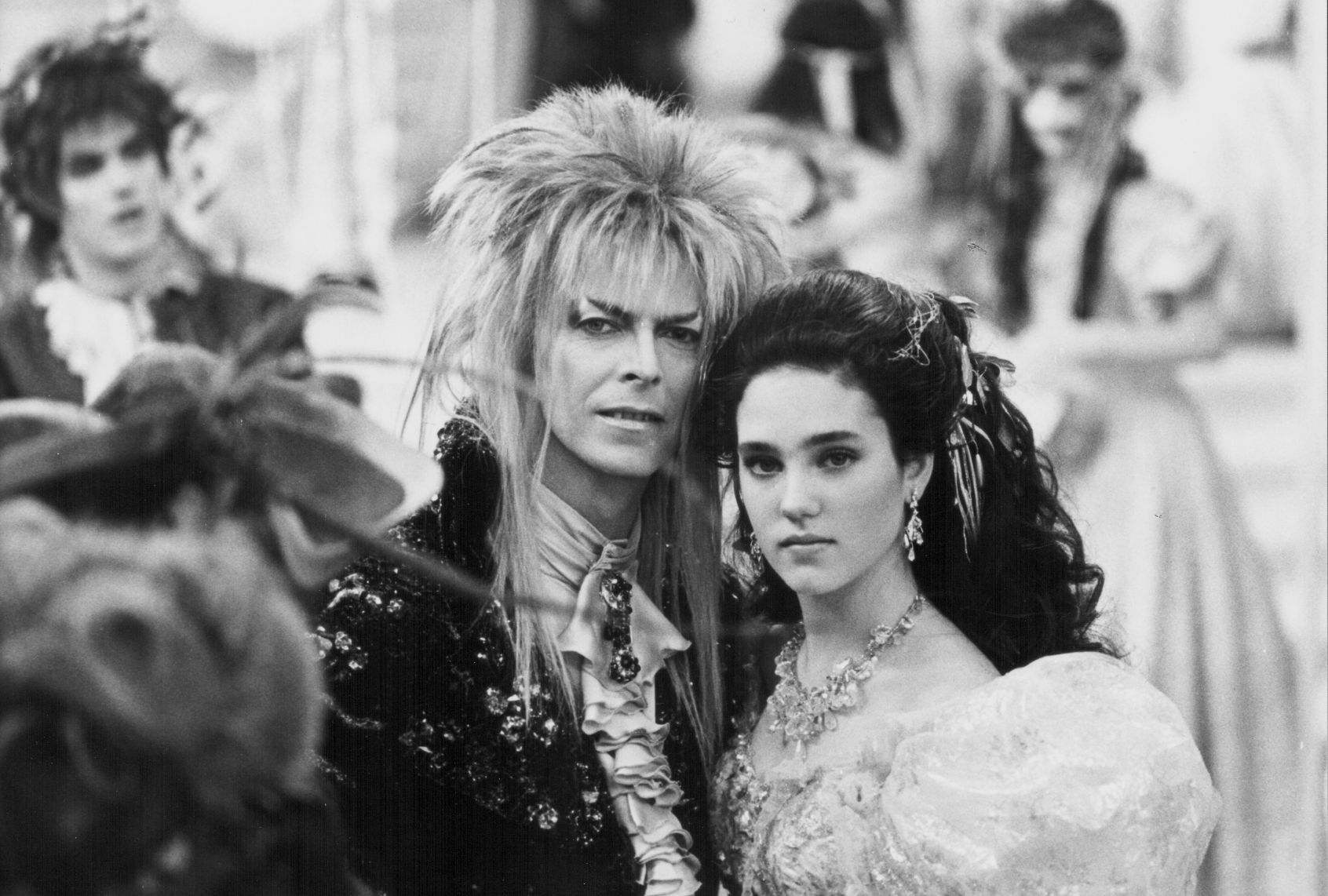
“Labyrinth” is fortified with trompe l’oeil wonders, but none are as powerful as a dream sequence resulting from Sarah lapsing into a hallucination after she bites into an enchanted peach. Where her vision clears, she’s in a hall lit by candlelight and crystal chandeliers draped in pearls, dressed in an iridescent gown and jewels evocative of the decade’s New Romantic style. Jareth peeks at her from between the masked dancers whirling around her, hiding and seeking, smiling gently, for once, as “As the World Falls Down” lilts behind the action.
That sequence’s sensuality is its own enticement: Sarah is a vision, but so is Jareth. An instructive Salon piece from a decade ago reveals the film’s designer dressed him to be “a young girl’s dream of a pop star.”When Bowie briefly takes Connelly’s hand for the briefest one-two-three, one-two-three, imagining millions of hearts swooning in concert isn’t hard to do.
The asterisk on his moment, of course, is that the prince in this fairy-tale moment is portrayed by a 39-year-old rock star with a history of bedding underage girls, waltzing with a would-be princess played by a 15-year-old. In the same way, hormonally tingly tweens and adolescents weren’t contemplating the storytelling cues in the props; we certainly weren’t taking that squeamishness into account.
Even if we do, that doesn’t change this immutable fact: How a person comes to know David Bowie cements the version of him living forever in your memory and soul.
Those who met Bowie’s many 1970s personas found him at his most avant-garde and mythic artistic period, when he consciously shirked every effort to define him, shaping the art and culture around him before shifting into his next, unpredictable form.
Aladdin Sane, Ziggy Stardust and the rest lorded over pop culture in their time, and each of us gets to choose which rules Bowie’s section of our memory’s kingdom.
“Let’s Dance” brought stadiums under Bowie’s spell, and he was conflicted about that. But Jareth and “Labyrinth” introduced a new generation to the magnitude of his bewildering, potent artistic sorcery. Forty years later, that spell has yet to be broken.
Read more
about David Bowie