
Predicting the Premier League table: How will all 20 teams finish the season?
-

Ryan O’Hanlon
We’ve already celebrated the not-quite-but-it’s-the-best-we-can-do halfway point of the Premier League season by looking backward.
Last week, I picked out my award winners for the first slightly-more-than-half of the season: the best goals, best players, best young players, and best coaches. But I wasn’t trying to predict anything with these selections; the sustainability of your performance didn’t matter. What’s already happened has, well, already happened.
What, though, might happen over the final 17 games of the Premier League season? Who’s going to win the league? Who’s getting relegated? And who’s going to be playing in Europe next season? Not only am I giving you my answers to those questions, but I’m also answering a bunch of questions no one is asking. Like, who will finish in 11th place? And will Brighton or Fulham finish higher in the table?
Here is my best guess for what the Premier League table is going to look like once the final whistle is blown on May 24. Let’s predict how this season ends:
– Predicting the Premier League season-end awards
– January transfer grades: All the biggest moves
– Tight Premier League table: Good teams, or bad ones?
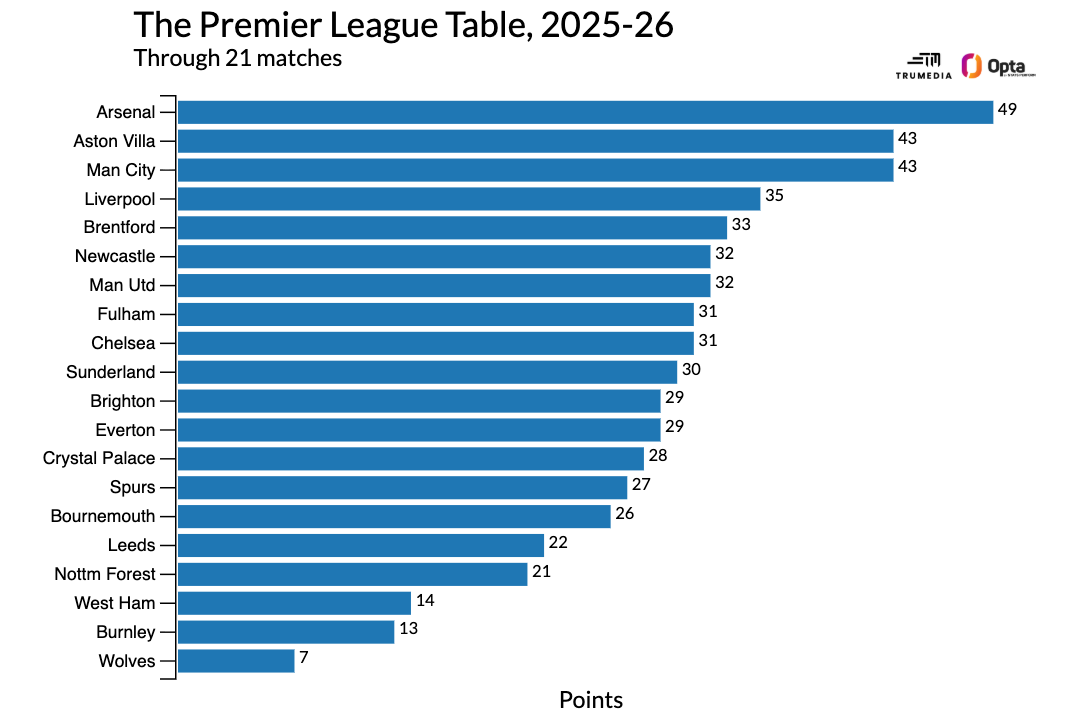
This one is pretty easy. Here’s the table sorted by how many points everyone has already won:
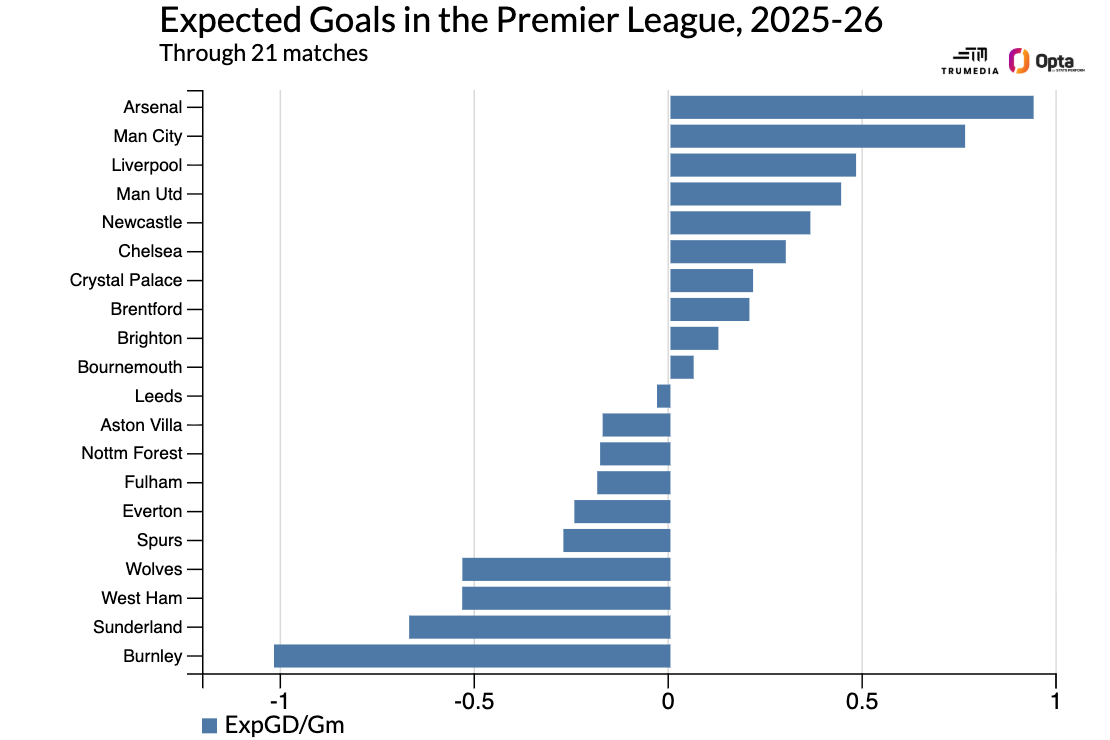
And here’s the table sorted by our best predictive measure, non-penally expected goal differential, of how everyone will play from here on out:
Mikel Arteta’s side have the most points, and they’re the most likely team to win the most points over the final 17 matches. Most prediction models give them around an 80% chance of winning their first league title since 2003.
It’s the same story here. The clear second-best team in the league has the second-most points, so second place is the overwhelmingly likely outcome.
Outside of riding the randomness inherent with trying to kick a soccer ball, it seems like City have two paths toward catching Arsenal: (1) Erling Haaland goes on a finishing hot streak, or (2) Rodri‘s legs come back as he starts to play more matches.
As you can see in the graphic above, Aston Villa feel primed to come crashing back to Earth. Their non-penalty expected goals (xG) differential is worse than Leeds and pretty much equivalent with Nottingham Forest. I think they’re better than both of those teams — but not by a ton.
Since they built up such a big lead on fourth place, Villa are the most likely team to finish in third place. But I’d still say that the most likely outcome is that someone other than Villa finishes in third place. Were I purely concerned with the accuracy of my predictions, I’d put Aston Villa here, but it’s more fun to try to figure out who might leap-frog them.
Enter: Liverpool.
What a bizarre season. Remember when they spent nearly half a billion dollars in transfer fees on attackers and attacking fullbacks, and it seemed like every game would end 6-5? Good times.
The current version of Liverpool sucks the life out of games with dominant possession, doesn’t give up many chances, and struggles to create any high-quality opportunities. If you managed to stay awake, you saw it in last week’s scoreless draw away to Arsenal or the scoreless home draw to Leeds on New Years Day.
Over the course of the season, Liverpool have been one of the best defenses in the league:
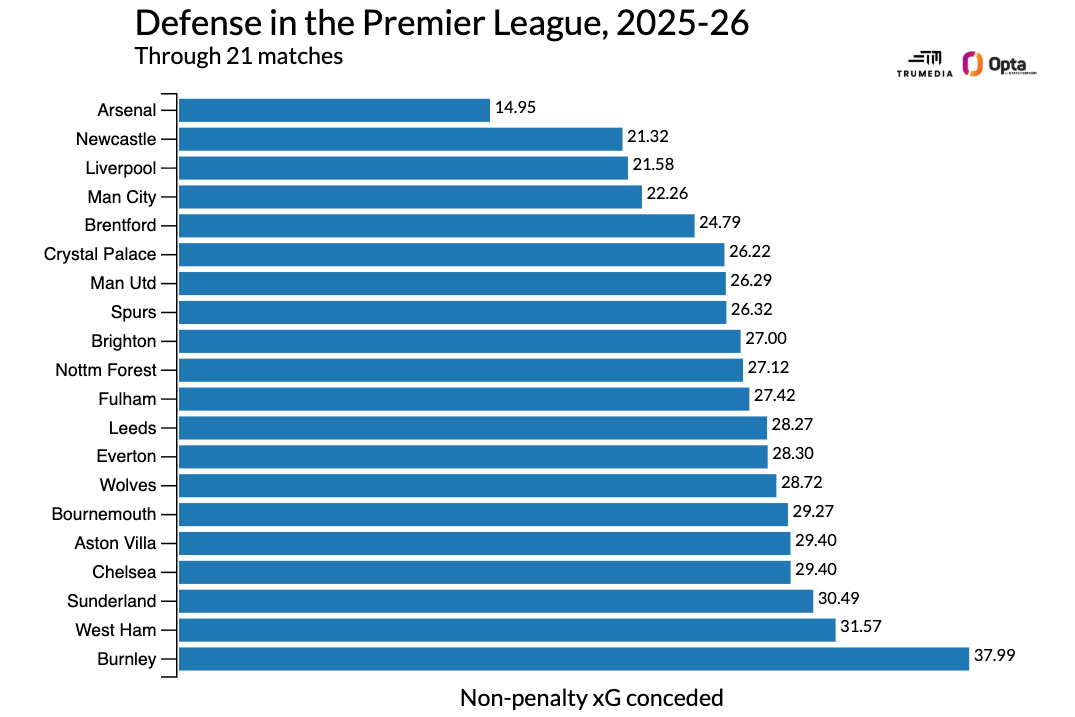
They rank just fifth in non-penalty xG created. But Alexander Isak has been out injured since right before Christmas, Mohamed Salah has been away at the Africa Cup of Nations for that same stretch, and Hugo Ekitike has missed the past couple of games with injury, too. Add in the growing influence of Florian Wirtz, and there are a bunch of reasons to be hopeful that the attack might improve over the final few months of the season.
If it does, they should continue their steady rise back up the table.
Simon Tinsley’s projections at his site Analytic Footy give the current top four — Arsenal, Man City, Aston Villa, Liverpool — all an 89% chance or better of finishing in the top five. And barring a sudden collapse of English teams in Europe, the Premier League is going to earn one of the extra Champions League places for next season.
Right now, though, the gap between 5th place and 10th place is three points. And Tinsley’s numbers give seven teams somewhere between a 29% and a 5% chance of finishing in the top five.
I think this race can — and will — get really weird from here on out. And while I’d say the race for fifth could be everyone from Villa down to Crystal Palace, it’s more likely that it’s a battle between Newcastle, Chelsea, Manchester United, and Brentford for the final spot over the final 17 matches.
Although they each have new managers all of a sudden, Chelsea and Manchester United have both been totally fine this season. The former has the third-best goal differential in the league. And the latter has a top-four xG differential. But I think both managerial situations have now introduced a higher potential of uncertainty — most of which is negative. There’s a chance Liam Rosenior is an elite manager who immediately makes Chelsea better, but hiring a 41-year-old to his first Premier League gig feels like much more of a long-term play than something that will immediately boost results.
United, meanwhile, built a team catered around Ruben Amorim’s specific wants and needs. They finally started playing well … and then they threw him out the door amidst a power struggle. It’s unclear if they’ll even hire a new long-term manager before the summer.
Were Enzo Maresca and Amorim both still around, I probably would’ve picked one of those two sides to finish in the top five, but I’m dropping them both down because of the potential downsides to both managerial situations.
Brentford have the advantage of both being in fifth right now and not having any European matches to worry about. I also really like the attacking talent they’ve brought in after the departures of Yoane Wissa and Bryan Mbeumo. But I just worry about the high-level sustainability of an approach where you only have 43% of the final-third possession — the fourth-lowest mark in the league. Brentford are the most consistent team in this group, but they’re also the least likely to run away from the pack.
And so, I’ve landed on Newcastle, a team that’s been quite good for the last four seasons-and-change since Eddie Howe came in as manager and Saudi Arabia’s Public Investment Fund took over as owner. They still have to go on the road to Liverpool, Man City, and Arsenal, but the return of Wissa from injury should be a boost. Unlike United and Chelsea, we know what they are under their current coach. And unlike Brentford, we’ve seen them play at a top-five level before.
They’re only four points off of fifth right now, so they’re not out of it. But despite a theoretically impressive array of young talent and some really nice performances against some of the better teams in the league recently, it all adds up in the aggregate to what looks like a league-average team.
I wish I had room for Marco Silva in my “Managers of the Season” section from last week’s column. This team keeps getting older and keeps shedding talent, and he keeps them playing at a level that never really even comes close to sniffing the relegation zone.
The bottom has fallen out, in large part because Crystal Palace don’t have a squad big enough to compete in Europe and in the Premier League. But I also wonder about the sustainability of the style of play.
Here’s a chart that compares how aggressively teams press, as measured by PPDA (passes per defensive action), with how quickly they move the ball up the field:
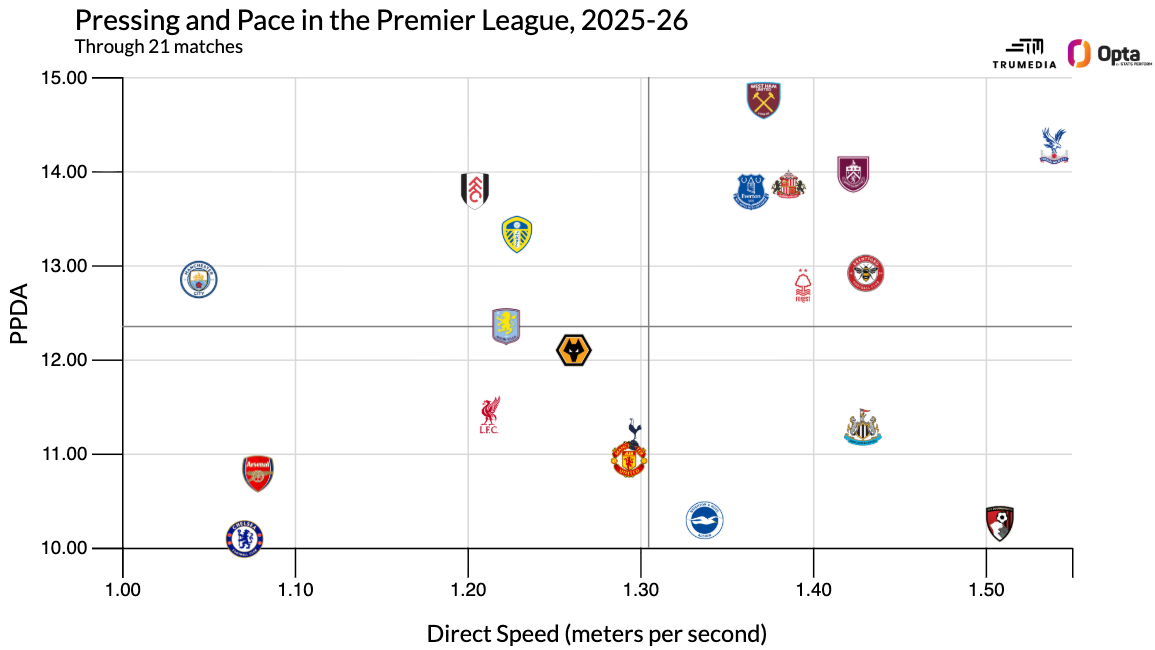
Bottom left: teams that press and move slowly. Top left: no press, no pace. Bottom right: pressing and pace. Top right: teams that don’t press but do move quickly.
Oliver Glasner’s Palace play faster than anyone in the league, but they also don’t challenge their opponent’s ability to keep the ball. It’s rare that those two extremes lead to Champions League or Europa League-level performances over the course of a full season.
If you go back and look at that chart with pace and pressing, you can see why Andoni Iraola would be a better fit for a bigger club than Glasner. While the chaos of Bournemouth ball might not work at, say, Liverpool or Manchester United, Iraola has shown an ability to put together a team that places opposition possession under a high level of pressure.
Perhaps Bournemouth’s place in the table will turn teams away, but losing three-fourths of your defense to Champions League clubs and your starting defensive midfielder to injury and still eking out a positive xG differential is just more evidence that Iraola makes his teams better.
What happens when you lose Harry Kane and Son Heung-Min, never really replace either of them, and bring in a manager who has coached a team that’s produced a high-level attack? You get a rich team that’s created the fourth-fewest non-penalty expected goals of any team in the Premier League.
Thomas Frank’s openness to set-piece success has allowed Spurs to keep their head above water, but they have the fourth-worst xG differential in the league. That’s awful — and way worse than they ever were under Ange Postecoglou or pretty much any manager they’ve had since 2010.
They, too, are only four points back of fourth place, and they do have some fun, attacking talent, but we just still haven’t seen it cohere into anything fun and effective at that end of the field.
This is the biggest projected drop off for anyone. Sunderland could win their next game against Crystal Palace and be tied with Brentford in fifth place this time next week.
But the Black Cats have only scored 21 goals so far this season; Wolves are the only team with fewer. And while they only conceded 22 goals — fewer than everyone outside of Arsenal and Man City — that’s in spite of 314 shots allowed (third-most in the league) and 674 touches conceded inside their penalty area (most in the league).
There aren’t many reasons why we should expect the attack to improve, and there are plenty of reasons why the defense is likely to get much worse.
A handful of teams Leeds has a better expected goal differential than: Aston Villa, Fulham, Tottenham, and Sunderland.
Now, soccer isn’t only about creating better opportunities than your opponent does, but I’d say it’s about 75% of what soccer is about. And Leeds have done that part of the sport better than about half of the teams in the Premier League so far this season. I’d be surprised if they don’t win more points than Sunderland from now until the end of the season.
These are Forest’s xG differentials under their three managers this season:
• Nuno Espirito Santo: minus-0.51
• Ange Postecoglou: minus-0.82
• Sean Dyche: plus-0.02
We are powerless to the Dyche Effect. We must stand in awe and behold its beauty.
I don’t think Forest or Leeds are one of the three worst teams in the league and I do think that West Ham are one of the three worst teams in the league. So, it’s hard to envision much of a relegation battle when West Ham are seven points back of Forest and eight points back of Leeds.
Wolves have played pretty well in road matches against Liverpool and Arsenal over the past couple months. They’re doomed because they only have seven points through 21 matches, but they’re a good deal better than their one-third-of-one-point-per-match pace suggests.
Burnley, on the other hand, are one of the worst Premier League teams of the past decade. They attempt the fewest shots of any team in the competition, and they concede the most shots of any team in the competition.
There’s nothing interesting about what they’re trying to do — no tactical oddities that might help them overachieve, no player-identification process that makes them stand out. No, they just get buried under an avalanche of chances every game and hope for the best.
By the end of the season, I think Wolves will catch them in a race that both teams are going to lose.