
Growing concern as mosquito-borne West Nile virus gains ground in France
In its most recent bulletin published on 7 October, French public health agency Santé Publique France reported 161 human cases of the West Nile virus nationwide, 16 more than the week before.
These cases were identified as part of seasonal surveillance period which started on 1 May and will continue until 30 November.
Of the 161 locally acquired cases, 28 were asymptomatic – detected during routine blood donation screening – and 133 were symptomatic.
Among those with symptoms, 60 were neuro-invasive cases, including five deaths.
SPF warns that the data does not allow for a determination of whether these deaths were attributable to the West Nile virus infection.
This is an unprecedented figure for France, which recorded 62 cases and five deaths in the summer of 2025.
Discovered in the early 20th century in the West Nile area of Uganda, the first cases in France appeared in the 1960s, mostly around the Mediterranean basin and certain endemic areas such as the Camargue.
The virus has gradually spread to several other French regions, including most recently Île-de-France, which includes Paris.
In 80 percent of cases, the disease goes unnoticed, causing no symptoms. In 20 percent, symptoms are similar to those of the flu with fever and headaches.
In rare instances, the virus can affect cause encephalitis – inflammation of the brain tissue – and meningitis and prove fatal.
There is no commercially available vaccine or preventive treatment for the virus.
Vastly underestimated
Yannick Simonin, professor of virology at the University of Montpellier says the latest figures are just the tip of the iceberg.
“There are potentially ten times as many actual unidentified cases; transmission is vastly underestimated,” told public broadcaster Franceinfo on Tuesday.
“Many people with flu-like symptoms, such as headaches or fever, do not necessarily see a doctor. And even when they do consult one, the virus is not necessarily diagnosed,” he continues.
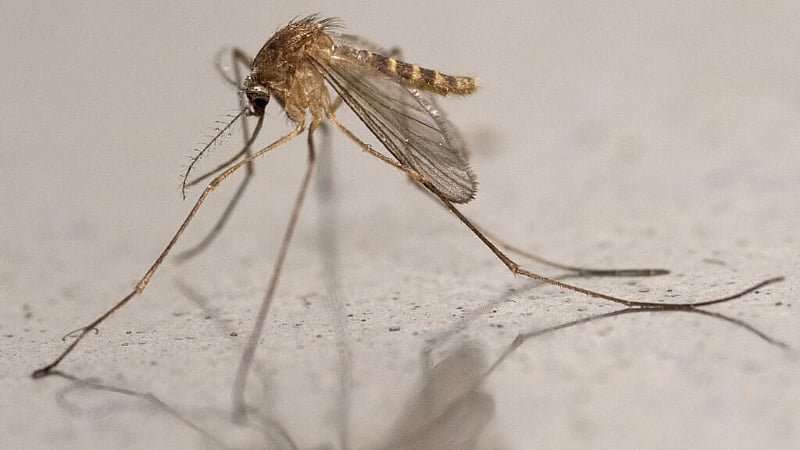
The West Nile virus is transmitted by the Culex pipiens, known as the “common mosquito” because it has always been present in Europe unlike the tiger mosquito (which transmits dengue or chikungunya) – an invasive species that began colonising France in 2004.
France ramps up fight against tiger mosquitoes after record outbreaks
Mosquitos become infected from infected birds – either migratory birds returning from Africa or birds infected locally in Europe.
Horses infected
As of 30 September, the national agency for horse veterinarians (AVEV) recorded 364 symptomatic cases in horses and 18 cases in birds, spread across eight regions of France.
Anna-Bella Failloux, a medical entomologist (a specialist in insects that transmit diseases to humans) at the Institut Pasteur told RFI that there is no human-to-human transmission, except in cases of blood transfusion or transplantation, which are rare occurrences.
“Birds are asymptomatic carriers, but they can be the source of infection for mosquitos, which in turn can bite humans and horses. Humans are accidental hosts, so they do not develop high levels of the virus, ” she says.
“Humans – like horses – are what we call ‘dead-end hosts’ in our field. A human cannot be the source of infection for a mosquito that bites them; that simply cannot happen,” Failloux explains.
Regularly detected in the south of France before spreading to the central Nouvelle-Aquitaine area in 2022 and Île-de-France in 2025, the West Nile virus is currently circulating “quite vigorously” across Europe, Simonin warns.
“As it stands, there have been just under 80 deaths in Europe, with a large proportion of identified cases in Italy. Among mosquito-borne viruses, it is the one that causes the most deaths in Europe,” the virologist says. A worker attends a mosquito control sequence ordered by the Provence Alpes Cote d’Azur Regional Health Agency to prevent the spread of chikungunya in Nice, southern France, on 10 October, 2025.
Warmer temperatures, less water
The EU’s health agency said last month 15 European countries had recorded more than 1,000 cases of the West Nile virus this year.
The sharp rise in cases is largely attributed to climate change and in particular global warming.
According to Failloux, the historic drought this summer fostered more contact between mosquitos and birds, as both were concentrated around scarce water sources.
“Mosquitos breed in pools near the birds they bite. And this year, due to heatwaves, there were fewer bodies of water. That is where the birds came to drink, and also where the mosquitos thrived most,” explains Failloux.
Southwest France steps up mosquito control after 20 chikungunya cases
Global warming is also driving the geographical spread of mosquitos, with warmer temperatures shortening their development cycle, leading to larger populations, she says.
“At 25C, it takes 8 to 10 days to go from egg to adult. If the temperature rises to 30C or 35C, that time drops to just 6 or 7 days,” Failloux says.
“Naturally, higher temperatures mean adults emerge much sooner, increasing mosquito density. At the same time, more and more areas are becoming suitable for their development. Today, for instance, there are cases of West Nile virus in Germany (Berlin) and the Netherlands – countries that are not exactly tropical,” notes Failloux.
Step up surveillance
Simonin agrees that the West Nile virus is likely boosted by climate change.
“Up to a certain point, higher temperatures and storms encourage mosquito egg-laying. Climate change also affects the bird populations. This is more complex to gauge, but bird behavior and migration routes can be influenced,” he explains.
Simonin says it is inevitable that cases will rise across Europe and says monitoring and surveillance must be carried out “at an institutional level.”
“We need to gain a better understanding of which bird species are introducing the virus into the Île-de-France region and which ones are maintaining it within the territory. We have little information on this; we need to fill the gaps in our data,” he points out.
“It is a global trend; we are increasingly exposed to viruses that were considered exotic just a few years ago. We must prepare to face new types of diseases with diagnostic, treatment, and surveillance programs,” he warns.