
NAO at 20: Nigeria needs more orthodontists, wider access to care
…Experts seek AI, digital technology to bridge specialist gap
By Matthew Johnson
Nigeria needs more orthodontists and wider access to specialist dental care as demand for treatment of dental and craniofacial conditions continues to grow, experts have said.
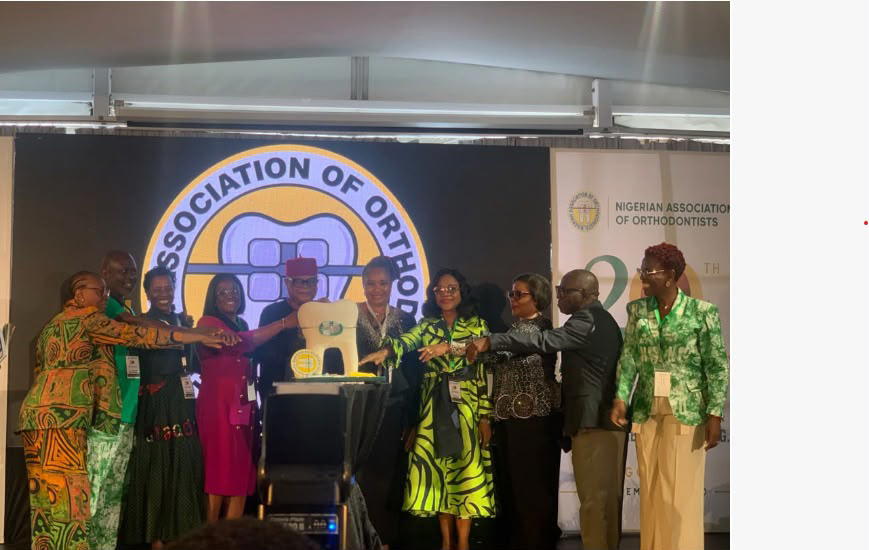
The call came as the Nigerian Association of Orthodontists, NAO, marked its 20th anniversary, with specialists urging greater investment in orthodontic training, digital technology, artificial intelligence, locally generated research and healthcare infrastructure.
The experts, who spoke at the association’s 20th anniversary conference in Lagos, said technology could help extend specialist expertise to underserved communities, but warned that artificial intelligence must complement, rather than replace, professional clinical judgment.
National President of NAO and Chief Medical Director, University of Benin Teaching Hospital, UBTH, Professor Idia Izayi-Iyamu, said the anniversary provided an opportunity to assess the development of orthodontics in Nigeria and prepare practitioners for the future.
She said the association had moved beyond traditional approaches to orthodontic practice and must now embrace a broader, 360-degree perspective covering ethics, technology, mentorship and clinical excellence.
Izayi-Iyamu said: “When we started 20 years ago, we were looking at it straight on, which is what we call one dimension. But if you look at life and the world we live in now, it is round. That is a 360-degree perspective with inclusion of Artificial Intelligence.
“Younger orthodontists need a new version of lecture compared to what we had then because the world is digitally evolved.
“We said, let’s look at orthodontics holistically in 360 degrees. Let’s look at it from the ethical point of view. What are we doing right? What do we need to do right to get it right?”
Delivering the keynote address, Professor Carlos Flores-Mir of the University of Alberta, Canada, said AI could help improve access to orthodontic services, particularly by supporting early detection and referral in areas with limited access to specialists.
He said emerging technologies, including digital imaging, intraoral scanning, 3D printing, remote monitoring and data-driven treatment planning, were changing orthodontic practice.
According to him, AI could assist with diagnosis, cephalometric analysis, growth assessment, treatment planning, image segmentation and patient monitoring.
However, Flores-Mir cautioned against allowing technology to replace clinicians, stressing that orthodontics remained a profession requiring human judgment.
“AI should not replace the orthodontist. It should reduce the amount of mechanical work that prevents the orthodontist from doing what humans do best,” he said.
He also called for Nigerian orthodontic institutions to develop locally generated and ethically governed datasets to ensure that AI systems used in the country accurately reflect Nigerian and African populations.
“An AI system is only as good as the data in which it is fed into it. If the data predominantly represents populations from other parts of the world, we should not automatically assume that the resulting algorithms will perform equally well with Nigerian patients,” he said.
Flores-Mir further warned that the adoption of AI must address patient privacy, cybersecurity, informed consent, data ownership and professional accountability.
He said properly validated digital systems could enable general dental practitioners to identify patients requiring specialist orthodontic assessment and facilitate earlier referrals.
On the development of the profession in Nigeria, Professor Michael Chukwudi Isekwu, described as a pioneer of orthodontics in Nigeria and sub-Saharan Africa, said the country had progressed from having only a handful of orthodontists to more than 70 specialists.
Isekwu, the first professor of orthodontics in Nigeria and sub-Saharan Africa, said the quality of orthodontic training in the country could compete internationally.
“When you hear somebody is an orthodontist in this country, it equals orthodontists anywhere because I go to examine in England and America and I am a visiting professor,” he said.
A pioneer of orthodontic training in Nigeria, Professor Oluwatosin Sanu of the Department of Child Dental Health, College of Medicine, University of Lagos, and Consultant Orthodontist at Lagos University Teaching Hospital, LUTH, recalled being among the first three locally trained orthodontists in the country.
Sanu attributed the growth of orthodontics in Nigeria to the mentorship and vision of Professor Isekwu, noting that the expansion of residency programmes had produced successive generations of specialists.
Meanwhile, Chief Medical Director of LUTH, Professor Wasiu Adeyemo, said Nigeria had made progress in healthcare delivery despite persistent challenges, including the migration of health professionals.
Adeyemo called for increased investment in healthcare infrastructure, training and public-private partnerships, saying Nigerian specialists could deliver quality services despite limitations in equipment and infrastructure.