
ORC marks Risk Awareness Week with quest to build resilient institution

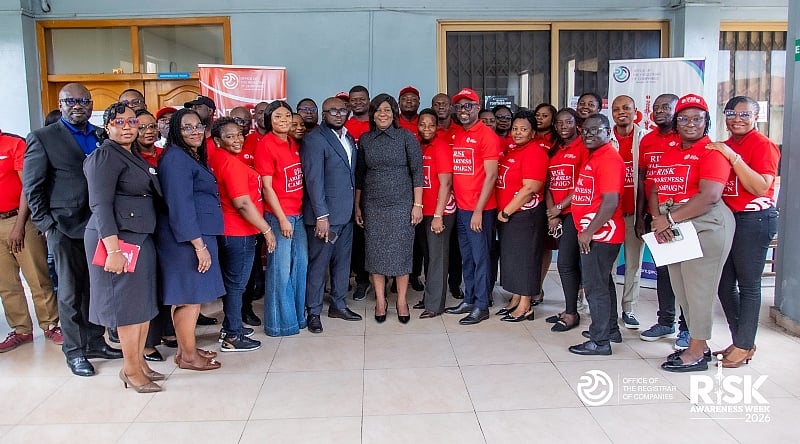
The Office of the Registrar of Companies (ORC) has set a new approach to risk management across its directorates and zonal offices by encouraging staff and management members to move beyond identifying risk-related issues to actively taking ownership and preventing risk cases during work.
The call was made during the official opening of the 2026 Risk Awareness Week on Tuesday, 22nd September, 2026, under the theme “Building a Risk–Smart ORC: Strengthening Resilience, Accountability and Service Excellence.” It was held at the ORC conference room in Accra.
The four-day programme, scheduled from Tuesday 22nd to Friday 25th September, 2026, sought to deepen staff understanding of Enterprise Risk Management (ERP) and to strengthen the culture in which risks are identified early, discussed openly and managed or mitigated before they adversely affect the ORC’s operations and service delivery.
During the opening ceremony, Mrs. Maame Samma Peprah, Esq., the Registrar of Companies, reminded staff that risks associated with ORC’s operations are critical aspects of the institution’s mandate. Hence, the need to create awareness among staff and to take steps to mitigate the identified risks.
She emphasized that effective risk management cannot be confined to one department or a selected group of staff. Rather, staff across directorates and zonal offices have a role to play in safeguarding the organisation’s resources, reputation, and ability to deliver quality services.
“The public depends on us for reliable company registration, accurate records, effective compliance services and timely support,” she said. She added that to deliver these services well, staff must recognize the risks that could interrupt their work, weaken public confidence or prevent us from achieving our objectives.
According to Mrs. Peprah, staff should appreciate risk management as a responsibility shared across ORC. She therefore called on directorates, zonal and unit heads as risk owners and risk champions to understand the risks in their area of work, ensure that agreed controls and mitigation measures are carried out, keeping risk discussions active and helping to identify and report emerging issues.
The Registrar of Companies indicated the importance of taking risk considerations into everyday decisions and activities, rather than waiting until risks materialise. Therefore, staff should place ownership and accountability firmly at the centre of ORC’s risk management agenda.
Mr. Prince Kakah, Head of Internal Audit and Risk Coordinator, in further explanation of the programme outline for the Risk Awareness Week, intimated that the Governing Board is determined to incorporate ERM in ORC’s daily operations. He noted that the Board’s focus goes beyond policy documents, which is aimed at ensuring that risk awareness shapes how staff plan, execute, and evaluate their assigned duties at work.
Mr. Kakah outlined the Risk Awareness Week activities as focusing on promoting awareness and providing practical understanding of risk management to all staff. The activities covered from Tuesday to Friday include the following: Opening and Staff Engagement; Directorate Risk Engagements and Risk Awareness Campaign; Health, Wellness and Organisational Resilience Talk; and Risk Management Educational Symposium and Awards Ceremony. The final event seeks to recognise and appreciate staff and teams who demonstrate strong risk management practices at the workplace.
The opening ceremony brought together the Deputy Registrar of Companies, Mr. Benjamin Zigorsh-Nyakpenu, Heads of Directorates, Risk Owners, Risk Champions, and other staff of ORC. The Heads and staff at the Zonal Offices in Kumasi, Sunyani, Sekondi and Tamale joined virtually. This signalled strong institutional support for the ORC risk awareness initiative.
Also, it is expected that the 2026 Risk Awareness Week celebration would reinforce the fact that risk management is not merely an Audit function, a management responsibility, or a compliance requirement, but a collective responsibility for all to be more accountable in taking decisions and to be better prepared to protect the ORC’s mandate and improve service delivery.