
Julius Debrah champions cocoa transformation as Ghana targets 50% local processing
Chief of Staff Dr. Julius Debrah has renewed calls for a major transformation of Ghana’s cocoa industry, with the government setting an ambitious target of processing at least half of the country’s cocoa locally.
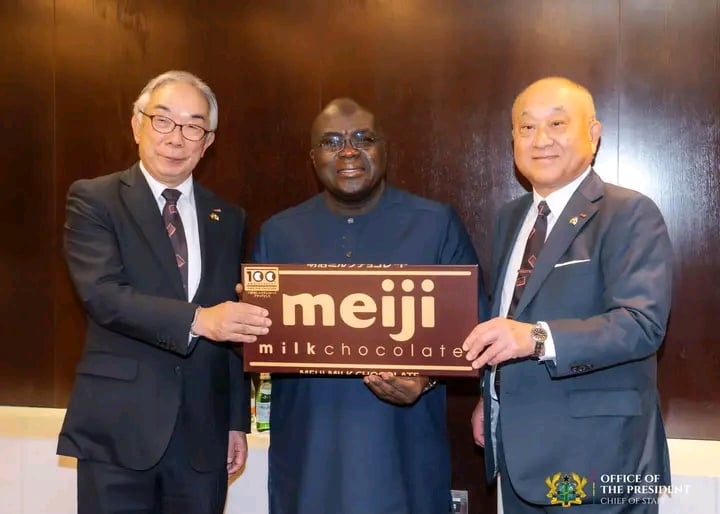
Dr. Debrah made the statement during the commemoration of the 100th anniversary of Meiji Milk Chocolate, attended by Japan’s Ambassador to Ghana, His Excellency Hiroshi Yoshimoto, Meiji executives, representatives of JICA and JETRO, COCOBOD, cocoa farmers and other partners.
Representing President John Dramani Mahama, the Chief of Staff congratulated Meiji on a century of quality, innovation and international success.
He said the milestone was also an opportunity for Ghana to reflect on how its cocoa resources could generate greater benefits for farmers and the national economy.
Dr. Debrah said President Mahama’s cocoa-sector reforms are aimed at protecting farmer incomes, improving productivity and expanding local processing.
He explained that the government’s objective of processing at least 50 percent of Ghana’s cocoa locally would help create jobs and retain more value within the country.
The Chief of Staff further acknowledged Meiji’s contribution to Ghana’s cocoa-growing communities through its Cocoa Support programme, which has been in operation since 2006.
He said the initiative has supported improved farming practices, agroforestry, education, traceability and measures aimed at combating child labour and deforestation.
Beyond conventional cocoa processing, Dr. Debrah identified cocoa pod waste as another area where Ghana could unlock significant economic value.
He expressed particular interest in Meiji’s work on cocoa-derived bioplastics, noting that cocoa pod waste could potentially be transformed into biochar, fibre and bio-based or biodegradable plastics.
According to him, such innovation could create new industries and employment opportunities while contributing to a cleaner and more sustainable economy.
He therefore called for practical collaboration between Ghana and Japan in areas including technology transfer, local manufacturing, research, training and commercial production.
Dr. Debrah stressed that Ghana must ensure that promising innovations do not remain at the level of ideas but are translated into viable businesses and technologies that benefit the Ghanaian economy.
“The cocoa pod has already given the world chocolate. With partnership, innovation and disciplined execution, it can give our people much more,” he stated.
He expressed optimism that the partnership between Ghana and Japan would continue to expand opportunities in cocoa, manufacturing, technology and sustainable development.
Dr. Debrah concluded by congratulating Meiji on its 100-year milestone and wishing for continued growth in the longstanding friendship between Ghana and Japan.