
IMANI Challenges Youth Ministry to Align Budget, Skills, and Governance for Ghana’s Next‑Gen Workforce

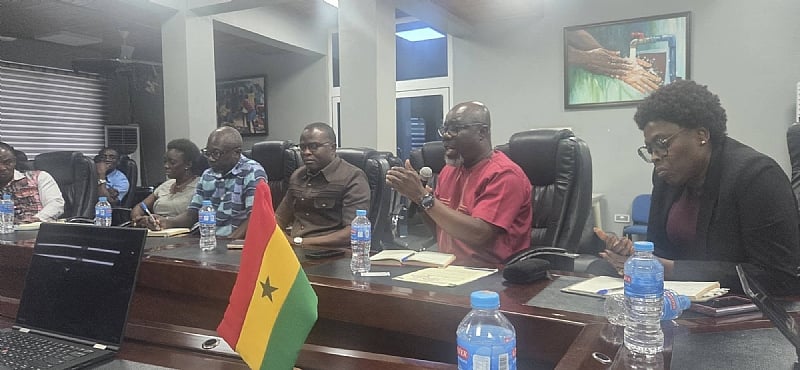
On September 2, 2026, the Ministry of Youth Development and Empowerment (MYDE) hosted a strategic dialogue at its premises in Accra with policy analysts from the IMANI Centre for Policy and Education. The IMANI delegation was led by its Founding President and CEO, Franklin Cudjoe, accompanied by Evans Selorm Branttie, IMANI’s Vice-President; Ransford Brobbey, IMANI’s Research Assistant; Kay Codjoe, Writer and Associate of IMANI; and John Sitsofe Mensah, a technology expert and IMANI Associate.
The engagement sought to critically examine the Ministry’s 2026–2029 medium-term priorities, institutional architecture, and programme execution. Discussions progressed from an initial presentation of ministerial achievements to a robust evaluation of fiscal constraints, programme conversion metrics, industrial aggregation, and public health vulnerabilities affecting Ghana’s youth.
Fiscal Realities and Resource Mobilisation
A dominant theme throughout the dialogue was the misalignment between the Ministry’s policy aspirations and its fiscal realities. IMANI analysts underscored the need for stringent commitment control, drawing parallels with historical challenges faced by statutory funds such as GETFund, where unbacked project allocations often resulted in delayed execution and accumulated arrears.
Addressing the Ministry’s nominal 2026 budget of GHS 1.6 billion, leadership clarified that statutory obligations significantly constrain the fiscal envelope. Approximately GHS 1.1 billion is ring‑fenced for economic transition programmes, with nearly GHS 1.0 billion absorbed entirely by National Service Authority (NSA) personnel allowances. As a result, discretionary capital for enterprise modules remains severely limited.
To mitigate this, IMANI proposed aggressive corporate co‑financing strategies, urging the Ministry to leverage the corporate social investment portfolios of multinational manufacturing and beverage firms to expand programme impact without over‑reliance on the central treasury. Both parties also acknowledged growing support among development partners for establishing a dedicated statutory youth funding mechanism.
Programmatic Scale and Cooperative Enterprise Infrastructure
The evaluation of the Ministry’s flagship initiatives—particularly the Adwumawura Programme—prompted a critical review of scale and delivery mechanisms. Analysts noted that the programme’s current reach of 54,000 individuals translates to just over 200 beneficiaries per district across Ghana’s 261 Metropolitan, Municipal, and District Assemblies (MMDAs), a figure deemed insufficient given prevailing unemployment levels.
The dialogue critiqued the traditional political practice of distributing isolated artisan equipment and instead advocated for a transition to cooperative enterprise models. By aggregating beneficiaries into shared mini‑manufacturing hubs, artisans could access pooled machinery, reliable utilities, and unified procurement opportunities.
Aligning with this recommendation, MYDE confirmed ongoing efforts to convert ten existing National Youth Authority (NYA) resource centres into light‑industrial parks, two of which are complete. IMANI researchers further highlighted the untapped potential of indigenous crafts—such as beadmaking, weaving, and basketry—as drivers of Non‑Traditional Exports (NTEs) and circular‑economy jobs. They urged the Ministry to establish direct aggregation hubs within these industrial parks to protect rural artisans from middleman exploitation.
Evaluating Output, Conversion Rates, and Labour Market Integration
Moving beyond gross programme headcounts, IMANI analysts pressed for longitudinal tracking to determine true economic “conversion rates.” While the Ministry reported substantial outputs—such as 14,000 youths enrolled in the National Apprenticeship Programme and thousands receiving enterprise grants—the think tank emphasised the need to measure how many trainees transition into sustainable self‑employment, formal tax‑paying roles, and active SSNIT contributors.
The Ministry acknowledged the importance of outcome tracking but cautioned that economic impacts cannot be conclusively assessed within the first year of intervention. To address this data gap, MYDE announced the deployment of a centralised digital “Youth Tracker.” The system will monitor beneficiaries across all state agencies, mapping their progression from initial training to enterprise incubation, preventing duplicate enrolments, and providing empirical data on long‑term multiplier effects within local communities.
TVET Reorientation, Mindset Transformation, and Technical Competency
Structural bottlenecks in Ghana’s education‑to‑work pipeline formed another critical pillar of the discussion. Participants observed that domestic contractors frequently import artisan labour from neighbouring West African countries—not due to a lack of technical knowledge among Ghanaians, but because of perceived deficits in professional reliability, work ethic, and honesty.
To address this, stakeholders advocated for a holistic revamp of civic and moral education from the basic school level upwards. The Ministry outlined its forthcoming “TVET First‑Choice” campaign, executed in partnership with the Commission for TVET (CTVET) and the Design & Technology Institute (DTI), aimed at destigmatising vocational education.
IMANI further recommended integrating applied Artificial Intelligence (AI) literacy into non‑formal training modules to enhance job relevance for non‑academic youth and position Ghana as a continental leader in tech‑enabled vocational skilling.
Civic Governance Platforms and Democratic Inclusion
In assessing mechanisms that connect young citizens to governance structures, the dialogue scrutinised the newly launched YouthXplore app. While acknowledging its potential, IMANI identified onboarding bottlenecks and recommended expanding its functionality into a two‑way civic portal through which youth can directly report community grievances to local assembly officials and Members of Parliament.
Complementing this digital approach, the Ministry detailed its multi‑tiered Youth Parliament architecture—spanning district, regional, and national levels—designed to channel youth resolutions directly to the Parliament of Ghana. MYDE also announced the formalisation of biennial policy dialogues between the youth and the President of the Republic, alongside plans to develop a Centre of Excellence for Youth Leadership benchmarked against Singaporean public‑administration models.
Public Health Interventions and Inter‑Agency Harmonisation
The dialogue urgently addressed the escalating crisis of adolescent substance abuse, referencing survey data indicating that 67% of young drug users initiate exposure before age 18. To combat the proliferation of synthetic opioids and prescription syrups, IMANI recommended expanding the Ministry’s “RED MEANS STOP” campaign through a partnership with the Driver and Vehicle Licensing Authority (DVLA) to target commercial motorcycle operators, while simultaneously promoting road safety.
The Ministry highlighted its strategic alliances with traditional Queen Mothers and the Christian Council of Ghana to leverage community and faith‑based influence for moral regeneration.
Ultimately, the success of these multifaceted policies depends on dismantling institutional silos. Over the past 18 months, the Ministry has prioritised harmonising the operations of the NYA, NEIP, YEA, and NSA to create a seamless “Apprenticeship to Entrepreneurship” pipeline.
Looking ahead, IMANI committed to providing the Ministry with a comparative benchmarking concept note for the YouthXplore app, while the Ministry’s PPME directorate agreed to facilitate ongoing peer review of upcoming youth‑policy frameworks.