
Canada knows the US can’t be trusted. It’s ready to fight
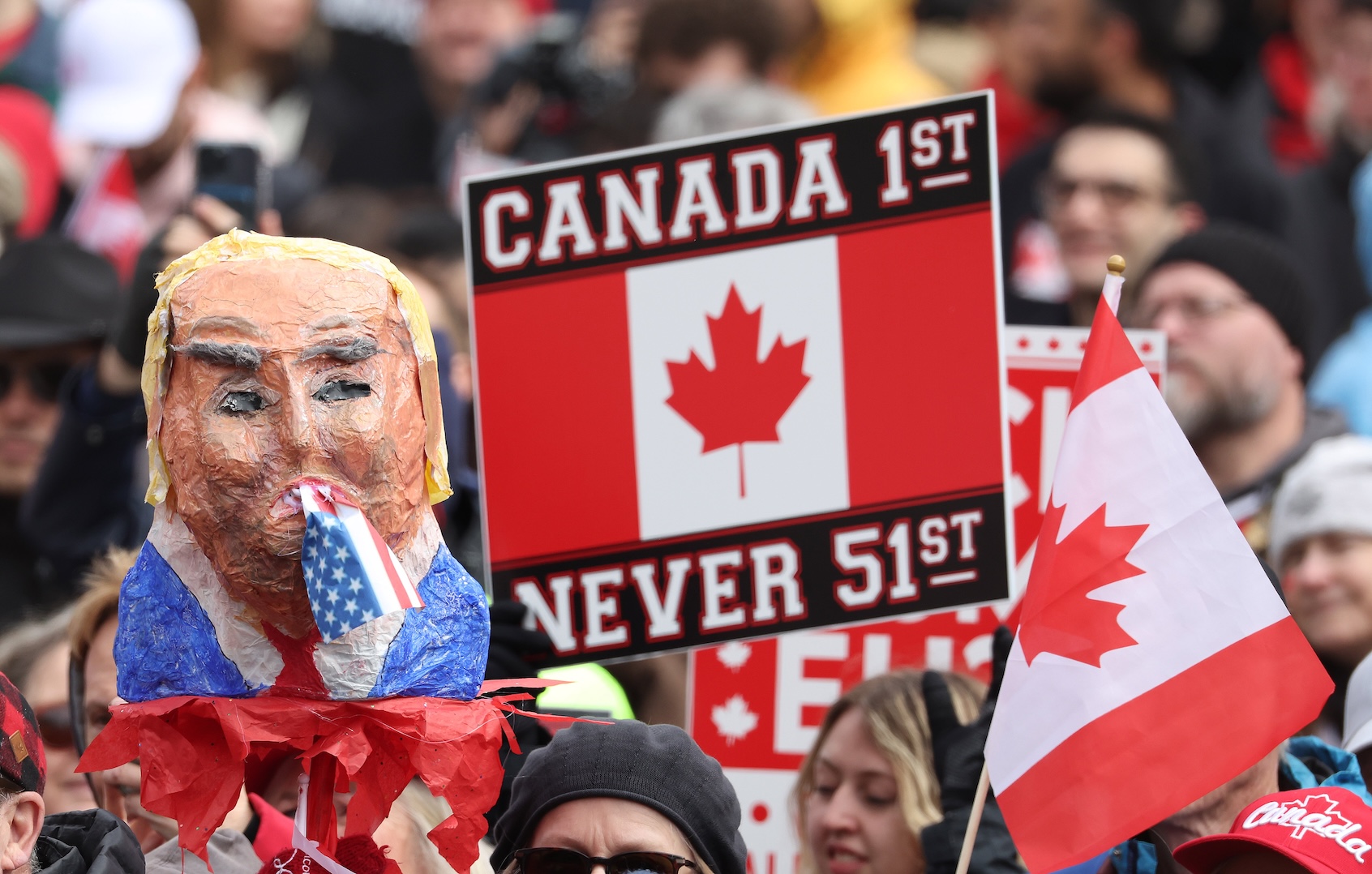
Canadians have made it clear: They don’t want to become the 51st state. For the record, and despite the increasingly delusional geography lessons delivered by the Trump administration, actual Americans overwhelmingly agree. That’s without even dealing with the fact that Canada has 10 provinces and three territories, all with distinct identities, except perhaps for Saskatchewan. (Sorry! Joke!) So in the imaginary universe where this scenario plays out, aren’t we’re talking about 60 states or so? That’s definitely a non-starter from the Republican point of view.
Canadians have also made clear, in a subtler but equally forceful act of defiance, that they’re not willing to surrender their economic independence and bedrock cultural principles just to get Coors and Jack Daniel’s back on the shelves. (That’s not a metaphor: The Canadian boycott of American wine, liquor and beer has been especially galling to the Trump administration and its allies.)
“America is trying to break us so they can own us,” Prime Minister Mark Carney said recently. “That will never, ever happen.”
If it’s surprising to hear the elected leader of a country known for its collective politeness talking that way, it reflects the fact that the current U.S.-Canada trade war is about much deeper issues than tariffs on goods and services. On the American side, it’s a self-destructive conflict that hurts everyone and benefits no one, driven primarily by, um, a Certain Individual’s wounded but enormous ego. (A familiar refrain, I know.)
At a deeper level still, one we might describe as psychic or spiritual, the Trumpian trade war reflects a troubled history that remains much better understood in Canada than in the U.S. To boil it down to a single sentence, Canadians have never felt quite safe with America, while Americans have consistently misunderstood and underestimated the enormous land to the north, when they think about it at all.
Indeed, it seems more than possible that the stereotypical Canadian “niceness” is a consequence of living next door to an armed and dangerous neighbor. Canadians have adjusted cheerfully to many decades of friendship, have welcomed booming trade partnerships and have endured Yank ignorance and condescension. But beneath all that, they are better prepared for an unprovoked American assault, whether military or economic, than they may appear.
As Toronto Star columnist Liz Renzetti put it recently, “We are wolves in beavers’ clothing. Call us cute if you must, but don’t be surprised when we bare our teeth in a snarl.”
Trump’s trade war reflects a troubled history that remains better understood in Canada than in the U.S.: Canadians have never felt quite safe with America, while Americans have consistently misunderstood and underestimated the enormous land to the north.
Of course the facts dutifully recited by mystified U.S. mainstream media in recent weeks are correct: None of this should be happening! These two countries are longtime military and strategic allies, with deeply enmeshed economies and several thousand miles of minimally guarded border. Under Canada’s newly liberalized citizenship laws, nearly one in four residents of the New England states may be eligible, along with millions more Americans across the country. (Thousands apply every month, so get in line!)
But Carney directly invoked the darker, flintier aspects of North American history when he was asked on Aug. 22 whether his country was now at war. “You’re at war when you get attacked,” he replied. “We got attacked.”
No doubt he was willing to cut a deal with Trump, even an unappetizing one. An all-out trade war is likely to hurt Canadian consumers worse than Americans. Trump and his flunkies clearly assumed they held the whip hand and could keep moving the goalposts and forcing the Canadians into humiliating concessions, such as matching U.S. tariffs on imports from other countries or dropping requirements for French-language packaging on U.S. imports. That was a miscalculation, born of limitless arrogance and boundless stupidity. Another familiar refrain!
The first of those Trumpian demands — surrendering national trade policy to an imperial overlord, in effect — was something no self-respecting nation would ever agree to. (Which doesn’t mean it couldn’t happen.) But the second was a direct attack on Canada’s multicultural and bilingual national identity, which no doubt seems like random irritating “wokeness” to the Trumpers. That’s almost certainly what provoked Carney to fight back, and no conceivable Canadian leader could have done otherwise.
It’s safe to assume that Donald Trump knows almost nothing about the history of America’s previous attacks on Canada. But along with his half-baked notions about tariff policy and his obsession with Greenland, he has somehow inhaled or inherited a notion that goes back before the founding of our republic, which is that Canada is not quite a real country and should either be an American possession or an American protectorate.
That may have something to do with Canada’s peculiar history, which involved gaining independence from Britain only gradually and by degrees over the course of 300 years. To this day, the “King of Canada,” who also happens to be the monarch of the United Kingdom, is the official head of state, and full constitutional separation from Britain didn’t happen until 1982. That’s a dramatically different national story from that of the United States, for better or worse. But a similar process unfolded in Australia and New Zealand, too far away for Americans to feel any investment.
Very few Americans of the 21st century, outside the inner circle of Trumpian auto-asphyxiation, share the view that Canada isn’t real, if they think about it at all. But our friends in the Great White North have not forgotten. (As the Quebec license plate puts it, “Je me souviens.”) Whether Carney was consciously summoning up that history I couldn’t say, but one thing Canadians learn in school is that every time the U.S. has tried to conquer them, the Yanks have been sent home in defeat.
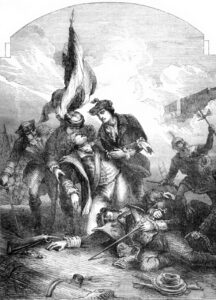
(John Cassell/Public domain via Wikimedia Commons) The death of Maj. Gen. Richard Montgomery at Quebec City, from an 1865 history.
Most accounts of the American Revolution skate right over the ill-fated invasion of Quebec in 1775, months before the Declaration of Independence. That’s understandable, but I’m inclined to view this episode as a cautionary tale, one repeated far too often in American history.
George Washington and the Continental Congress hoped to sever French-speaking eastern Quebec from the rest of British Canada and bring it into the war as a 14th rebel colony. I guess it must have seemed like a good idea at the time, but the expeditions led by Richard Montgomery and the not-yet-infamous Benedict Arnold went so poorly that it’s a wonder the entire revolutionary cause didn’t go south with them.
Although the Continental forces (as they were then known) successfully seized Montreal and held it for almost nine months — and some Quebecois actually did come over to the American cause — hunger, smallpox and the Canadian winter reduced their forces to the point that their attempted siege of Quebec City was an abject failure. Montgomery was killed and Arnold badly injured, and by the autumn of 1776 the British had recovered all the lost territory and then some, driving the Americans deep into present-day Vermont and New York.
As Canadians may also remember, Benjamin Franklin later argued that Britain should cede all of Quebec to the new nation, and he won that argument more than you might think. Sure, present-day francophone Quebec is still there, but the former British colony of that name extended westward all the way to Lake Michigan, and included all or parts of six future Midwestern states, inhabited at the time mostly by Indigenous peoples. All of that became U.S. territory, and the policy of relentless expansion that came to be called “manifest destiny” soon followed.
In both of these misguided invasions, Americans convinced themselves that Canadians did not exist, at least not as a people or a nation with a shared collective identity. The historical irony is obvious: By attacking Canadian identity, the Yanks helped create it.
Then we get to the main event — at least from the Canadian point of view — less than 40 years later. Whatever you learned in school about the War of 1812, it was probably wrong. In most American accounts, it appears as a confused sequel to the Revolutionary War and an assortment of disconnected episodes: The British burned the White House, Francis Scott Key wrote the national anthem (sort of) during the siege of Baltimore, Andrew Jackson “won” the Battle of New Orleans, two weeks after the war had officially ended.
Want more sharp takes on politics? Sign up for our free newsletter, Standing Room Only by Amanda Marcotte, also a weekly show on YouTube or wherever you get your podcasts.
Although the proximate causes of that pointless conflict are still being disentangled by historians two centuries later, only flat-out propaganda can turn it into an American crusade of resistance against imperial reconquest, or make the Yanks look like the good guys. Among other things, Britain’s invasion brought freedom to thousands of enslaved people, and established Canada as an ultimate stop on the Underground Railroad.
That war began as an unprovoked U.S. attack on British Canada — following a few naval skirmishes and, um, a trade dispute — after President James Madison’s advisers convinced him that the British were too busy fighting Napoleon in Europe to resist and “Upper Canada” (more or less present-day Ontario) was there for the taking.
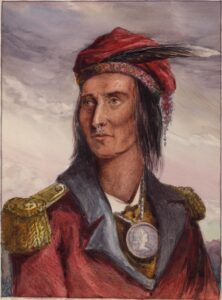
(Toronto Public Library/Public domain via Wikimedia Commons) Shawnee chief Tecumseh, in a painting attributed to Owen Staples, circa 1915.
Another Yank miscalculation, although the odds looked good at first. A hastily assembled force of a few thousand regular British troops, local militias from both the anglophone and francophone communities, and allied groups of First Nations people — led by the great Shawnee chief Tecumseh — banded together to drive back the Americans once again. It was a messy and indecisive conflict, but its importance as a formative event in Canada’s multilingual, multicultural national identity was enormous. (It’s fair to say that Indigenous people did not benefit from that for many years to come.)
In both of these misguided invasions, Americans apparently convinced themselves that Canadians essentially did not exist, at least not as a people or a nation with a shared collective identity. They were only a bunch of oppressed and delusional colonials who not-so-secretly yearned to be Americans. The historical irony here is obvious: In attacking Canadian nationhood, Yankee invaders helped to create it.
How relevant is this history-book material to Canadians’ view of their southern neighbors in 2026? I won’t presume to answer that; probably not much. But if the ties of trade, kinship and strategic alliance are real, so is the deeply ingrained suspicion. Canadians like Americans just fine. But they’ve learned not to trust us too much, and they’re ready to fight.
Read more
from Andrew O’Hehir on our strange and terrifying world